Retention defines the financial health and operational maturity of any membership organization. Today, high renewal rates are the byproduct of systems that unify engagement, automate workflows, and create measurable member value. So, you can’t achieve them by chance. Yet, most associations still mistake functionality for effectiveness. The real test of a membership CRM is not how many features it offers, but how many actually sustain engagement over time. A well-built system strengthens relationships through structure, not manual effort.
In this article, you’ll examine the CRM capabilities that directly impact retention and learn how to identify those that matter most to long-term stability.
Or skip the read and book a quick demo with our experts to learn more about our all-in-one membership management software.
Key Takeaways
- Retention is an operational strategy, not a campaign outcome.
- Centralized data and automation ensure consistent engagement.
- Predictive analytics turn member behavior into actionable foresight.
- Simplicity outperforms feature overload in driving long-term renewals.
- Integration between communication, finance, and reporting is essential for clarity.
The Five CRM Features That Drive Retention
Retention depends on more than good intentions; it’s engineered through systems that align visibility, automation, and responsiveness. Below are the five CRM features that define the operational edge for modern associations:
Centralized Member Data
Retention begins with clarity. When member data is scattered across systems, engagement becomes guesswork. A CRM that consolidates every interaction—renewals, payments, events, and communications—eliminates that uncertainty.
Centralization creates a verified single source of truth. You see every member’s lifecycle in real time, enabling leadership to identify engagement gaps and act with confidence rather than assumption.
Intelligent Segmentation
Generic outreach breeds disengagement. Segmentation solves this by classifying members based on lifecycle stage, behavior, or participation history. When paired with automation, segmentation allows you to deliver context-driven communication that aligns with what members value most.
For example, a member who regularly attends events should receive post-event surveys or early access to future programs, while those who haven’t renewed in two years may receive personalized incentives.
Automation Across the Lifecycle
Automation is not a convenience—it’s risk control. Missed reminders, manual follow-ups, and delayed invoicing directly impact revenue stability. An intelligent CRM manages these processes autonomously, sending timely renewals, onboarding sequences, and engagement campaigns.
Automation maintains engagement consistency across all members regardless of staff size. It ensures the experience remains predictable, professional, and proactive.
Predictive Analytics
Predictive analytics convert behavior into foresight. By analyzing trends, such as declining participation, reduced payments, or inactivity, associations can intervene before attrition occurs.
In short, a retention-focused CRM uses these insights to help leadership forecast renewal rates, identify engagement hotspots, and refine value delivery. You move from reacting to losses to preventing them altogether.
Integrated Feedback and NPS Tracking
Retention is sustained by perception management. When feedback loops are integrated directly into your CRM, survey data, ratings, and Net Promoter Scores (NPS) become measurable inputs that inform leadership decisions.
This feedback visibility enables you to connect satisfaction data with actual retention outcomes, strengthening your member value proposition with real evidence rather than assumptions.
Glue Up CRM: Centralization and Retention in Practice
Glue Up’s Membership CRM was designed for associations that prioritize retention as a measurable goal. Its architecture focuses on simplification, automation, and centralization—the foundations of sustainable growth.
Unified Member Database
All member information, from invoices to event participation, is stored within one ecosystem. This transparency eliminates data silos and improves decision accuracy across teams.
Dynamic Smart Lists
Smart Lists update automatically based on real-time engagement metrics. This automation keeps communication relevant and targeted, whether it’s for renewals, event follow-ups, or new campaigns.
Automated Renewal Workflows
Renewal notices, payment reminders, and onboarding messages are sent automatically. Members experience uninterrupted engagement while administrative effort remains minimal.
AI Copilot for Campaign Optimization
The AI Copilot helps your team generate campaign content, refine outreach timing, and identify behavioral trends without needing external tools or consultants.
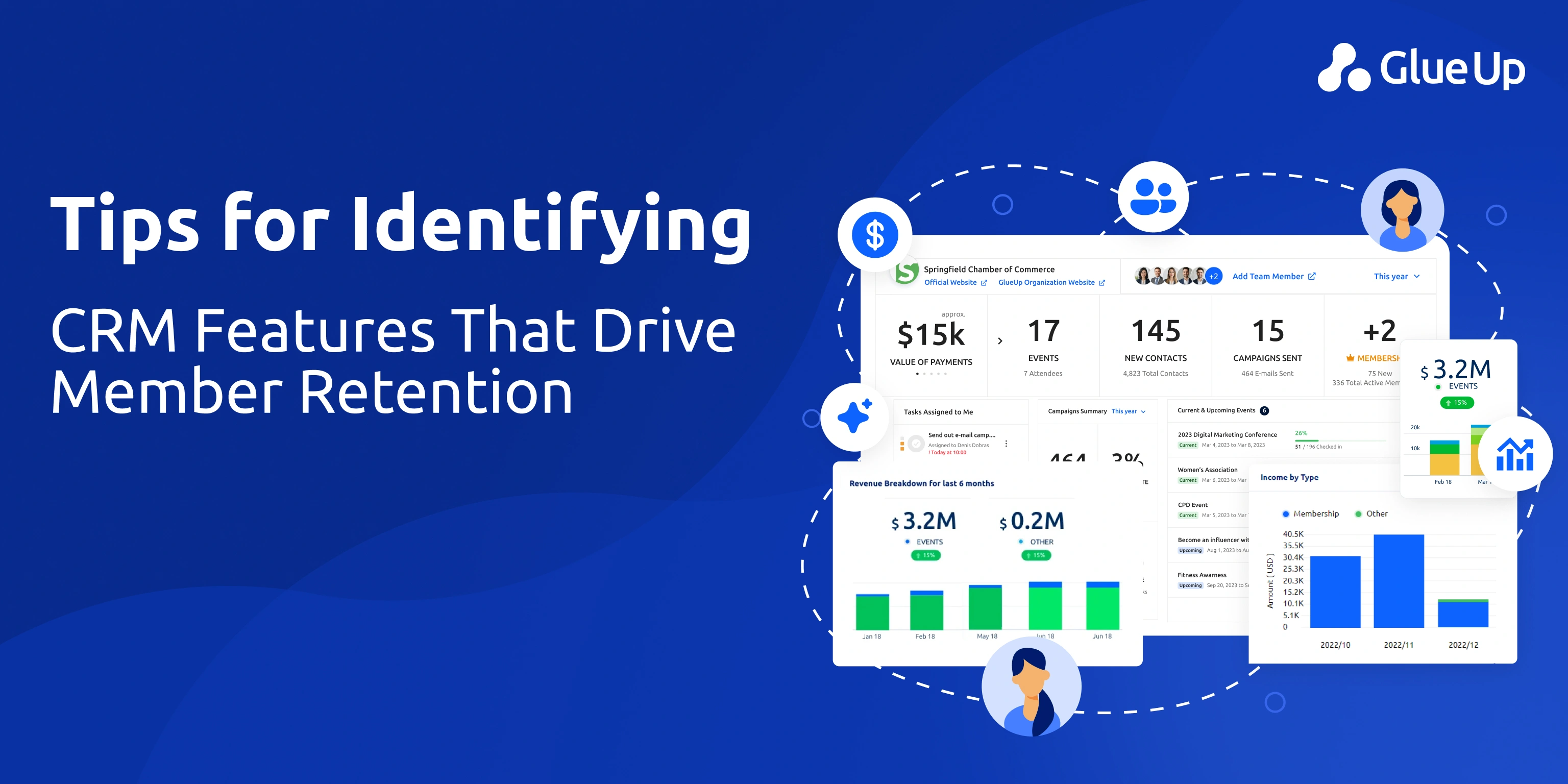
Integrated Finance and Reporting Dashboards
Finance and CRM modules share data seamlessly. Executives can monitor renewals, payments, and revenue performance from a single interface—making it easier to align financial strategy with engagement metrics.
These features don’t overpromise performance. Instead, they simply solve real operational problems. Each one enhances visibility, continuity, and scalability—the critical pillars of modern retention strategy.
Build Retention That Scales With Glue Up
Retention is a function of system design, not staff effort. When your CRM unifies data, automates engagement, and translates behavior into measurable insight, you achieve stability that compounds year after year. The most effective membership CRM features don’t compete for attention; they quietly ensure continuity across every interaction.
Book a demo with Glue Up today to see how centralized intelligence and automation drive long-term retention without adding complexity to your operations.
Frequently Asked Questions
Which CRM features improve retention the most?
Centralized data management, automation, segmentation, and behavioral analytics directly influence retention outcomes.
Why is centralization so critical for membership organizations?
It creates a unified view of each member’s engagement journey, enabling precise forecasting and faster decision-making.
How does automation reduce churn?
It eliminates missed communication and ensures consistent, timely engagement through every stage of the membership lifecycle.
What role does AI Copilot play in member retention?
AI Copilot enhances efficiency by optimizing campaigns, recognizing behavioral trends, and simplifying administrative tasks.
How does Glue Up measure renewal success?
Through integrated dashboards that connect CRM, finance, and event data, providing leadership with a clear view of renewal performance and member engagement health.
Quick Reads
- How to Build a Revenue Engine with Association Management Software
- Add-On Cart for Member Retention & Growth
- Simplify Multi-Currency Payment Posting for Community Chapters With Glue Up + Paygage
- AI Automation for Event Registration & Beyond
- Integrating AI into CRM for Membership Growth
- How to Build a Chapter Event Calendar
- What Is All-In-One Association Software?
- AI-Powered Member Check-In Software