Chapters represent an association's most visible presence, and its most variable one. And in 2026, Chapter event planning will demand far more than scheduling venues or coordinating volunteers. It's now about optimizing operations, proving ROI, and maintaining consistency across decentralized teams.
A recent industry analysis found that 73% of event professionals expect hybrid delivery models and data-driven forecasting to be permanent fixtures of post-2025 planning. For chapters, that shift introduces new challenges in logistics, financial oversight, and technology adoption that can't be solved with manual coordination.
The good news is that these challenges are predictable and solvable when approached systematically. In this post, you'll learn a four-dimensional framework for planning high-value chapter events:
- Venue and Logistics
- Finance and ROI
- Format and Experience
- Technology and Data
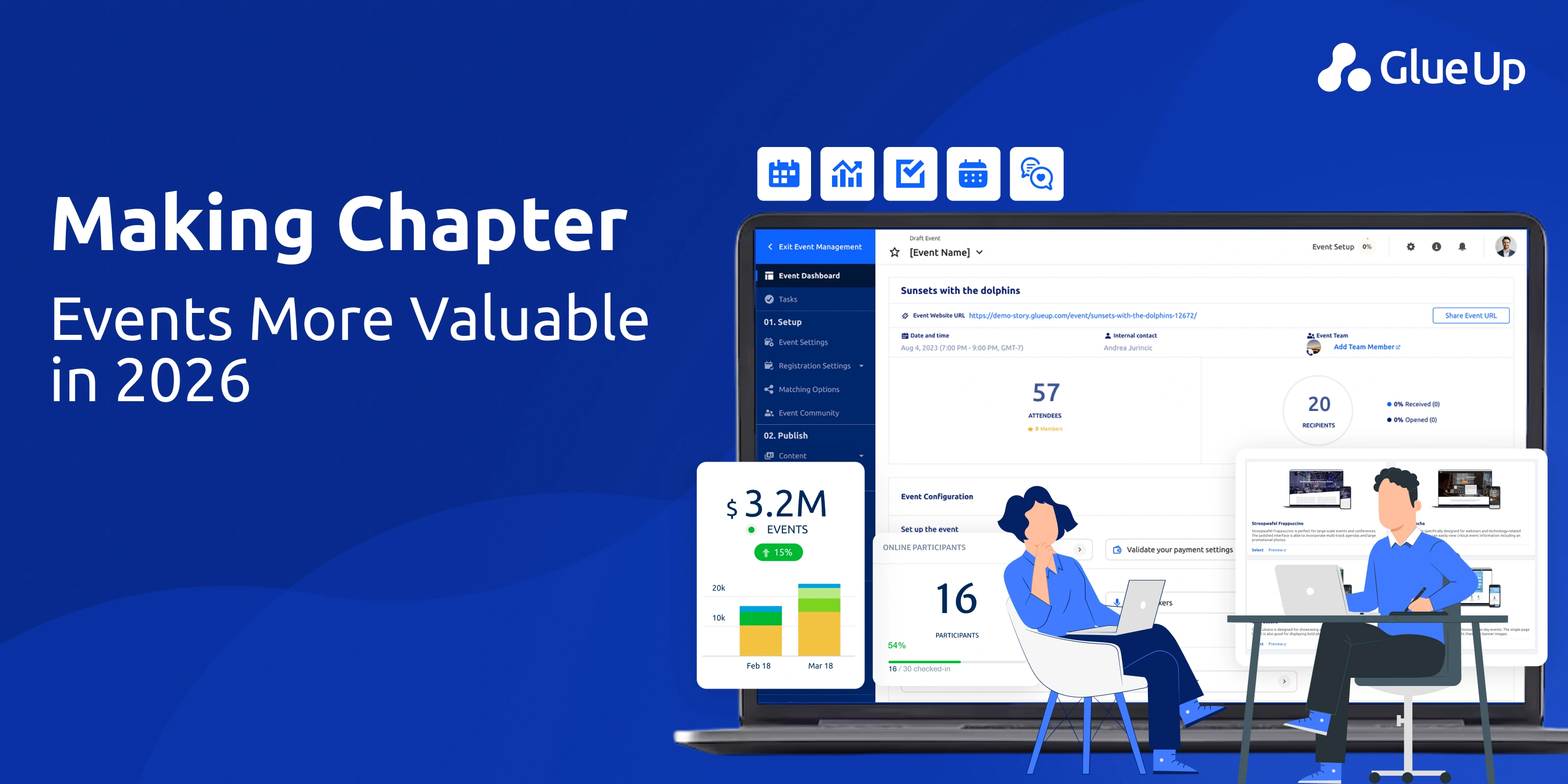
Each category outlines practical strategies that help chapters operate like professional event teams while maintaining local authenticity. And Glue Up's event management software supports this approach through unified registration, payments, and hybrid event tools that make every chapter event measurable.
Key Takeaways
- Consistency, not creativity, defines scalable chapter event success.
- Shared logistics templates improve efficiency while preserving local flexibility.
- Financial dashboards replace spreadsheets for real-time accountability.
- Engagement quality and emotional ROI drive retention more than attendance counts.
- Data integration turns event reports into predictive insights.
- Glue Up centralizes registration, payments, and engagement in one connected system.
Venue and Logistics: Building Consistency Without Losing Local Relevance
You already know that, like any corporate organization with multiple branches or touchpoints, every chapter operates within its own ecosystem. Local markets vary, infrastructure differs, and audience behavior changes from region to region. The challenge is to create a unified framework that maintains consistency without sacrificing flexibility. Once you establish this foundation, you create operational predictability without limiting local initiative.
Establish a Centralized Venue Framework
Start by identifying vetted venue and vendor partners who meet your association's quality, compliance, and accessibility standards. A centralized list helps chapters make faster, more confident decisions while maintaining uniform quality and experience. Once you define key parameters, such as capacity, accessibility, and technical readiness, your teams can focus on engagement, not administration.
Standardize Contracts and Compliance Protocols
Next, remove unnecessary complexity from the process. Pre-approved contract templates and compliance guidelines protect both your organization and its chapters. They also reduce negotiation time and prevent oversight issues that can undermine financial or legal standing later.
Coordinate Calendars for Strategic Scheduling
After operational consistency, focus on timing. Use a shared master calendar to coordinate chapter schedules with regional and national events. When your organization aligns on dates, you prevent attendance competition, improve volunteer distribution, and strengthen sponsorship visibility.
Maintain Flexible Layout and Flow Standards
Once scheduling is aligned, design standardized event layouts that retain a recognizable structure while allowing local personalization. Uniformity in check-in design, stage positioning, and signage builds a coherent brand experience across regions.
Apply Data to Future Planning
Finally, ground every decision in data. Use attendance metrics, satisfaction scores, and expense reports to inform venue choices and timing. As industry insights confirm, data-informed logistics can reduce operational waste by nearly a quarter while improving cost accuracy.
When logistics become measurable and repeatable, chapters evolve from reactive planners into efficient operators: consistent, agile, and fully aligned with the national strategy.
Finance and ROI: Turning Chapter Events into Business Units
Financial oversight should not limit creativity; it should enable confidence. Many associations already collect financial data, but few convert it into insight that drives better planning. You need to treat each event as a performance system, one that connects revenue, expenses, and engagement into a measurable framework.
Define Shared Financial KPIs
Begin with clarity. Establish core metrics such as event ROI, cost-per-attendee, and revenue diversification ratio. Once chapters adopt these benchmarks, you can evaluate performance across locations using standardized criteria rather than assumptions.
Integrate Registration and Finance Workflows
Next, close the data gap between registration and accounting. Link registration and payment processes directly to your finance infrastructure. Glue Up's Finance Module enables seamless connection between events, CRM, and accounting systems, offering real-time P&L visibility and payment tracking for every chapter.
Structure Tiered Sponsorship Packages
Once you achieve financial visibility, standardize how chapters sell sponsorships. Tier-based membership packages aligned with audience size and sponsor objectives ensure consistent pricing logic and value delivery. This framework also builds trust with partners who expect transparency across the network.
Align Budgets with Event Objectives
Then, bring purpose into budgeting. Allocate resources based on strategic goals rather than arbitrary percentages. If your priority is advocacy visibility, invest more in programming; if it's lead generation, prioritize marketing. Financial alignment follows operational intent.
Move to Dashboard-Based Reporting
Finally, evolve from static reports to visual dashboards. As association finance research emphasizes, visualization turns data into decisions. Dashboards help chapter leaders interpret financial health in real time, enabling mid-event adjustments rather than post-event autopsies.
When each chapter manages finances like a self-sustaining business unit (measurable, transparent, and aligned with strategy), you move beyond oversight into empowerment. That's how financial clarity turns into organizational confidence.
Format and Experience: Designing Events That Resonate
Once your logistics and finances are in place, it's time to focus on what truly defines success: the attendee experience. Chapter events succeed when members feel seen, valued, and connected to a broader mission. Hence, your goal should be to design event formats that serve the local audience's needs while reinforcing national alignment.
Match Event Type to Purpose
Every chapter event communicates intent. Training sessions, policy briefings, networking mixers, and galas all serve distinct objectives. Choose the format that aligns with desired outcomes (learning, advocacy, or engagement) rather than defaulting to what was done last year. When you match structure to strategy, satisfaction follows.
Balance Scale and Intimacy
Next, design experiences that match capacity with quality. Hybrid formats let you expand your reach without diluting engagement. As recent event engagement studies note, participants now expect hybrid access even for local events. Maintain small-group interactivity through breakout rooms, private discussions, or micro-sessions, ensuring value for every attendee.
Curate Meaningful Content
Once the structure is set, focus on substance. Avoid generic programming. Use data from past sessions to identify which topics drew the highest attendance or satisfaction scores. Chapters that leverage feedback loops create agendas that resonate more deeply, leading to higher retention and stronger event ROI.
Integrate Member Recognition Opportunities
Then, build recognition into your events by spotlighting member achievements, contributions, or community initiatives. Recognition strengthens loyalty, reinforces a sense of belonging, and enhances perceived value. The most successful associations use events as platforms to celebrate members, not just convene them.
Measure Emotional ROI
Finally, look beyond attendance numbers. Track engagement quality through surveys, interaction metrics, and sentiment analysis. Members often remember how an event made them feel long after they forget what it cost. When emotional connection becomes a KPI, your chapter events shift from functional to unforgettable.
Exceptional events don't happen by accident. The best associations and chapters engineer through intentional design, data-informed decisions, and relentless alignment between purpose and experience.
Technology and Data: Building the Infrastructure for Scalable Success
Even the most creative programming fails without reliable infrastructure. The next frontier in chapter event planning is intelligent data integration. Technology isn't just a tool; it's the framework that connects people, decisions, and performance metrics into one coherent system.
Integrate CRM, Events, and Finance Systems
Start by removing silos. Integrate your event management software with CRM and finance modules to centralize registration, payments, and reporting. This eliminates duplication, increases transparency, and allows every chapter to operate with shared visibility.
Leverage Predictive Analytics
Next, use analytics to anticipate rather than react. As emerging event tech insights confirm, predictive tools can forecast attendance trends and identify at-risk events before they underperform. Data-driven foresight enables proactive decision-making and more accurate budget allocation.
Automate Routine Workflows
Once integration is complete, automate repetitive processes such as confirmations, post-event surveys, and follow-ups. Automation reduces administrative strain, speeds up member communication, and ensures consistency across every event touchpoint.
Adopt Mobile Event Management
Then, make real-time management effortless. Equip your teams with mobile tools for check-ins, notifications, and schedule adjustments. Chapter leaders gain instant visibility into attendance and operations, allowing them to pivot during live events with precision.
Use Data Dashboards for Continuous Improvement
Finally, establish a single dashboard that consolidates metrics like attendance velocity, engagement duration, and satisfaction ratings. As shown in event performance frameworks, visualization improves accountability and encourages teams to iterate faster.
Technology turns events into intelligence. When your systems collect, analyze, and visualize data in real time, you shift from reporting what happened to predicting what will — the hallmark of a modern, data-literate association.
How Glue Up Connects Every Chapter Event into One Scalable System
The most successful chapter events don't rely on creativity alone; they depend on systemized execution. That's where Glue Up brings measurable value. As the leading chapter management software, it connects every operational layer in your association and chapters into one seamless ecosystem, from logistics to finance to engagement.
With Glue Up, you can:
- Automate event registration and payments with integrated financial tracking that syncs directly to your CRM.
- Use Blueprints and Templates to replicate successful event models across chapters with consistent branding and workflows.
- Enable mobile check-in and live updates through the Glue Up Manager App to keep your on-site operations fast and transparent.
- Collect and analyze post-event surveys to capture feedback, measure satisfaction, and predict attendance for upcoming programs.
- Integrate Zoom, Cvent, and QuickBooks to enable hybrid delivery and ensure precise accounting, keeping every report board-ready.
- Visualize performance with event dashboards that display ROI, engagement, and registration velocity in real time.
By consolidating these tools into one AI-powered AMS, Glue Up gives you what every chapter leader wants: visibility, repeatability, and control without complexity.
Moving Forward: Operational Precision as the New Competitive Advantage
Modern chapters no longer measure events by attendance or applause; they judge them by financial performance, engagement quality, and operational efficiency. When you connect planning, data, and execution into one measurable framework, you give your chapters the ability to perform like professional event teams every time.
2026 will reward associations that treat their chapters as connected systems, not isolated efforts. With the right technology in place, consistency becomes effortless, and success becomes predictable.
Book a quick demo today to see how Glue Up helps associations manage every chapter event, from registration to reporting, with one connected platform built for measurable growth.
Frequently Asked Questions
What makes chapter event planning different from general event planning?
Chapter event planning involves decentralized teams and localized audiences, requiring frameworks that maintain quality and brand alignment while adapting to local conditions.
How can associations ensure consistent event experiences across chapters?
Standardize templates for logistics, sponsorships, and communications. Use centralized systems that give chapters flexibility within defined parameters.
What KPIs should chapters use to measure event performance?
Key metrics include cost-per-attendee, event ROI, engagement rate, and sponsor renewal ratio — all measurable through integrated event dashboards.
How does Glue Up support financial visibility across chapters?
Glue Up's Finance Module tracks payments, invoices, and P&L reports automatically, providing real-time visibility to national and local teams simultaneously.
Can Glue Up handle both hybrid and in-person chapter events?
Yes. Glue Up integrates with Zoom and Cvent for hybrid formats and includes on-site features such as mobile check-in and live updates for in-person events.
How can data improve future chapter event planning?
Aggregated analytics from registrations, surveys, and engagement metrics reveal performance trends, helping you predict attendance and allocate budgets more accurately.
Why should associations centralize chapter event management?
Centralization doesn't reduce autonomy; it improves efficiency, consistency, and reporting accuracy, empowering chapters to focus on engagement rather than administration.
Quick Reads
- How to Build a Revenue Engine with Association Management Software
- Add-On Cart for Member Retention & Growth
- Simplify Multi-Currency Payment Posting for Community Chapters With Glue Up + Paygage
- AI Automation for Event Registration & Beyond
- Integrating AI into CRM for Membership Growth
- How to Build a Chapter Event Calendar
- What Is All-In-One Association Software?