
Every multi-chapter organization faces the same tension: how do you give chapters the autonomy to serve their local members while ensuring headquarters maintains oversight across data, finances, and brand reputation? This chapter management handbook is designed for association and chamber leaders who need to strike that balance without creating friction or slowing growth.
When autonomy is unchecked, chapters risk drifting away from governance standards. On the flip side, when oversight is too rigid, innovation and local engagement suffer. The solution isn't choosing one side of the equation but rather creating systems and frameworks that protect accountability while giving chapters room to lead.
Glue Up's chapter management software was built for this challenge. It connects headquarters and chapters in one ecosystem, enabling real-time reporting, role-based access, and consistent branding across every level of the organization.

Book a demo today to see how Glue Up helps multi-chapter organizations align autonomy with oversight.
Or, stick around. In this post, we'll outline how to define autonomy and oversight, examine the common governance challenges that associations face, and show how Glue Up's chapter management software operationalizes this balance.
Key Takeaways
- Autonomy and oversight aren't opposites. Both are necessary for healthy multi-chapter organizations.
A chapter management handbook sets the rules. Glue Up's software operationalizes them across chapters.
Automation reduces risk and inefficiency. Membership renewals, financial ties, and workflows become seamless.
Dashboards and apps create visibility. Leaders track KPIs like renewals, revenue, and events in real time.
Brand consistency is protected. HQ pushes templates and campaigns while chapters adapt locally.
Defining Autonomy and Oversight in Chapter Management
At the core of this chapter management handbook is one principle: autonomy and oversight are not competing forces, but interdependent requirements for any multi-chapter organization. Autonomy gives local chapters the ability to respond to member needs, tailor programs to regional priorities, and maintain the agility that headquarters often can't replicate. Oversight, on the other hand, ensures that chapters remain aligned with institutional strategy, financial governance, and brand reputation.
When Autonomy Turns Into Fragmentation
Too much independence risks fragmentation. Chapters create their own systems, dilute the brand, and report data inconsistently. As executive leadership experts argue, autonomy without boundaries can undermine performance at scale.
When Oversight Becomes Overreach
Excessive centralization discourages innovation and stifles local leaders who understand their communities best. Research on autonomy in the workplace shows that when decision-making is overly restricted, engagement and initiative decline. For chapters, this translates into weaker member relationships and slower responsiveness.
How Systems Create Balance
The most effective organizations don't choose between control and freedom; they implement a chapter management system that enables both. With role-based access, the headquarters defines what information chapters can control while retaining oversight of sensitive data. With shared dashboards and chapter reporting tools, both HQ and chapter leaders see performance in real time, reducing blind spots.
Turning Governance Into Partnership
A unified chapter management software reframes governance not as restriction, but as partnership. Autonomy fuels engagement at the local level, while oversight preserves the consistency and accountability required to secure trust from boards, members, and sponsors alike. As association governance frameworks point out, alignment comes from shared systems and transparent processes.
Common Oversight Challenges in Multi-Chapter Organizations
Balancing autonomy and oversight isn't just a leadership dilemma. For many multi-chapter associations, chambers, and nonprofits, it manifests in specific operational blind spots that weaken governance, financial stability, and member value.
Fragmented Reporting Across Chapters
When chapters rely on disconnected spreadsheets or ad hoc tools, headquarters loses visibility. A chapter management handbook must define standardized reporting practices so leadership can track performance consistently. Without them, small gaps in reporting compound into larger compliance risks. As governance researchers emphasize, oversight is ultimately about building ethical frameworks that protect long-term trust.
Financial Blind Spots and Compliance Risks
Managing multi-chapter associations, especially their finances in isolation, often delays reconciliation and obscures organizational health. Many association executives cite financial transparency as a top governance concern. For both umbrellas and chapters, this translates into stalled audits, misaligned budgets, and diminished accountability at the board level.
Brand Inconsistency in Local Campaigns
When chapters launch events or campaigns without guidelines, branding becomes inconsistent and credibility suffers. This is more than cosmetic — inconsistent branding dilutes market trust and complicates sponsor relationships. As team culture studies note, lack of alignment across units erodes cohesion and weakens performance.
Limited Accountability Without Role-Based Access
In many organizations, chapter leaders or volunteers hold more permissions than their roles require. Without role-based access and shared chapter reporting dashboards, accountability breaks down, creating both governance and security risks. Similar to challenges highlighted in managed security frameworks, unchecked access introduces vulnerabilities that can escalate quickly.
How a Chapter Management Handbook Guides Governance
The purpose of a chapter management handbook isn't to control chapters, but to create a governance framework that makes autonomy work without risking oversight. Think of it as the operating system for a multi-chapter organization — codifying expectations, clarifying roles, and embedding accountability into every process.
Setting Role-Based Access and Permissions
Clear definitions of who can access what data and functionality prevent both duplication and risk. A chapter management system that enforces role-based access ensures chapter leaders work within their responsibilities while HQ retains oversight of financials, sensitive data, and compliance requirements.
Establishing Shared Dashboards and Reporting Tools
Without standardized visibility, HQ decisions are reactive. By mandating shared chapter dashboards, leadership ensures consistent reporting on membership growth, renewals, revenue, and events. This aligns chapters and headquarters around the same KPIs, reducing blind spots that can derail governance.
Defining Financial Transparency Standards
Transparency is the backbone of trust. A strong handbook outlines how chapters report finances, reconcile payments, and share data with HQ. With an integrated chapter management software, reconciliation and compliance reporting can be automated, reducing the margin for error and audit delays.
Creating Consistency Through Governance Protocols
Chapters thrive when expectations are clear. Governance protocols should standardize how membership applications are handled, how events are branded, and how communications are delivered to members. As autonomy and oversight frameworks highlight, clarity reduces conflict by making the rules of engagement explicit.
Operationalize Governance With Glue Up's Chapter Management Software
A chapter management handbook gives you the rules. Glue Up gives you the system to enforce them. For executives leading multi-chapter organizations, the key challenge is ensuring governance policies are applied consistently, across every chapter, in real time. That's where Glue Up's chapter management software creates measurable impact. You can:
Centralize Oversight Across All Chapters
Manage data, configure access levels, and standardize chapter operations from one secure platform. With full visibility across every level of your organization, you eliminate manual spreadsheets and reduce the blind spots that slow decision-making.
Automate Membership and Financial Workflows
Glue Up simplifies membership approvals, renewals, and payments. Automated financial ties between umbrella and chapter levels reduce reconciliation delays, ensure accuracy, and free staff from repetitive administrative work.
Standardize Membership With Universal Workflows
Every chapter follows the same membership process with custom application forms, shared lists, and painless renewals. Consistency builds trust with members while giving leadership accurate, aggregated data at both the chapter and national levels.
Maintain Brand Consistency While Enabling Local Flexibility
Push branded templates, websites, and campaign assets to chapters in one click. Headquarters protects brand equity, while chapters adapt content for their audiences, creating alignment without stifling agility.
Run Branded Events Aligned With Umbrella Goals
Chapters can launch events quickly with Glue Up's integrated event management software. Branded invitations, automated reminders, surveys, and flexible payment options keep events professional and revenue-focused while rolling data back to HQ in real time.
Gain Real-Time Insight With Dashboards and Mobile Apps
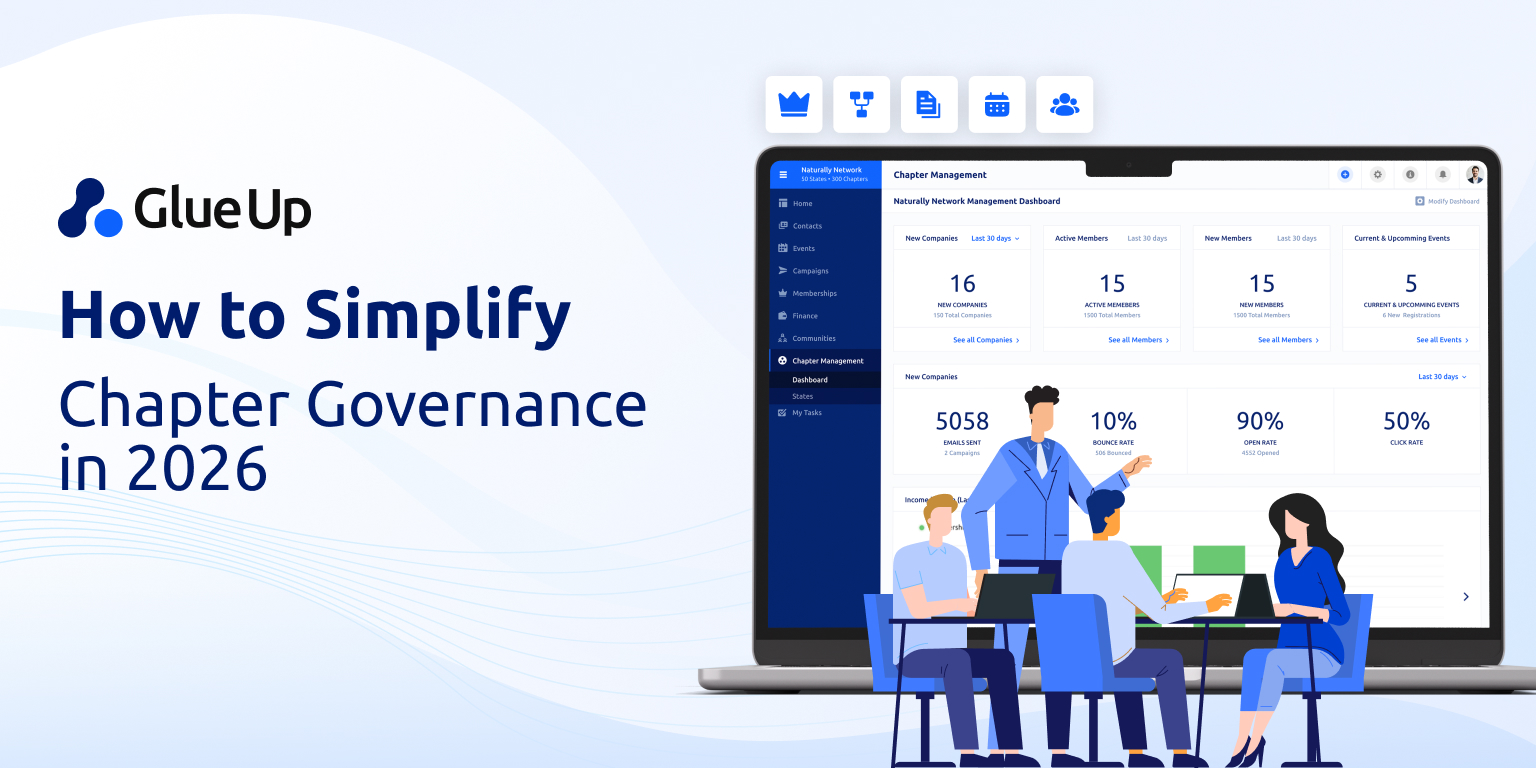
Glue Up's dashboards track key KPIs — membership growth, renewal rates, revenue, event participation, etc. — chapter by chapter. With the Manager App for staff and the My Glue App for members, engagement is visible anywhere, ensuring autonomy isn't a risk but a measurable advantage.
Build Stronger Communities Across Every Chapter
Glue Up's digital hub brings members together under one branded platform. With 1-on-1 chats, posting and sharing features, document exchange, and digital business cards, members stay connected and engaged across local and umbrella levels.
Turn Chapter Governance Into Strategic, Sustainable Growth
Balancing autonomy with oversight doesn't need to feel like a zero-sum tradeoff. With Glue Up, executives gain visibility, chapters gain tools, and members gain value. You reduce administrative friction, protect governance, and scale your impact without losing agility. It's simple, it's efficient, it's all your chapters in one place.
Book a demo today and see how Glue Up's multi-chapter association management software turns your workflows into a system that drives accountability, consistency, and growth.
Frequently Asked Questions
What is a chapter management handbook?
It's a governance guide that defines how chapters operate, report data, and align with headquarters. It sets the rules for autonomy and oversight.
Why do multi-chapter organizations struggle with oversight?
Without standardized systems, HQ often faces fragmented reporting, inconsistent branding, and financial blind spots that make governance difficult.
How does Glue Up support chapter governance?
Glue Up consolidates chapter operations into one platform with role-based access, automated financial ties, real-time dashboards, and branded communication templates.
What KPIs can executives track with Glue Up?
Membership growth, renewal rates, revenue, event participation, and chapter engagement metrics are all visible through dashboards.
How does Glue Up balance autonomy with control?
By giving HQ oversight tools and chapters local flexibility. Headquarters sets policies and branding, while chapters adapt content and workflows for their members.
Quick Reads
- Event Sponsor Retention for Associations
- Add-On Cart for Member Retention & Growth
- Simplify Multi-Currency Payment Posting for Community Chapters With Glue Up + Paygage
- AI Automation for Event Registration & Beyond
- Integrating AI into CRM for Membership Growth
- How to Build a Chapter Event Calendar
- What Is All-In-One Association Software?
- AI-Powered Member Check-In Software