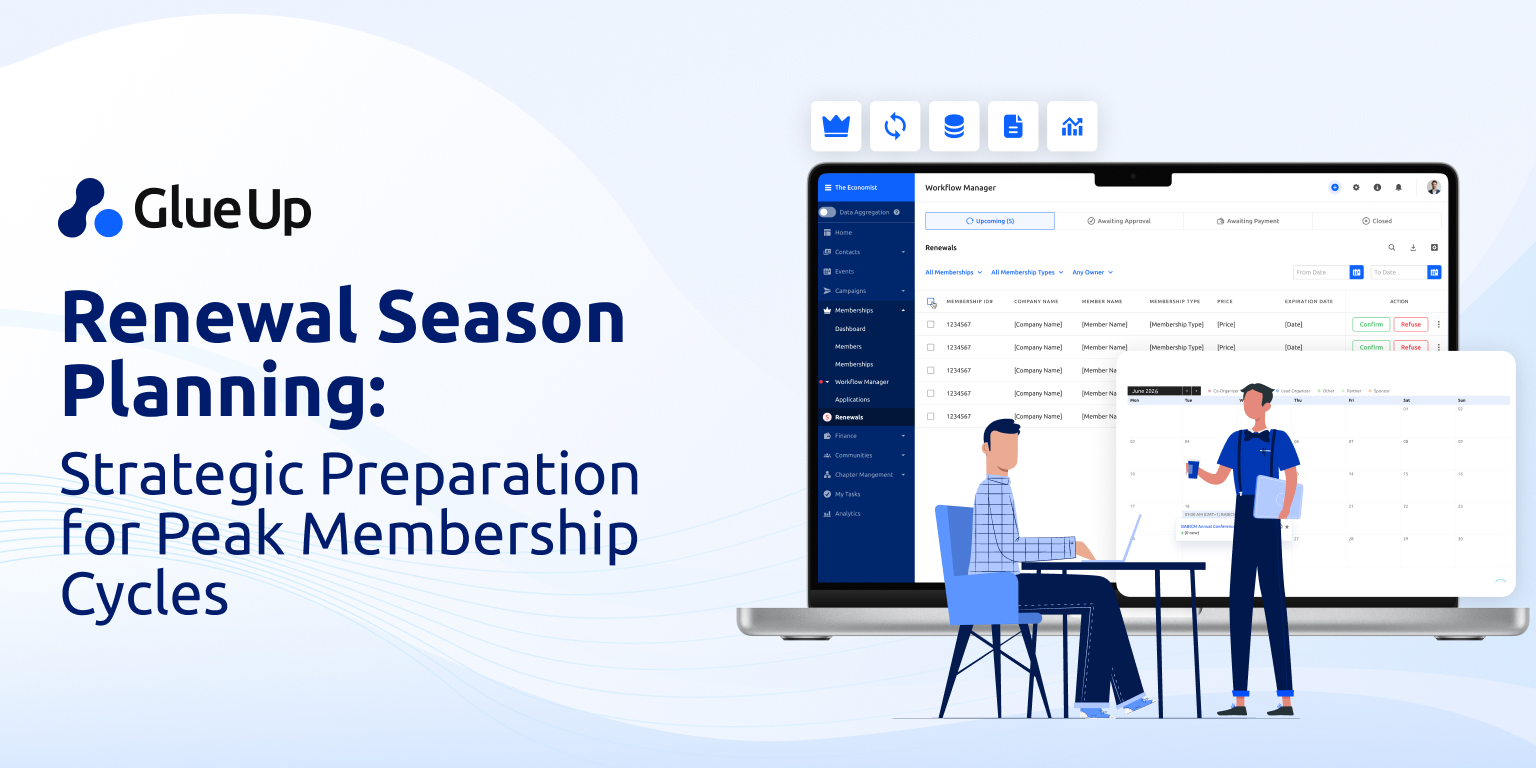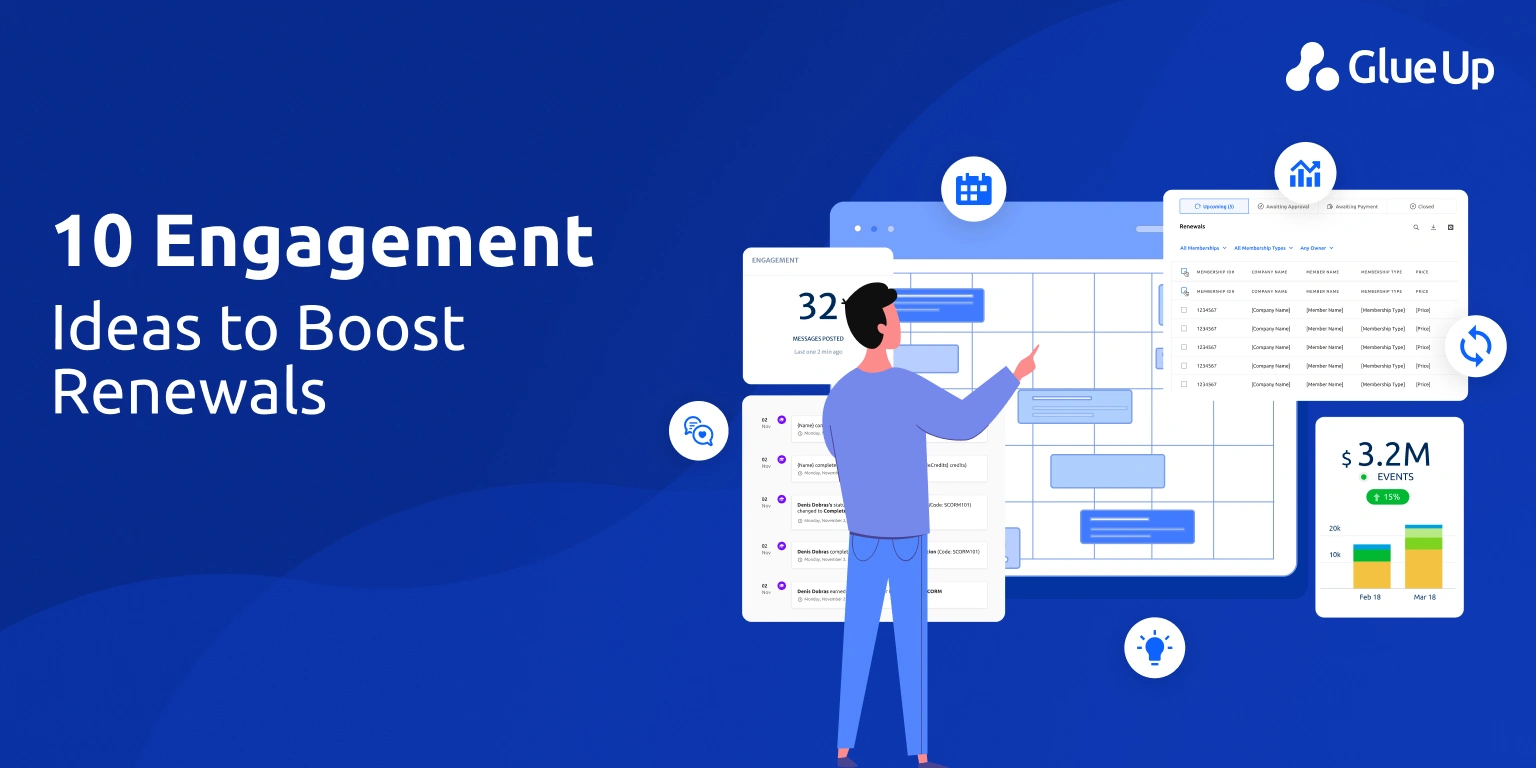

Year-end always exposes the truth behind your member retention strategies. You can track satisfaction, engagement, events, and emails, but renewals give the clearest signal. Members either see enough value to stay or enough distance to leave. Manual renewal workflows widen the margin for error. Deadlines slip. Invoices get missed. Follow-ups fall through. Attrition becomes accidental instead of meaningful.
Accidental churn is a risk you cannot afford during budget planning and year-ahead forecasting. And manual retention processes do not support that level of coordination. In contrast, automated renewals create a dependable retention engine that runs ahead of deadlines and reinforces your value at scale.
In this post, you’ll learn how automated renewal workflows elevate your retention playbook before January hits. And if you’d like to see how Glue Up’s all-in-one finance management software supports this, book a quick demo for a walkthrough.
Key Takeaways
- Automated renewals anchor your member retention strategies by removing operational friction and ensuring consistent, proactive outreach.
- Predictable renewal cycles improve financial clarity across membership, finance, and chapter leadership.
- Personalized, segmented communication drives higher engagement and reduces the likelihood of passive churn.
- Data helps you identify early warning signs and intervene before members disengage.
- Glue Up’s membership management system supports automated reminders, invoicing, segmentation, and payment management in one place, which strengthens your year-end outcomes.
Why Automated Renewals Strengthen Retention at Year End
Member retention isn’t a communication issue. It’s a systems issue. When your renewal mechanism lacks automation, you create vulnerability across operational, financial, and psychological dimensions.
Operationally, manual reminders require staff vigilance that’s unsustainable during Q4. Financially, unpredictable cash flow forces the board and finance committee to rely on assumptions instead of evidence. And psychologically, inconsistent reminders weaken members’ perception of organizational competence, which is one of the most predictive drivers of renewal decisions.
Automation changes the frame. It transforms renewals from episodic outreach into a continuous system that anticipates member behavior, orchestrates timing, and maintains uniformity across chapters.
So, instead of reacting to expiring memberships, you’re shaping renewal momentum with precision.
Automate Renewal Timelines to Establish Behavioral Consistency
Members respond to rhythm. When renewal communication arrives at irregular intervals, the cognitive load increases and decision friction grows. Automated renewal timelines create behavioral predictability, which in turn supports higher conversion rates.
Your renewal arc should behave like a structured lifecycle:
Initial notification
You prime members with a low-pressure reminder and anchor the renewal in continuity rather than urgency.
Mid-cycle reinforcement
You highlight institutional value, peer outcomes, and programmatic results tied to the previous year.
Final call to action
You use clarity and precision rather than fear or pressure. Members appreciate procedural consistency.
Use Segmented Communication to Reinforce Value Perception
Sophisticated member retention strategies depend on segmentation because value perception isn’t uniform across your membership base. Automated systems allow you to assign nuanced messaging architecture to each segment.
Examples of high-impact segmentation include:
- Tenured members who respond to long-arc value narratives and leadership continuity.
- Early-stage members who renew when onboarding momentum remains visible.
- At-risk segments identified through declining multi-channel engagement.
- Geographically distributed members whose value experience originates at the chapter level.
You’re not personalizing for novelty. You’re personalizing to reduce cognitive distance between renewal cost and perceived benefit. Automation operationalizes that personalization without increasing labor.
Resolve Friction Before It Becomes Attrition
Most non-renewals originate from preventable friction, not dissatisfaction. Automated renewal systems allow you to neutralize these friction points preemptively.
You can eliminate:
- Failed or expired payment methods
- Administrative ambiguity about dues levels or membership tiers
- Missed deadlines caused by inconsistent chapter outreach
- Perceived lack of value when members lose visibility into their own engagement record
Retention improves when you treat friction as a systems defect, not a member behavior issue. Automation gives you the mechanism to manage defects at scale.
Use Data to Anticipate Retention Risk Instead of Reacting to It
High-performing associations treat member retention as a predictive discipline rather than a reactive one. Automation provides the behavioral telemetry that enables this.
You should evaluate:
- Downshifting email engagement curves
- Reduced participation in flagship programs
- Declining chapter involvement
- Drops in event attendance frequency
- Increasing overdue payments or invoice delays
These indicators signal changes in perceived value long before a member decides not to renew. Automation doesn’t just surface these signals. It activates interventions at the appropriate moment in the lifecycle.
How Glue Up’s AI-Powered AMS Supports Automated Renewals
Glue Up’s all-in-one membership management software for associations provides the operational and analytical infrastructure to execute automated renewals across national, regional, and chapter structures. Here are key features to help you optimize member renewals:
Automated Renewal Cycles
You configure rules-based renewals for each membership tier, allowing the system to manage reminders, invoicing, and follow-up without manual oversight.
Integrated Invoicing and Payments
Members complete renewals through a unified payment experience with multiple payment methods and mobile access, which reduces abandonment.
Advanced Segmentation for Personalized Communication
Smart Lists allow you to classify members based on behavioral and demographic criteria, ensuring nuanced messaging during renewal cycles.
Unified Engagement Intelligence
Glue Up consolidates event attendance, email interactions, chapter activity, and financial status into one administrative interface, giving you a real-time picture of retention risk.
Lock In Retention Before Budget Season Hits
Retention isn’t an end-of-year scramble. It’s the result of systems that either reinforce loyalty or quietly introduce friction. Automated renewals give you the structure, visibility, and operational discipline you need to stabilize revenue and strengthen the membership experience before the calendar resets.
If you want to see how Glue Up supports this at scale, book a quick demo today!
Quick Reads
- How to Build a Revenue Engine with Association Management Software
- Add-On Cart for Member Retention & Growth
- Simplify Multi-Currency Payment Posting for Community Chapters With Glue Up + Paygage
- AI Automation for Event Registration & Beyond
- Integrating AI into CRM for Membership Growth
- How to Build a Chapter Event Calendar
- What Is All-In-One Association Software?
- AI-Powered Member Check-In Software

Automation removes human inconsistency, which is statistically one of the strongest contributors to passive churn. It creates a uniform experience that members interpret as organizational competence.
Not when segmentation and behavioral data inform the messaging architecture. Automated doesn’t mean generic. It means orchestrated.
The highest-performing associations begin between 60 and 90 days before expiration. Automation maintains cadence without increasing administrative burden.
Chapters influence relational proximity. Glue Up centralizes system logic so chapters stay aligned with national governance while still customizing local touchpoints.
Predictable renewals produce more accurate cash flow projections and reduce year-end financial volatility, which strengthens budget planning and board reporting.