Membership renewals don’t fail because members suddenly lose interest. They fail because renewal systems introduce friction, blind spots, or delays that compound quietly over time. When you examine common membership renewal challenges through a data lens, a pattern emerges. Churn is rarely emotional. It’s operational.
In this post, you’ll see how associations like yours diagnose membership churn, how member churn rate analysis exposes renewal breakdowns, and how organizations reduce member churn using analytics rather than reactive outreach.
You’ll also see how Glue Up’s all-in-one membership management software supports automated renewals, engagement visibility, and dues management in a single system. If you want a practical walkthrough of how this works in your environment, book a demo right away!
Key Takeaways
- Most membership renewal challenges are operational, not relational.
- Passive churn materially inflates the member churn rate.
- Analytics-driven retention outperforms reactive renewal campaigns.
- Automated workflows reduce renewal friction and internal workload.
- Unified membership and finance data strengthens long-term retention economics.
Why Membership Renewals Break Down at Scale
Before discussing fixes, it’s important to understand why renewal systems fail even in well-run associations. In most cases, the core issue isn’t intent but rather a structural drift that disrupts recurring cashflow:
Passive Churn Is a Systems Failure, Not a Member Decision
A large portion of membership churn stems from passive causes. Expired cards, missed invoices, internal approval delays, or emails that never reach the decision maker all contribute to rising member churn rates without signaling dissatisfaction.
Research across membership organizations consistently shows that passive churn can account for 10% to 50% of non-renewals. Yet many renewal strategies still treat churn as an engagement problem rather than a workflow problem.
Fragmented Renewal Communications Create Hidden Friction
When reminders, invoices, confirmations, and follow-ups are managed across disconnected tools, members experience inconsistency. Renewal messages lose context, timing slips, and staff compensates manually.
This fragmentation increases renewal friction while simultaneously increasing internal workload. Over time, renewal conversion rates erode quietly, often masked by stable topline numbers.
Lack of Engagement Data Delays Intervention
Associations struggling with membership churn analysis often discover that disengagement was visible months earlier but never surfaced operationally. Without consolidated engagement data, renewal outreach begins too late to change outcomes.
Manual Processing Introduces Renewal Latency
Manual renewal approvals, invoice creation, and reconciliation slow the renewal cycle. These delays disproportionately impact organizational memberships, chapters, and members operating under fiscal or procurement constraints.
Fixing Membership Renewal Challenges with Analytics and Automation
Effective retention strategies don’t rely on persuasion alone. They redesign renewal mechanics so retention becomes the default outcome. Below are a few steps you can take to improve retention with automation and analytics:
Shift from Reactive Renewals to Predictive Retention
Associations that reduce churn sustainably use analytics to identify risk before expiration. Reducing member churn with advanced analytics means monitoring engagement patterns, payment behavior, and renewal timing together.
When you track churn alongside participation and communication history, renewal outreach becomes targeted, timely, and credible.
Standardize Renewal Cadence and Expectations
Predictable reminder schedules reduce renewal hesitation. Members are more likely to renew when timing feels expected rather than urgent. High-performing associations define renewal cadences at the system level, not through individual staff discretion.
Automate Grace Periods and Recovery
Short, automated grace periods recover a meaningful share of passive churn. These recoveries directly improve member lifetime value (LTV) without increasing acquisition costs or staff effort.
Align Membership and Finance Operations
Renewals also fail when membership status and financial records diverge. To reduce churn, align dues, invoices, and renewal status within a single system like Glue Up’s association management software. You can shrink renewal friction and improves reporting accuracy for leadership.
How Glue Up Helps Associations Reduce Member Churn
Glue Up’s all-in-one membership management software for associations addresses common membership renewal challenges by unifying CRM, finance, communications, and analytics into a single renewal workflow. Here’s how:
Automated Renewal Workflows Reduce Passive Churn
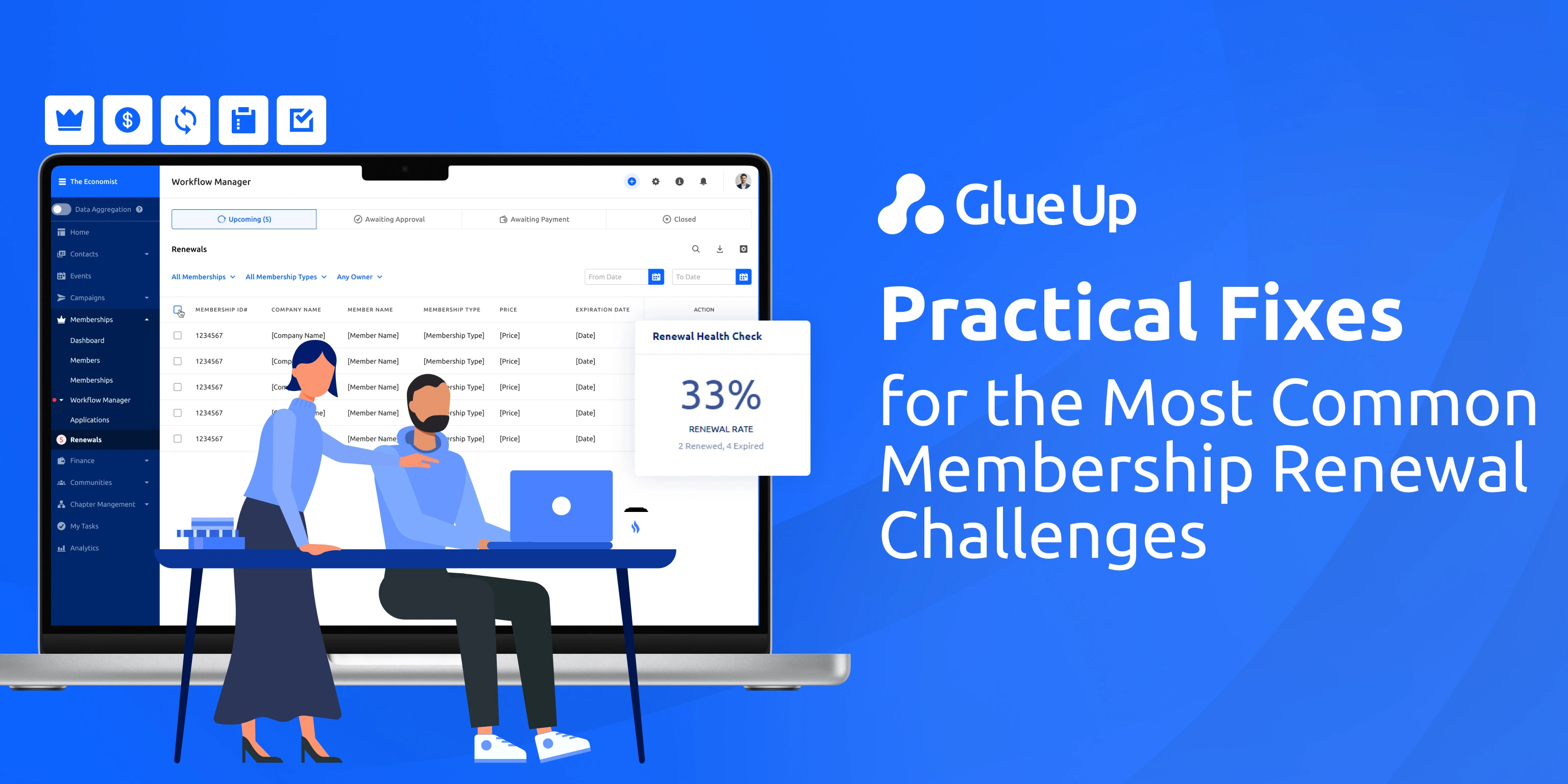
Glue Up supports automated renewal reminders, recurring dues, and configurable grace periods. Renewal communications stay synchronized with membership status, reducing lapses caused by oversight or timing gaps.
Centralized Engagement Visibility Enables Surface Churn Analysis
Member engagement history, event participation, email interactions, and renewal status live in one CRM. This enables membership churn analysis grounded in actual behavior rather than assumptions.
Leadership teams gain clarity into where renewal risk originates and which segments require intervention.
Integrated Invoicing and Payments
Invoices, payments, and membership records remain aligned automatically. Finance and membership teams operate from the same data set, reducing manual reconciliation and renewal delays.
Turn Renewal Insight into Predictable Retention Outcomes
Membership retention doesn’t improve because teams try harder. It improves when leadership treats renewals as an operating system problem, not a communications problem. Once renewal workflows, engagement data, and financial records operate inside a single system, churn stops being a surprise and starts becoming a managed variable.
If your organization is still diagnosing renewal failures after members lapse, you’re already late. The advantage comes from seeing renewal risk early, acting consistently, and removing friction before it reaches the member.
Book a demo to see how renewal automation and analytics work together inside Glue Up, and how your team can reduce member churn without increasing operational load.
Quick Reads
- The Hidden Costs of Free Membership Management Software & How Glue Up Delivers Real ROI
- How to Build a Revenue Engine with Association Management Software
- Strategic Event Planning Guide for 2026
- Event Planning Checklist: Associations & Chambers
- AI Membership Models for Modern Associations
- Chapter Management Handbook for Balancing Control

Passive churn, fragmented communications, lack of engagement data, and manual renewal processing delays.
By monitoring engagement trends, renewal timing, and payment behavior together to identify risk early.
Member churn rate, renewal conversion rates, engagement signals, and grace period recovery rates.
They eliminate missed renewals caused by oversight and create predictable renewal experiences.
No. Smaller organizations often see faster ROI because automation replaces manual processes that strain limited teams.