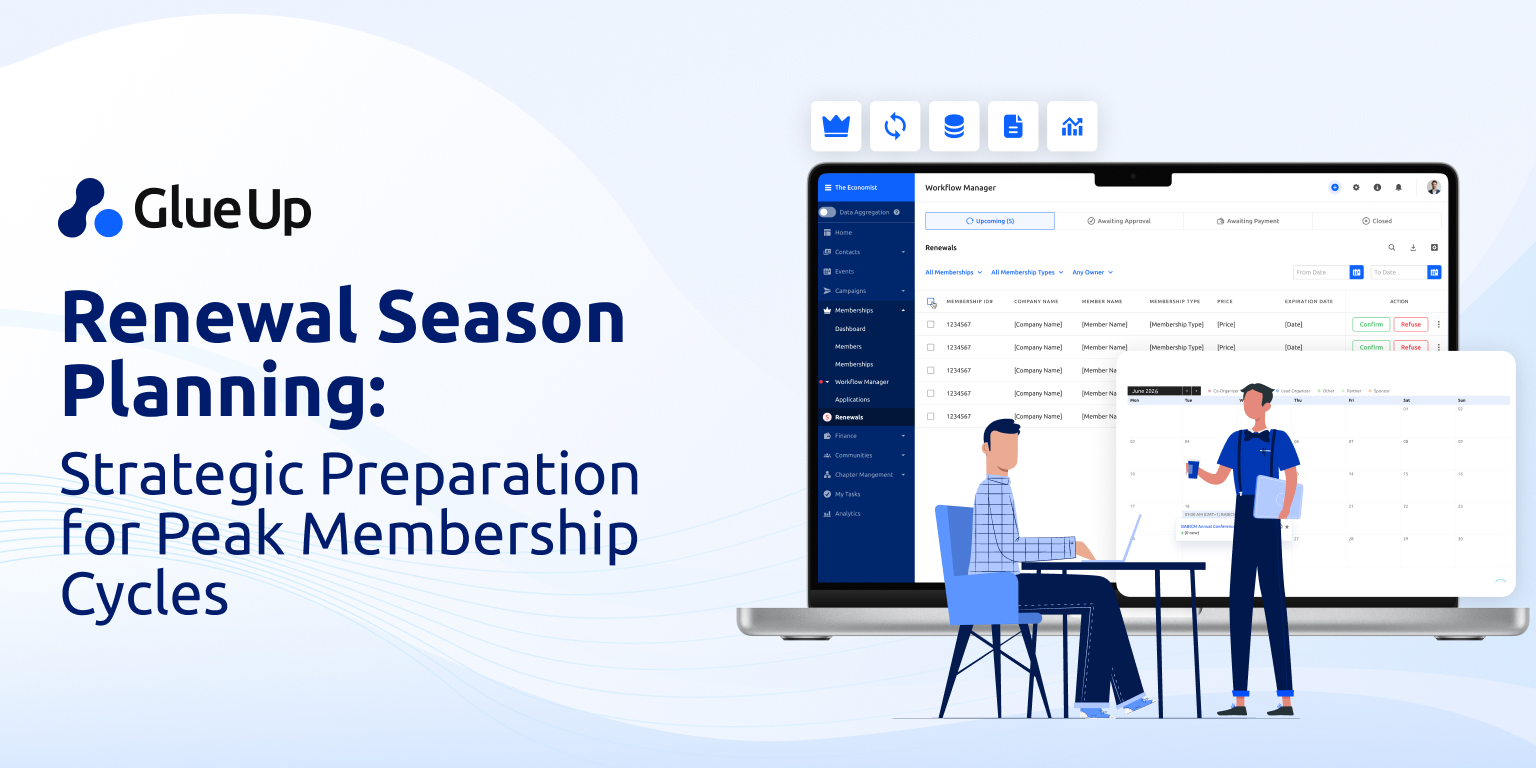

Associations don’t miss revenue goals because of weak ideas. They usually miss them because teams don’t usually operate on the same calendar. Membership renewals follow one schedule, sponsor cycles follow another, and chapters run their own timelines. When you build a quarterly membership campaign calendar, you replace scattered execution with a unified operating rhythm that aligns sales, marketing, finance, and chapter leadership around dates that drive revenue.
This post outlines how to structure campaigns around renewal months, fiscal cycles, and demand signals so every offer, message, and asset launches with the right timing and ownership.
If you want a platform that supports this structure with integrated CRM, event tools, email campaigns, and financial tracking, you can book a demo of Glue Up’s all-in-one association management software to see how it centralizes your campaign operations.
Key Takeaways
- A quarterly membership campaign calendar aligns sales and marketing with real renewal behavior.
- Planning around fiscal cycles and sponsor timelines increases conversion performance.
- Shared organizational calendars prevent missed assets, unclear ownership, and launch delays.
- Campaign sequencing strengthens retention, acquisition, and sponsor engagement.
- Glue Up provides the infrastructure to support unified calendaring across chapters and teams.
Why Associations Need a Quarterly Campaign Calendar
Associations run complex revenue ecosystems. Membership renewals drive one portion of revenue, sponsorships and events drive another, and chapters add localized cycles that rarely map to national headquarters. Without a shared calendar, teams operate reactively, and you lose the strategic advantage every association needs.
A quarterly membership campaign calendar solves that by turning revenue planning into a predictable discipline. Below are the core reasons this structure works.
Renewal Months Dictate Marketing Rhythm
Members renew at specific times. Therefore, your calendar should sequence offers, content, and outreach around these cycles so every touchpoint supports retention.
Sponsor Fiscal Years Shape Offer Windows
Sponsor budget decisions follow quarterly patterns. Aligning campaigns to their fiscal cycles increases the likelihood of closing packages on time.
Events Create Natural Momentum for Acquisition
Annual conferences and webinars generate activity spikes. Calendar planning ensures marketing leverages these windows for new member campaigns.
Sales and Marketing Alignment Prevents Missed Targets
When revenue and marketing teams operate from the same page, offer timing, messaging, and asset development stay synchronized.
How to Build a Quarterly Campaign Calendar That Teams Actually Use
A sophisticated calendar isn’t complicated. It’s precise, predictable, and connected to the dates that matter. Below is a practical structure your association can adopt:
Identify Renewal Clusters and Build Around Them
Every association has renewal spikes. Cluster them by month or quarter and schedule acquisition, onboarding, and engagement campaigns around these cycles. Renewal behavior dictates timing more than any other metric.
Add Sponsor Fiscal Cycles and Planning Cadences
Sponsors often allocate budgets in Q1 or Q3. Add these cycles to your calendar so your sponsorship team sequences outreach, proposals, and follow-ups with the highest probability of success.
Assign Ownership and Required Assets Early
A calendar is only as strong as the people accountable for execution. Add owners for every stage, campaign, webinar, or offer. Include asset deadlines so content, design, and chapters operate with full transparency.
Integrate Chapter Calendars for Geographic Alignment
Chapters run programs locally, so map their key events, workshops, and membership drives into the national calendar. This prevents duplication and improves regional engagement.
Hold Quarterly Funnel Review Sessions to Adjust and Reforecast
A quarterly membership campaign calendar isn’t static. Run reviews every quarter to evaluate conversion rates, pipeline health, sponsor engagement, and member feedback. Then adjust the next quarter's plan.
What Should Be Included in a Quarterly Membership Campaign Calendar
Below is a blueprint for what your calendar must capture to keep campaigns aligned and revenue predictable:
1. Key Dates for Renewals, Expirations, and Onboarding
These dates anchor your retention strategy. Use them to schedule renewal reminders, member value campaigns, and onboarding workflows.
2. Sponsor Cycles and Event Deliverables
Sponsors expect clarity. Track proposal windows, negotiation dates, fulfillment deadlines, and partner promotions.
3. Campaign Themes and Revenue Goals
Map themes like recruitment pushes, chapter growth campaigns, and event promotions. Align each theme with a clear revenue goal.
4. Asset Requirements and Content Deadlines
Every campaign needs email sequences, landing pages, social posts, and offers. Put these deadlines on the shared calendar so nothing slips.
5. Channel Mapping and Activation Windows
Each channel has different performance patterns. Email, community groups, events, and social each require timing discipline.
6. Cross-Functional Dependencies
Sales, marketing, membership, finance, and chapters must know when handoffs occur. Add dependency notes to prevent bottlenecks.
How Glue Up Supports a Quarterly Membership Campaign Calendar
Glue Up’s all-in-one association management software provides the operational infrastructure to maintain a unified quarterly calendar across your CRM, email campaigns, membership workflows, chapters, and events. You get one source of truth for planning, executing, and analyzing campaigns tied to real renewal and revenue behavior.
CRM Visibility for Renewal Months and Engagement Signals
Track membership cycles, retention risk indicators, and acquisition patterns so your calendar aligns with actual behavior.
Email Campaign Automation for Timely Execution
Automate renewal reminders, onboarding journeys, sponsor announcements, and new member outreach tied to your calendar dates.
Event Management Integration for Campaign Momentum
Plan event promotions, sponsor recognition, and post-event follow-ups within the same platform that manages registration, attendance, and analytics.
Chapter Management Capabilities for Localized Planning
Chapters can run local calendars that sync with headquarters for coordinated national and regional execution.
Finance and Reporting Tools for Revenue Goal Alignment
Track dues, sponsorships, invoices, and payment activity so your campaign calendar links directly to financial performance.
If your association wants a planning system supported by unified data, automated workflows, and cross-functional alignment, book a demo to see how Glue Up can support your quarterly planning.
Turn Your Quarterly Calendar into a Revenue Engine
A quarterly membership campaign calendar is the simplest way to align strategy and execution across your association. When renewals, sponsor cycles, events, and chapter activities live on one shared timeline, you eliminate operational blind spots and unlock predictable performance.
If you want the structure, automation, and visibility needed to support this model at scale, book a demo of Glue Up to see how our platform anchors your full campaign calendar.
Quick Reads
- How to Build a Revenue Engine with Association Management Software
- Add-On Cart for Member Retention & Growth
- Simplify Multi-Currency Payment Posting for Community Chapters With Glue Up + Paygage
- AI Automation for Event Registration & Beyond
- Integrating AI into CRM for Membership Growth
- How to Build a Chapter Event Calendar
- What Is All-In-One Association Software?
- AI-Powered Member Check-In Software

Renewal dates, sponsor cycles, event timelines, asset deadlines, owners, revenue goals, and chapter activities.
By tying campaigns, offers, and deadlines to revenue workflows both teams can see and act on.
Yes. Local calendars should integrate into the national one to avoid overlap and improve regional performance.
Glue Up centralizes CRM data, workflows, email automation, event operations, and chapter management so your calendar stays aligned with real-time activity.