You think your chapter is doing fine until renewal numbers quietly dip, event RSVPs stall, and a few long-time members stop showing up. Chapter surveys exist for exactly this moment. There are no angry emails, no big complaints, just silence, which is often the most expensive signal to ignore.
Now imagine if you’d asked two weeks earlier.
Not a 20-question survey with a long explanation. Just one or two quick chapter surveys or polls, built into a newsletter or a post-event email. Simple enough to finish in 30 seconds, but clear enough to surface issues while there’s still time to act.
That’s the difference between waiting for disengagement to appear in your reports and using chapter surveys to catch it early, when small adjustments still make a real impact.
For too long, chapter surveys and polls have been treated as optional extras. For associations running regional or chapter-based models, they’re anything but. They work as an early-warning system, a planning signal, and often the only reliable way to understand what members actually need at the local level.
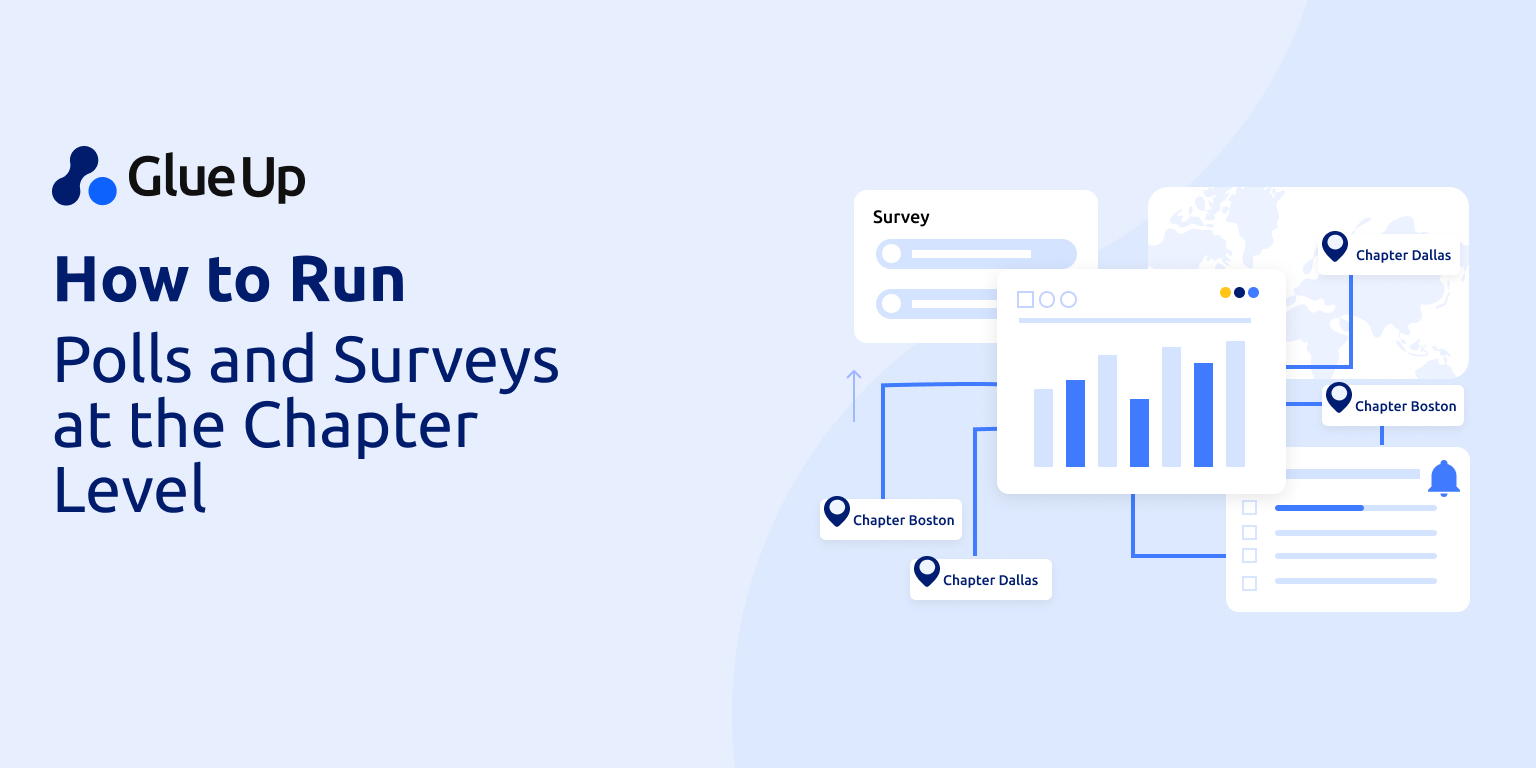
This blog walks through how to run chapter surveys well and why using Glue Up helps turn responses into usable insight, so chapters stay aligned, decisions stay grounded, and members feel heard before silence sets in.
Key Takeaways
When used early and often, chapter surveys surface disengagement before it shows up in renewals or attendance reports. Silence is a signal, and surveys help you catch it while there’s still time to respond.
Annual surveys, HQ-only questions, and long forms reduce response quality and relevance. Short, well-timed, chapter-specific surveys consistently produce more honest and useful feedback.
The real value comes from breaking data down by chapter, member type, and engagement level. That’s how teams spot quiet attrition, shifting preferences, and where programming needs to change.
Without early feedback, organizations face event fatigue, burned-out chapter leaders, misaligned programs, and HQ decisions based on incomplete signals rather than member intent.
When chapter surveys live inside the same system used for memberships, events, and communications, feedback becomes routine instead of burdensome. That consistency turns surveys into a reliable input for smarter chapter management.
Quick Reads
- AI-Powered CRM in Membership Management
- Partnership vs Sponsorship: What’s Best for You?
- How AI is Revolutionizing Event Planning
- Comparing the Best Association Management Software
- Transform Your Financial Management with Tools
- How to Promote Membership in the Most Effective Ways
Why Chapter Surveys and Polls Deserve More Respect
In many associations, chapter surveys appear late in the process. They are sent after programs are delivered, after calendars are locked, or after engagement has already started to decline. At that point, surveys don’t guide decisions. They simply document outcomes.
At the chapter level, this timing problem is amplified.
Chapters operate closer to members, but with fewer formal feedback loops. Leaders often rely on attendance, anecdotal input, or the voices of a few active members to judge how things are going. That creates blind spots. The most engaged members become proxies for the whole chapter, while quieter segments go unheard.
Chapter surveys and polls correct this imbalance when they are used intentionally.
They provide a lightweight way to test assumptions before decisions are finalized. They surface differences between chapters instead of averaging them away. They help HQ distinguish between isolated issues and patterns that require structural attention.
Most importantly, they give chapter leaders a shared reference point. Instead of debating opinions in meetings, teams can ground discussions in what members are actually saying, across locations, tenure, and participation levels.
When surveys are treated as administrative tasks, they produce shallow input. When they are treated as operational signals, they become one of the few tools chapters have to steer engagement while there is still time to adjust.
Common Mistakes Chapters Make with Surveys
Most chapters don’t ignore surveys because they don’t care about feedback. They struggle because surveys are often used in ways that limit their value from the start.
Here are the most common mistakes that quietly undermine chapter surveys:
Sending surveys only once a year: Annual surveys arrive after decisions are already made. By then, disengagement has settled in, and feedback reflects frustration rather than opportunity.
Using HQ-wide surveys with no chapter context: Chapter-level issues get buried when questions are designed for the entire organization. Local scheduling, leadership dynamics, and regional needs rarely surface in global surveys.
Asking too many questions at once: Long surveys feel like work. Response rates drop, answers become rushed, and the data becomes harder to interpret or act on.
Collecting feedback but never closing the loop: When members don’t see their input reflected in changes, future surveys feel pointless. Silence grows faster the second time.
Surveying after members have already disengaged: Feedback arrives too late when members stop attending, renewing, or responding. At that stage, surveys explain what happened instead of helping prevent it.
These mistakes are common because they’re easy to fall into. Recognizing them creates the opening for better habits, which is where thoughtful chapter surveys begin to pay off.
How to Run Chapter Surveys and Polls That Don’t Get Ignored
A bad survey feels like homework. A good one feels like someone finally asked the right question.
Here’s how to run chapter surveys and polls your members will actually respond to and that your team can use without getting overwhelmed:
1. Start With a Purpose
Before writing a single question, be clear on what you’re trying to learn.
Do you want feedback on event formats, programming topics, or member satisfaction? Don’t ask everything at once.
2. Keep It Short
Aim for under 5 questions if it’s a poll, under 10 if it’s a survey. The longer it is, the lower your completion rate, especially at the chapter level, where people are busier and more distracted.
3. Be Selective with Open-Ended Questions
They’re useful, but one or two is enough. Too many open-ended fields create survey fatigue and leave you with a pile of unstructured data that’s hard to act on.
4. Time It Right
- After an event? Send a quick poll within 24 hours.
- New member? Trigger a 30-day check-in.
- Feeling disengaged? Don’t wait, ask now.
5. Make It Feel Personal
Use the chapter name in the message. Mention local events, leaders, or goals. A generic “Rate our association” email feels corporate. “Help us shape the next Northeast Chapter meetup” feels like it’s worth responding to.
Chapter Surveys and Polls Done Right: What the Data Should Tell You
It’s not just about collecting responses; it’s about turning feedback into action.
The real value of chapter-level polling shows up when you disaggregate your data. That means separating responses by region, member type, tenure, or engagement level, not lumping them into a single dashboard that buries local nuance.
Here’s what great chapter survey data should help you spot:
- Which chapters are thriving and which are silent: Its signal is a low response rate. A chapter that used to engage now shows radio silence. It's time to check in.
- What different member segments actually care about: Maybe new members want networking, but long-time members want policy briefings. You’ll only know if you ask and filter properly.
- Where your next move should be: If 60% of one chapter’s members say they can’t attend weekday events, why keep scheduling them?
- What’s not working, but no one’s saying out loud: Anonymous polling often reveals what people hesitate to share in meetings: burnout, cliques, confusion, or poor communication.
The key isn’t just gathering the feedback, it’s making sure your team sees the right patterns and knows what to do next.
What Happens When You Don’t Listen Early
When chapter feedback arrives too late, issues rarely surface as clear complaints. They appear as gradual shifts that are easy to overlook and harder to correct later.
Quiet attrition becomes invisible
Members stop attending before they stop renewing.
Engagement fades quietly, without emails or objections.
Without early chapter surveys, this silence looks like normal variation instead of a warning sign.
Event fatigue sets in
Attendance levels off even though programs continue.
Chapters repeat familiar formats because they feel safe.
Without feedback, teams can’t tell whether consistency reflects success or fatigue.
Chapter leaders carry the strain
Planning relies on assumptions instead of signals.
Leaders spend more time encouraging participation than shaping relevant experiences.
Over time, effort feels disconnected from outcomes, which accelerates burnout.
Programming drifts out of alignment
A small group of vocal members shapes decisions by default.
Local needs and preferences go untested.
Chapters slowly lose relevance, even when activity levels appear stable.
HQ decisions rely on incomplete signals
Reports show attendance, revenue, and renewals, but not intent.
Leadership infers meaning from outcomes rather than member input.
Strategic adjustments risk addressing symptoms instead of causes.
Listening late doesn’t trigger sudden failure. It allows small, manageable issues to compound quietly. Early chapter surveys and polls interrupt that cycle by turning silence into usable signals while chapters still have room to adjust.
Where Glue Up Fits: Making Chapter Feedback Part of the Workflow
By the time teams reach this point, the challenge is no longer understanding why chapter surveys matter. The real question is how to run them consistently without adding more work, more tools, or more follow-ups.
This is where Glue Up fits naturally.
Most chapters collect feedback through standalone tools. Someone builds a form, sends a link, exports results, updates a spreadsheet, and hopes someone remembers to act on it later. The effort adds friction, which is why surveys happen less often than they should.
Glue Up removes that friction by keeping surveys and polls inside the same system chapters already use to manage members, events, and communications.
Here’s what that looks like in practice:
- Surveys and polls live alongside chapter operations: Feedback is collected where events are managed, members are tracked, and communications are sent, not in a separate tool that gets forgotten.
- Targeting stays specific and local: Chapter leaders can reach the right members based on chapter, tenure, participation history, or status, instead of sending broad, generic requests.
- Responses connect to real context: Feedback ties back to member records, events, and chapters, making it easier to understand patterns without manual cleanup.
- Follow-up becomes easier to manage: Teams can schedule reminders, review results, and act on them without switching systems or chasing files.
- HQ gains visibility without flattening nuance: Leadership can see chapter-level signals while preserving local differences, rather than averaging everything into one report.
Placed here in the story, Glue Up doesn’t introduce a new idea. It answers a practical concern: how to listen earlier, more often, and with less effort. By keeping chapter surveys inside everyday workflows, feedback becomes routine, timely, and far more useful for both chapters and HQ.
From Noise to Signals: Building a Listening Culture at the Chapter Level
The most successful chapters aren’t just the ones with the biggest events or highest dues; they’re the ones that listen consistently.
Not once a year, not just when things go wrong, but regularly, quietly, and with purpose.
A short poll after a networking night, a check-in survey for new members, and a quick ask before planning the next quarter create a rhythm where members know their voice shapes what happens next.
That kind of listening builds:
- Trust: Members feel seen, not just counted.
- Responsiveness: Chapters course-correct faster, before problems grow.
- Loyalty: When people see their feedback reflected in action, they stay.
Glue Up makes this scalable. Your team doesn’t have to switch tools or chase spreadsheets. You can listen locally and act globally, all from one place.
Because engagement isn’t always loud in chapter-based organizations, sometimes, it starts with a single question.
Ready to Hear What Your Chapters Have Been Trying to Tell You?
Every event, every membership lapse, every unanswered email tells a story. But you don’t have to wait until things go quiet to understand what’s happening.
With Glue Up’s built-in chapter polling and survey tools, you can:
- Ask better questions, in the right context
- Reach the right members with Smart Lists
- Track feedback across regions and roles
- Turn answers into action without juggling forms and spreadsheets
Already using Glue Up? Or are you new to Glue Up?

Most chapters benefit from short, targeted surveys spaced throughout the year rather than one large annual survey. Frequency matters less than relevance and timing.
Anonymous surveys surface more honest feedback, especially around sensitive topics, while attributed responses help with follow-up. Many organizations use a mix depending on the goal.
Effective programs usually share ownership. HQ provides structure and standards, while chapter leaders handle timing and local context.
Polls are best for quick decisions or sentiment checks, while surveys work better for deeper feedback. Using both keeps listening lightweight and consistent.
Early feedback highlights disengagement patterns before renewal cycles begin, giving teams time to adjust programming, communications, or outreach strategies.
Yes. Glue Up allows surveys and polls to be sent to precise groups based on chapter, membership status, tenure, or participation history.
Survey and poll responses are linked to member records, which helps teams understand feedback in context instead of reviewing isolated results.
Yes. Surveys can be scheduled and paired with automated reminders, reducing manual follow-up and making consistent listening easier to maintain.
Glue Up surfaces chapter-level insights while preserving regional differences, so HQ can spot patterns without flattening all feedback into a single average.
Yes. Surveys and polls are built into the platform, which eliminates the need for external forms, exports, or disconnected reporting workflows.