
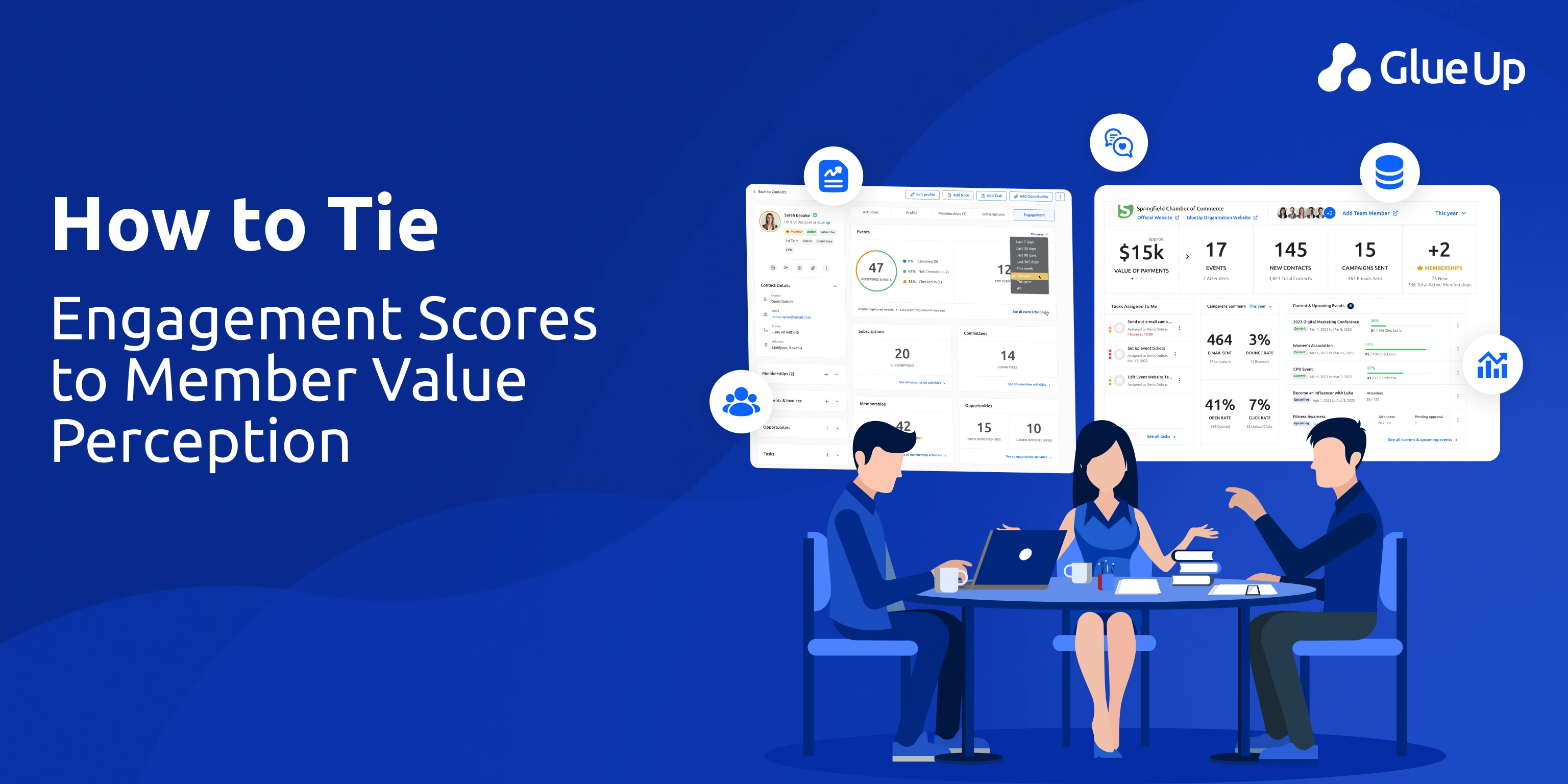
Measuring loyalty has always been harder than measuring attendance. That’s why leading associations increasingly rely on an engagement score to quantify how members interact, participate, and signal long-term value. Engagement scoring replaces anecdotal judgment with evidence, giving leadership a defensible way to connect behavior to retention, revenue, and strategic priority.
In this post, you’ll see how engagement scores differ from surface-level participation metrics, how member engagement scoring becomes a proxy for value perception, and how associations use structured scoring models to inform renewals, board reporting, and investment decisions.
Key Takeaways
Engagement scores work because they measure behavior, not sentiment claims
Value perception emerges from consistent interaction patterns across touchpoints
Scoring models must align with renewal risk, not vanity metrics
Boards respond to engagement data when it ties directly to retention and revenue
Platforms like Glue Up operationalize scoring by centralizing activity signals
Why Engagement Scores Matter More Than Satisfaction Surveys
Most associations already collect feedback, but surveys capture intent at a moment in time. Engagement scores reveal demonstrated behavior over time. That distinction matters because renewal decisions rarely hinge on one experience. They emerge from accumulated interaction patterns.
Engagement As A Behavioral Signal
An engagement score aggregates interaction frequency, depth, and diversity. This includes event participation, email responses, platform logins, and contribution activity. When measured consistently, these signals form a behavioral fingerprint that reflects how embedded a member is in your organization.
Value Perception Is Observed, Not Declared
Members rarely articulate declining value until renewal is already at risk. Engagement scoring surfaces this earlier by showing reduced interaction velocity, narrower participation, or disengagement from historically strong channels. This makes engagement a leading indicator rather than a lagging explanation.
From Activity Tracking To Engagement Scoring
Tracking activity alone doesn’t create insight. Scoring does. The shift happens when associations move from raw logs to structured interpretation:
Weighted Interaction Modeling
Not all actions carry equal meaning. A multi-day conference attendance conveys different value than a single email open. Therefore, mature engagement scores apply weighting rules that reflect strategic priorities rather than volume alone.
Longitudinal Trend Analysis
Single-period snapshots distort reality. Engagement scoring gains power when viewed historically. Trends reveal whether engagement is deepening, stabilizing, or eroding across renewal cycles.
Connecting Engagement Scores To Member Value Perception
Engagement data becomes meaningful when linked to outcomes leadership already values. Here’s how:
Engagement And Retention Correlation
Research consistently shows that members with higher member engagement scoring profiles renew at materially higher rates. This isn’t correlation theater. It reflects deeper integration into programs, relationships, and workflows that would be costly to abandon.
Engagement As A Proxy For LTV
When paired with financial data, engagement scores support member lifetime value (LTV) modeling. Members who attend, contribute, and interact broadly tend to generate higher non-dues revenue and participate longer across membership cycles.
Using Engagement Scores For Executive And Board Decision-Making
Scoring models gain legitimacy when they answer board-level questions. Here’s what that looks like:
Board-Level ROI Visibility
Engagement scoring enables board-level engagement ROI summaries that move beyond anecdotal success stories. Leaders can see which programs drive sustained interaction and which consume resources without measurable impact.
Retention Risk Identification
By integrating predictive churn risk indicators, associations can identify members whose engagement patterns signal upcoming renewal friction. This shifts retention from reactive outreach to proactive intervention.
Scaling Engagement Scoring Across Chapters &Segments
Centralized scoring supports decentralized organizations. Here’s how:
Chapter Benchmarking
With chapter-specific engagement benchmarking, leadership can compare engagement health across regions using normalized scoring criteria. This reveals where structural support or programming recalibration is needed.
Behavior-Based Segmentation
Scoring enables behavior-based member segmentation, allowing membership teams to tailor outreach, benefits, and renewal paths based on actual engagement rather than demographic assumptions.
How Glue Up Operationalizes Engagement Scoring
Glue Up’s approach to engagement scoring is grounded in activity consolidation and transparent interpretation, not black-box automation. Based on the documented functionality of its engagement scorecards, the platform supports engagement scoring in the following ways:
Automated Member Engagement Scoring that aggregates interactions across CRM, events, emails, and membership activity
Native Glue Up CRM Activity Tracking to centralize all engagement touchpoints in a single member profile
Custom Engagement Weighting Rules that let associations define what “engaged” means based on their strategy
Real-time Member Health Dashboards for leadership visibility into engagement distribution and trends
Integrated Event Participation Metrics that feed attendance and check-in behavior into scoring models
Email Interaction & Click-through Analytics to capture communication responsiveness
Member Profile Engagement History for longitudinal analysis across renewal cycles
These capabilities allow engagement scores to function as a decision system rather than a reporting artifact.
To see how this works in practice, review Glue Up’s engagement scorecard framework or book a demo to explore how engagement scoring integrates with your renewal and reporting workflows.
Quick Reads

An engagement score is a composite metric that quantifies how members interact across programs, communications, and membership platforms over time.
Attendance is a single interaction. Engagement scoring evaluates patterns, frequency, and diversity of participation.
Yes. Sustained engagement trends correlate strongly with renewal likelihood and retention risk.
Membership directors, executive leadership, and boards use engagement scores for retention strategy, investment decisions, and ROI reporting.