AI in event planning no longer sits at the edges of the conversation. It has moved into the center of how serious organizations design, run, and evaluate events heading into 2026. That shift did not happen because planners wanted new tools. It happened because the job itself changed. Events now carry heavier expectations, tighter scrutiny, and far less tolerance for guesswork. AI in event planning stepped in because it offered something planners needed more than novelty. It offered structure when complexity started to feel unmanageable.
For member based organizations, events are not isolated moments. They shape retention, sponsorship confidence, board trust, and long term engagement. When one event underperforms, the impact rarely stays contained. It ripples into renewals, budgets, and credibility. That reality explains why AI in event planning and analytics has become less about efficiency and more about confidence. Leaders are no longer asking whether events ran smoothly. They are asking whether the organization understands what happened and why.
This article explores how AI in event planning reshapes scheduling, engagement, and analytics as one connected system. It also explains why platforms like Glue Up matter in that shift, not as a layer of automation, but as the operational foundation that holds the system together.
Key Takeaways
The move toward AI did not happen because planners wanted automation. It happened because events became more complex, more scrutinized, and more consequential. AI in event planning now sits at the center of scheduling, engagement, and analytics because static, linear planning can no longer keep up with real world participation.
AI event scheduling works because it reflects how people actually move through events, not how agendas look on paper. When schedules align with human behavior, engagement becomes more consistent, and analytics become easier to interpret. Scheduling, engagement, and insight reinforce each other as one system.
AI in event planning makes engagement visible while events are happening through real time prompts, recommendations, and interaction data. This visibility helps planners, speakers, and sponsors understand what resonates without waiting weeks for post event surveys.
Each event feeds the next. Historical participation patterns, engagement trends, and communication timing inform future decisions. Organizations that retain this institutional memory move from reactive planning to steady improvement, gaining confidence with every cycle.
AI in event planning succeeds when it lives inside a single operational environment rather than across disconnected tools. Platforms like Glue Up matter because they keep scheduling, engagement, and analytics connected across years, allowing events to evolve instead of resetting every season.
Quick Reads
AI in Event Planning and the End of Static Event Design
Event planning used to feel linear. Build the agenda. Promote the sessions. Host the event. Send a survey. Report the numbers. That rhythm worked when expectations were lighter and calendars were less crowded. Today, that approach feels fragile.
AI in event planning emerged as a response to a deeper problem. Static planning could no longer keep up with dynamic participation. Attendees move differently. Sessions compete for attention. Engagement rises and falls in real time. What planners needed was not faster execution. They needed a way to see how events behave while they unfold.
AI technology in event planning introduced that visibility. Instead of treating agendas as fixed artifacts, AI enabled planners to treat schedules as living structures that reflect how people actually participate. This shift explains why AI event scheduling became one of the earliest and most impactful use cases.
Scheduling is no longer just about time slots. It is about flow, energy, and decision making. AI solutions for event scheduling help planners identify conflicts before they surface, balance multi track programs, and reduce cognitive overload for attendees who face dozens of choices in a single day.
When scheduling improves, engagement improves. When engagement improves, analytics become clearer. AI in event planning works because it respects that sequence rather than isolating each part of the event lifecycle.
AI in Event Planning and Scheduling That Reflects Human Behavior
AI event scheduling reshaped how planners think about agendas by grounding decisions in historical participation rather than intuition alone. Session popularity, attendance drop off, room capacity strain, and timing preferences all leave data trails. AI in event planning uses those signals to help planners design schedules that align with how people move, not how spreadsheets assume they will.
This matters more than it sounds. Poor scheduling rarely looks dramatic. It shows up quietly. Half filled rooms. Attendees leaving early. Overlapping sessions that divide the same audience. AI in event planning and analytics brings those patterns into view so planners can correct them upstream.
Scheduling also affects speaker experience. When sessions are placed with more intention, speakers face audiences that are better aligned with their content. That alignment raises session quality, which feeds back into attendee satisfaction and post event engagement.
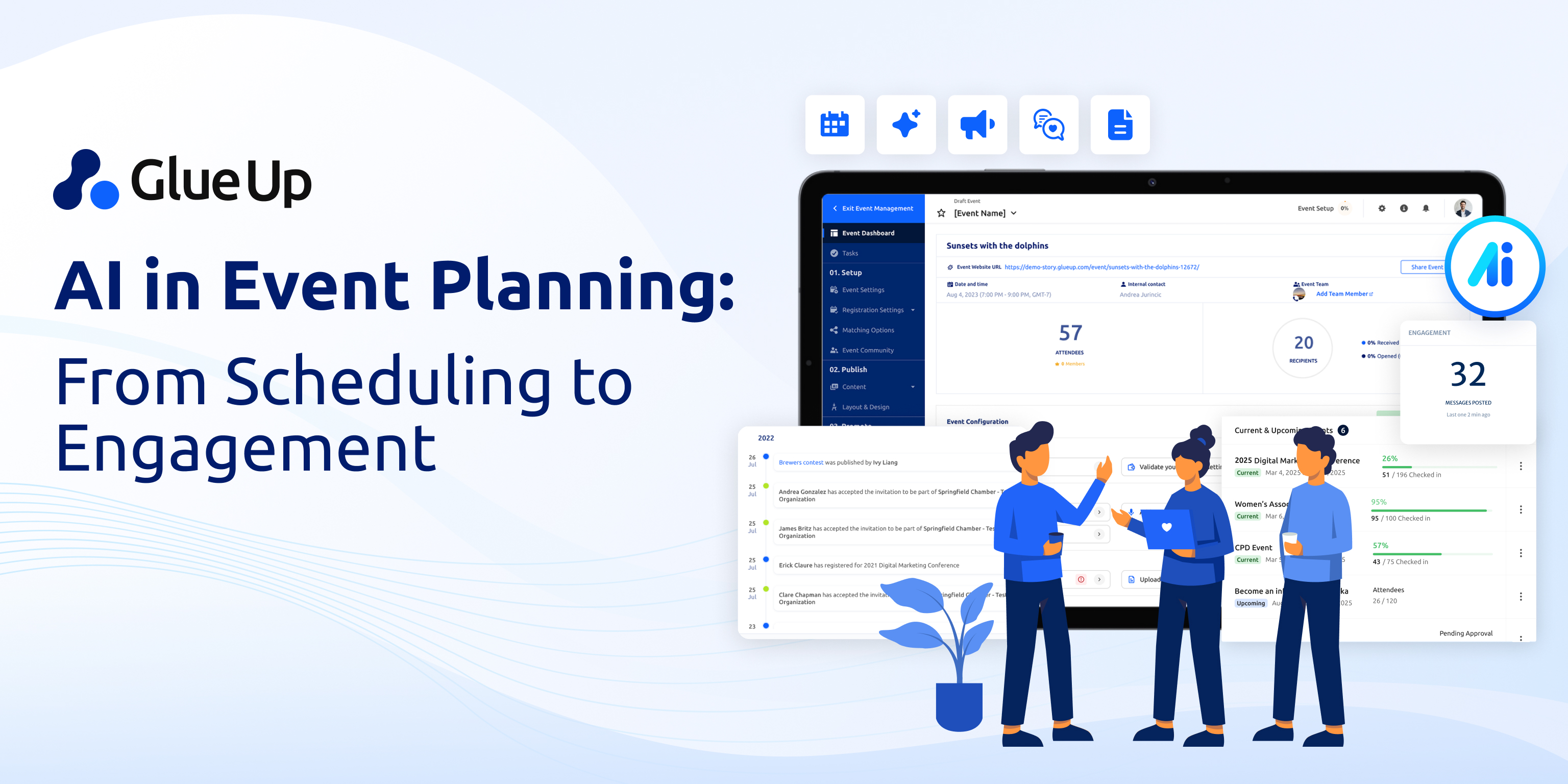
Glue Up supports this approach by treating scheduling as part of a broader event workflow. Agendas connect directly to registrations, communications, and participation tracking. That integration allows organizations to move beyond static calendars toward event schedules that reflect real engagement patterns year over year.
AI in Event Planning and Engagement That Feels Personal at Scale
Engagement remains the most discussed and least clearly measured part of event planning. Everyone values it. Few organizations feel confident explaining it. AI in event planning changes that by making engagement visible while it happens.
AI technology in event planning enables real time prompts, session recommendations, and interaction cues that guide attendees through complex programs. Instead of leaving participants to navigate dense agendas alone, AI assists them with contextual suggestions based on interests and past behavior.
Speed networking provides a clear example. When structured well, speed networking creates focused, meaningful interactions. When structured poorly, it feels rushed and random. AI in event planning helps schedule networking sessions that align participants by relevance, timing, and availability. The result feels intentional rather than forced.
Engagement tools also support speakers and sponsors. Interactive polling, Q and A, and live feedback loops provide immediate signals about what resonates. Those signals help speakers adjust in the moment and help organizers understand which sessions generate lasting value.
Glue Up approaches engagement as part of a continuous relationship rather than a one time interaction. Engagement data connects to member profiles, event history, and communication records. That continuity matters because engagement does not reset after the closing keynote. It carries forward into renewals, follow up events, and sponsor conversations.
AI in Event Planning and Analytics as Organizational Memory
Analytics once meant post event reports filled with attendance counts and satisfaction scores. Those metrics still matter, but they no longer tell the full story. AI in event planning and analytics expands what organizations can see and remember.
Engagement heat maps, session participation trends, and interaction patterns help planners understand how events actually performed beyond surface numbers. These insights become more powerful when viewed across multiple events, chapters, and time periods.
AI in event planning does not predict the future in this context. It clarifies the past with enough depth to inform better decisions. Organizations heading into a new fiscal year rely on that clarity to plan calendars, allocate resources, and communicate outcomes to boards and sponsors.
Glue Up plays a central role here by keeping analytics connected across events and memberships. Data does not live in isolated reports. It lives within the operational system leaders already use to manage their organizations. That integration allows insights to inform action rather than sit unused in dashboards.
AI in Event Planning and the Shift from Execution to Confidence
Confidence has become the quiet currency of event planning. Boards want confidence that investments make sense. Sponsors want confidence that engagement delivers value. Staff want confidence that systems support them during peak seasons.
AI in event planning contributes to that confidence by reducing uncertainty. When schedules align with behavior, engagement signals appear in real time, and analytics explain outcomes clearly, conversations change. Leaders move from defending decisions to discussing improvements.
This shift explains why AI in event planning now appears in board level discussions. Events represent significant financial and reputational commitments. Organizations that understand how their events perform carry less risk into the next planning cycle.
Glue Up supports this confidence by providing a single environment where planning, execution, engagement, and analysis intersect. That consistency matters because confidence rarely comes from tools alone. It comes from systems that behave predictably under pressure.
AI in Event Planning and Why Member Based Organizations Feel the Impact First
Member based organizations feel the impact of AI in event planning more acutely than most. Events often serve as the primary touchpoint for value delivery. They reinforce professional identity, foster relationships, and justify membership investment.
AI in event planning helps these organizations design events that respond to member behavior rather than assumptions. Chapters gain templates that support consistency while allowing local variation. Central teams gain visibility without imposing rigid control.
Sponsors also benefit. Clear engagement data and session participation insights strengthen sponsor reporting and relationship management. Sponsors respond positively when value feels measured and understood.
Glue Up positions itself within this ecosystem as the operational backbone that aligns events with membership management. That alignment reduces fragmentation and helps organizations maintain coherence as they scale programs across regions and formats.
AI in Event Planning and the New Expectations For 2026
Looking toward 2026, expectations continue to rise. Hybrid formats remain common. Attention remains scarce. Budgets remain scrutinized. AI in event planning becomes less about experimentation and more about readiness.
Organizations preparing for the next fiscal year ask practical questions. How do we design agendas that perform reliably? How do we keep participants engaged across long programs? How do we explain outcomes clearly to leadership?
AI in event planning answers those questions by turning events into systems rather than standalone projects. Scheduling, engagement, and analytics reinforce one another when supported by the right platform.
Glue Up reflects this shift by focusing on integration rather than isolated features. AI Copilot assists with agenda building and content workflows. Engagement tools connect to member data. Analytics remain accessible to decision makers who need clarity rather than complexity.
AI in Event Planning as a Quiet Advantage
The strongest shifts in event planning rarely arrive with spectacle. They arrive quietly, almost politely, reshaping how work feels long before anyone labels the change as strategic. That is exactly how AI in event planning has entered serious organizations. Its value shows up in calmer planning cycles, fewer last-minute adjustments, and clearer conversations with leadership.
Researchers studying technology adoption inside professional services and operations consistently observe the same pattern. Tools that succeed long term tend to fade into workflows rather than dominate them. They remove friction instead of adding steps. They support judgment instead of replacing it. Studies on AI adoption in service design and event management describe this as operational invisibility, where technology improves outcomes while staying largely out of sight.
AI in event planning fits this pattern. Its influence becomes visible through smoother agendas, more responsive engagement, and analytics that explain outcomes without overwhelming teams.
How AI in Event Planning Reduces Friction Without Changing Culture
One reason AI in event planning gained traction across associations and member organizations is cultural compatibility. Events carry tradition. They reflect identity. Planners, boards, and members tend to protect how events feel, even as expectations evolve.
AI technology in event planning succeeds because it works within existing norms. It helps schedules align with attendee behavior. It helps engagement tools respond to participation patterns. It helps analytics surface clarity that leadership already wants.
Industry research on event operations shows that planners value tools that enhance flow rather than disrupt it. AI driven scheduling and engagement systems support this preference by reinforcing what teams already do well. They simply make outcomes more reliable.
This explains why AI in event planning spreads through results rather than persuasion. When events feel easier to manage and clearer to explain, adoption follows naturally.
The Compounding Advantage of AI in Event Planning
The true advantage of AI in event planning emerges over time. Each event generates insight that informs the next. Each planning cycle becomes more grounded in what actually worked. Each conversation with sponsors or boards carries more substance.
Academic literature on learning systems emphasizes this compounding effect. Systems that retain and contextualize historical data allow organizations to improve decisions incrementally rather than episodically. AI in event planning and analytics operates as that learning layer.
Session attendance patterns inform future agendas. Engagement data shapes networking formats. Communication timing improves with each cycle. Over time, events evolve from isolated efforts into connected experiences.
Organizations using integrated platforms experience this compounding effect more clearly. Insights stay accessible. Teams avoid restarting planning from scratch. Leadership discussions shift from justification to refinement.
Why Continuity Matters More Than Features
Research across enterprise systems consistently shows that continuity drives adoption more than feature depth. Event teams work across tight timelines, seasonal pressure, and shifting priorities. Systems that preserve institutional memory reduce cognitive load and planning fatigue.
AI in event planning contributes to continuity when it stays embedded in the same operational environment where teams already manage members, communications, and events. This is where platforms like Glue Up matter.
Glue Up supports AI assisted planning by keeping schedules, engagement signals, and analytics connected across the event lifecycle. Planning builds on what the organization already knows. Engagement insights remain tied to member history. Analytics stay available for leadership review without translation between systems.
That continuity allows AI in event planning to feel supportive rather than intrusive. Teams trust it because it behaves consistently across cycles.
AI in Event Planning and Leadership Confidence
Leadership confidence often serves as the quiet measure of success. Boards ask fewer reactive questions when outcomes feel understood. Sponsors engage more deeply when participation data feels credible. Staff approach planning seasons with steadier expectations.
AI in event planning strengthens that confidence by making event performance legible. Scheduling decisions become explainable. Engagement trends feel observable. Post event analytics support informed discussions rather than defensive explanations.
Studies on governance and performance reporting highlight this effect. Decision makers place greater trust in systems that present context alongside metrics. AI in event planning and analytics does exactly that when implemented thoughtfully.
Glue Up aligns with this expectation by presenting event data within the same environment leaders already use to understand membership and revenue. Events stop feeling separate from the organization’s broader narrative.
The Quiet Advantage Heading Into 2026
As organizations prepare for 2026, event planning continues to carry more strategic weight. Calendars grow denser. Stakeholder expectations sharpen. Capacity remains finite.
AI in event planning offers a quiet advantage in this environment. It brings structure without rigidity. It supports engagement without forcing interaction. It explains outcomes without oversimplifying them.
The most effective implementations rarely call attention to themselves. They show up in calmer workflows, clearer insights, and stronger alignment between planning teams and leadership.
Glue Up supports this advantage by acting as the connective tissue across events, engagement, and organizational memory. Planning does not reset each year. It evolves.
That evolution, steady and cumulative, defines the real power of AI in event planning.
AI in Event Planning and What Comes Next
AI in event planning continues to mature, but its core value remains stable. It helps organizations manage complexity without losing clarity. It supports engagement without forcing interaction. It explains outcomes without oversimplifying them.
For member-based organizations, that balance matters deeply. Events remain one of the most visible expressions of organizational value. When they work well, they strengthen trust. When they feel disjointed, they erode it.
AI in event planning offers a way forward that feels grounded rather than speculative. It builds on historical data, real behavior, and practical workflows. It helps planners and leaders alike approach events with steadier hands and clearer eyes.
Glue Up stands within that approach as a platform built for continuity. It brings together scheduling, engagement, and analytics inside a single operational environment designed for organizations that plan not just for the next event, but for the years that follow.

AI in event planning refers to using artificial intelligence to support how events are scheduled, experienced, and evaluated. Instead of relying only on static agendas and post-event surveys, AI helps organizations design schedules based on historical participation, guide attendees in real time, and analyze engagement patterns after events conclude.
AI event scheduling improves agendas by grounding decisions in real attendee behavior. It helps planners identify session conflicts, balance multi-track programs, and reduce overload by analyzing attendance trends, timing preferences, and session popularity. The result is schedules that feel more intuitive and perform more consistently.
The role of AI in modern event planning centers on structure and clarity. AI connects scheduling, engagement, and analytics into one continuous system. That connection helps organizations understand how events behave while they unfold and explain outcomes with more confidence afterward.
AI technology in event planning supports engagement through real-time prompts, session recommendations, interactive polling, and structured networking. These tools help attendees navigate complex programs more easily and help organizers see which sessions and interactions resonate most while the event is still live.
AI in event planning and analytics focuses on making event outcomes visible and explainable. It goes beyond basic attendance counts to show participation trends, engagement patterns, and session performance across events and time periods. This clarity supports better planning decisions and stronger leadership reporting.
As events face higher expectations, tighter budgets, and more scrutiny in 2026, AI in event planning becomes essential for readiness. Organizations need schedules that perform reliably, engagement that feels intentional, and analytics that support confident decisions rather than assumptions.
For associations and chambers, events shape retention, sponsorship confidence, and member value. AI in event planning helps these organizations design events around member behavior, maintain consistency across chapters, and carry insights forward from one event to the next.
Glue Up supports AI in event planning by keeping scheduling, engagement, and analytics connected across the full event lifecycle. Planning builds on historical data, engagement stays linked to member profiles, and analytics remain accessible for leadership conversations without switching systems.
AI in event planning supports planners rather than replacing them. It reduces friction, highlights patterns, and provides clarity so planners can focus more on people, experience design, and strategic decisions instead of manual coordination.
The biggest advantage is compounding clarity. Each event generates insight that improves the next. Over time, planning cycles become smoother, engagement becomes more intentional, and stakeholder conversations become more confident and grounded.