The event planning meeting has always existed. It sat on calendars, carried polite updates, and produced shared nods before everyone returned to inboxes. Heading into 2026 and the new fiscal year, that version of the event planning meeting has begun to feel heavier. Event teams feel pressure. Sponsors move slower. Leadership asks sharper questions. Time feels compressed.
Inside that pressure, a different kind of event planning meeting started to surface across high performing associations, chambers, and member-based organizations. It lasts fifteen minutes. It happens weekly. It feels unusually calm. It creates visible movement.
Teams refer to it as the 15-minute weekly event sales stand up. Some call it a sales huddle. Others describe it as a revenue check in. Its power sits less in its name and more in its design. It uses historical data. It limits inputs. It assigns one clear action per owner. It reshapes accountability without adding weight.
As organizations prepare event calendars for 2026, this meeting has quietly become the most reliable control point for event revenue.
Key Takeaways
- In the new fiscal year, the event planning meeting shifts from coordination to governance. Fifteen focused minutes each week create shared visibility into event revenue movement, ownership, and timing.
- Timeboxed meetings succeed when teams review only three elements: pipeline stage counts, account level sales blockers, and one clear action per owner. This structure keeps discussions grounded in historical data and real progress.
- Question driven agendas outperform topic lists. Asking what changed, what slowed progress, and what moves next leads to decisions, follow through, and cleaner accountability across event sales teams.
- One screen, one rhythm, one shared view. A consistent template builds discipline, supports CRM hygiene, and helps teams move deals forward without adding meeting weight.
- Using Glue Up, teams rely on centralized event deals, visible pipeline stages, and assigned follow ups to run stronger weekly stand ups and enter 2026 with confidence.
Quick Reads
- Strategic Event Management for Modern Associations
- 2026 Event Planning Guide for Associations
- Data Driven Event Planning as Revenue Engines
- What Is the Best CRM Software for Events?
- Weekly Revenue Report & Agenda Stand-Up
Why The Event Planning Meeting Started Carrying Revenue Weight In 2026
For years, event revenue behaved like a seasonal rhythm. Flagship events anchored budgets. Sponsors returned out of habit. Membership renewals followed familiar cycles. Meetings reflected that comfort. Updates mattered more than outcomes.
That rhythm shifted. Leadership teams now read event revenue as a signal of organizational health. Sponsorship pipelines receive scrutiny. Event attendance patterns face comparison across years. Boards expect clarity around timing, movement, and ownership.
Research on meeting effectiveness from Harvard Business Review and organizational psychology shows a consistent pattern. Meetings generate value when structure replaces storytelling and when shared data replaces interpretation. Stand up meeting studies reinforce the same principle. Short, repeatable check ins succeed when they surface progress and friction quickly rather than recount activity.
The modern event planning meeting began absorbing this logic. Teams realized that revenue conversations thrive inside constraint. Fifteen minutes forces discipline. Weekly cadence builds rhythm. Historical data grounds discussion.
The Quiet Flaw Inside Most Weekly Event Planning Meetings
Most weekly event planning meetings drift into explanation. Each update carries context. Each account discussion stretches into background. Time fills itself.
Sales research and pipeline management studies describe this pattern as visibility without traction. Teams feel informed while deals remain stationary. Meeting fatigue rises. Accountability diffuses.
The issue rarely involves effort or intent. The issue lives in meeting design. When a meeting invites narrative, it stretches. When it invites numbers and ownership, it compresses.
Studies on stand-up meetings highlight that perceived value rises when teams share the same information, in the same format, at the same cadence. Teams stop debating reality and start coordinating action.
That insight reshaped the event planning meeting agenda for teams focused on event revenue.
Why Fifteen Minutes Became the Constraint That Changed Behavior
Timeboxing appears simple on the surface. Research shows its strength comes from input limitation rather than speed.
Fifteen minutes allows space for three elements:
- shared visibility
- friction surfacing
- ownership assignment
Nothing else fits comfortably.
Agile research on stand ups demonstrates that short meetings succeed when they ask three questions repeatedly. What changed. What slowed progress. What moves next.
Event sales teams adapted that structure to their own context. The result became the weekly event pipeline review, compressed into a fifteen-minute window.
This design supports event deal velocity tracking while protecting attention. Teams arrive prepared. Historical data does the talking. The meeting ends with clarity rather than momentum theater.
The Structure of a Fifteen Minute Weekly Event Sales Stand Up
The stand-up functions as an accountability framework rather than a discussion forum. Its power sits in three fixed inputs that remain constant week after week.
Pipeline Stage Count Review
The meeting opens with numbers. Teams review pipeline stage counts for event related deals. Each stage reflects a real milestone already recorded inside the CRM.
Examples include:
- interest confirmed
- budget discussed
- package shared
- commitment received
- invoice scheduled
The focus stays on change since last week. Movement matters more than volume. Historical comparison replaces speculation.
This approach aligns with sales pipeline management research emphasizing stage clarity tied to buyer behavior rather than internal optimism.
Account Level Sales Blockers
Next comes friction. Each owner surfaces account level sales blockers in a single sentence. The blocker lives outside the owner’s control. It receives visibility rather than debate.
Stand up research shows that surfacing impediments early supports coordination and reduces downstream delay. Event sales accountability improves when friction receives collective awareness.
One Action Per Owner Methodology
The meeting closes with ownership. Each person leaves with one clear action tied to a specific account. The action appears inside the CRM as a task or follow up.
Next week, the stand up begins by revisiting completion. Accountability becomes visible without escalation. This method aligns with behavioral research on commitment and follows through.
Designing An Event Planning Meeting Agenda That Creates Movement
Effective meeting science recommends framing agendas as questions rather than topics. Questions demand answers. Answers create closure.
A high performing event planning meeting agenda uses three repeating prompts:
- Which pipeline stage counts changed this week
- Which accounts face friction
- Which owner commits to which action
This agenda resists drift. It supports sales coordination while preserving time.
CRM driven stand up agendas succeed because the data already exists. Teams read from shared reality rather than personal notes.
The Event Planning Meeting Template That Supports Execution
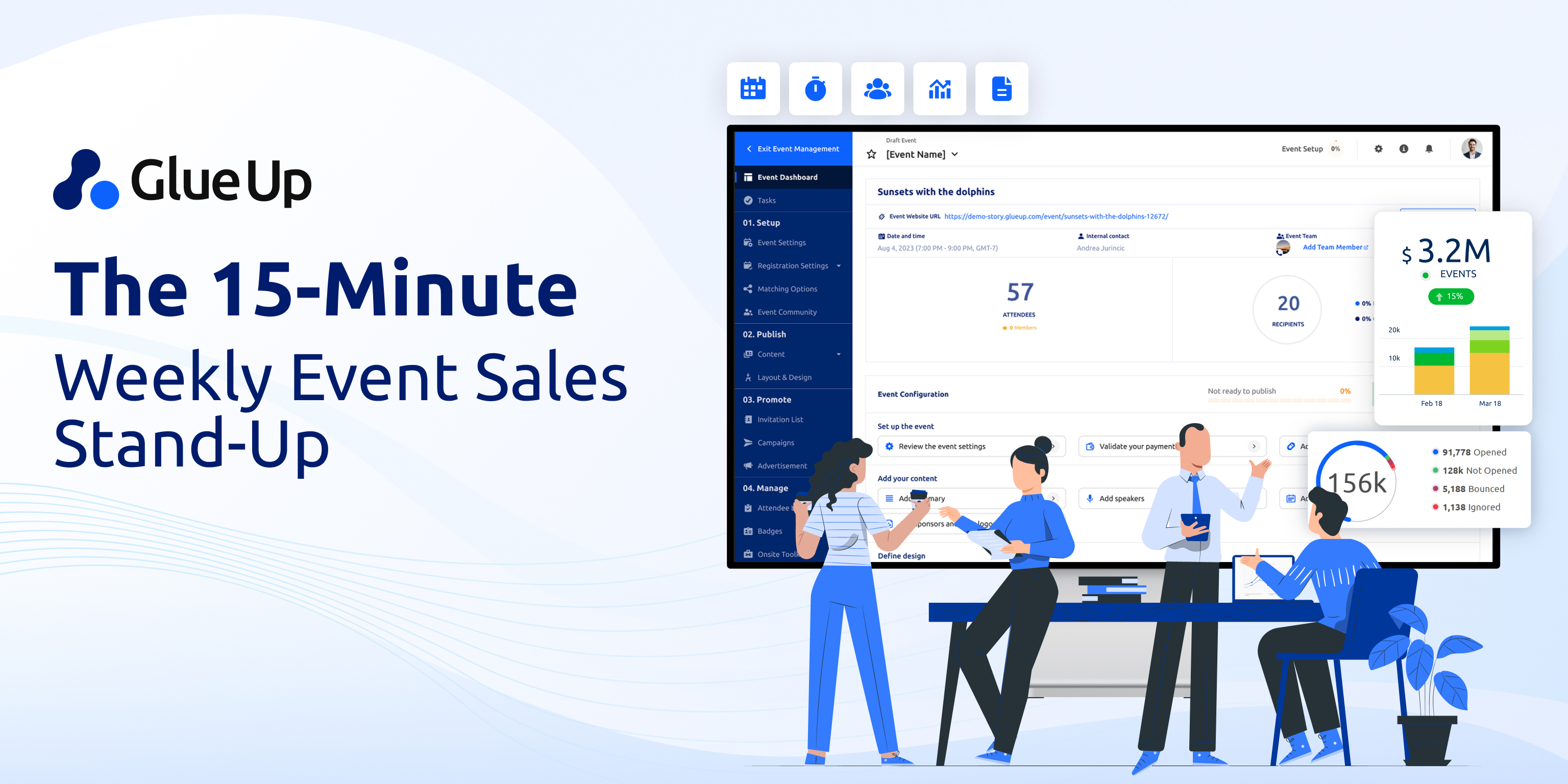
The most effective event planning meeting template fits on one screen. It displays:
- pipeline stage counts
- blocker column
- owner and next action
The template remains visible during the meeting. It receives updates live. Over time, it becomes a behavioral artifact.
Research on sustainable meeting culture shows that repeatable formats reduce cognitive load and improve consistency. Teams trust the structure. Energy shifts toward execution.
Long tail use cases demonstrate its value for small teams running practical fifteen-minute weekly event sales stand ups with limited capacity.
CRM Hygiene and Revenue Discipline Inside the Stand Up
CRM hygiene improves when meetings depend on historical accuracy. Teams update records because the meeting reads from them.
This dynamic explains why organizations using Glue Up experience cleaner data around event sales without enforcement. Pipeline stages, ownership, and follow ups already live inside the system. The stand up simply surfaces them.
Glue Up supports this workflow by centralizing event related deals, maintaining historical movement, and connecting tasks to accounts. The meeting builds clarity. The platform holds memory.
Why This Event Planning Meeting Holds Through the Next Fiscal Year
Heading into 2026, leadership attention gravitates toward systems that scale clarity rather than effort. The fifteen minute weekly event sales stand up fits that expectation.
It respects time. It surfaces truth. It assigns ownership.
Meeting research confirms that shorter, structured check ins build trust over time. Sales research confirms that stage clarity and accountability shorten cycles.
The event planning meeting evolves from obligation to operating rhythm. Teams rely on it. Leadership references it. Revenue conversations stabilize.
The Broader Meaning for Member Based Organizations
Associations and chambers often operate with lean teams and ambitious calendars. The stand-up honors that reality. It creates alignment without burden.
This meeting design supports:
- increased sales efficiency
- clearer sales accountability
- sustainable meeting culture
- consistent pipeline visibility
As organizations plan events for 2026 and beyond, the fifteen minute stand up offers a grounded response to complexity.
Closing Perspective
The most effective event planning meeting in 2026 carries quiet confidence. It avoids noise. It values shared reality. It leaves teams lighter rather than drained.
Fifteen minutes each week builds rhythm. Rhythm builds trust. Trust supports revenue.
Glue Up sits beneath that rhythm, holding the data that allows teams to meet with purpose.

An effective event planning meeting in 2026 stays short, structured, and grounded in historical data. Teams review pipeline stage counts, surface account level blockers, and assign one clear action per owner within a fifteen minute weekly stand up.
A strong event planning meeting agenda includes three elements: changes in event related pipeline stages, visible sales blockers at the account level, and one next action tied to a specific owner. This format keeps the meeting focused and outcome driven.
The best event planning meeting template fits on one screen and shows pipeline stage counts, blockers, owners, and next actions. A simple template supports consistency and helps teams maintain momentum week after week.
Fifteen minute meetings work because time limits reduce storytelling and shift attention toward facts, ownership, and follow through. Research on stand up meetings shows that short, repeatable check ins improve coordination and accountability.
Glue Up supports weekly event planning meetings by centralizing event related deals, tracking historical pipeline movement, and connecting follow up actions to account owners inside a single platform.