A strange thing happens inside associations, and nobody really names it until it’s too late. You’re sitting in a board meeting, everything feels routine, and then someone asks the question that slices straight through the room.
“So… where are we with next year’s renewals?”
It lands heavier than it sounds. People glance down like the answer might magically appear in those printed packets. Someone flips to a spreadsheet that hasn’t been updated in weeks. Someone else opens last year’s file because at least the numbers in it agree with themselves. A few scroll through emails hoping a hidden report might bail them out.
That tiny pause is the tell. The issue isn’t member enthusiasm. The real problem is that nobody is working from the same renewal timeline. Everyone is doing their best, but the work is happening in fragments.
Once you notice it, it’s impossible to ignore. Renewal chaos doesn’t come from members. It comes from the organization not speaking the same calendar language. Finance sends invoices whenever they need cash flow. Membership blasts value reminders whenever engagement dips. Marketing tries to tuck renewal messages between event pushes. IT keeps duct-taping data so the numbers don’t contradict each other. The board wants clarity. Staff wants air. Members just want renewal to feel like a straight line instead of a scavenger hunt.
“Easy renewal” isn’t a tagline. It’s what happens when a renewal timeline finally gives the entire organization a shared rhythm.
This guide walks through how to build that rhythm. It pulls together behavioral cues, membership strategy, and the daily operational constraints that make-or-break renewals. It’s written for the leaders who carry accountability, the membership teams who carry relationships, the finance folks who carry revenue, and the operations and tech teams who carry the systems that hold it all together.
The goal is simple: take renewal season out of the category of “annual stress event” and turn it into something predictable, human, and aligned. Build your renewal timeline right, and you don’t just lift retention or lighten staff workload. You start shaping a membership experience people want to return to instead of tolerating.
Key Takeaways
You do not have a renewal problem; you have a structure problem. Most issues with low renewal rates come from not having a clear, shared member renewal timeline.
A modern member renewal timeline runs in stages. The strongest results come from a staged flow (T-90, T-60, T-30, T-10, T-1, and T+ lapsed messages), with each touch doing a specific job: warm, clarify, nudge, then recover.
Value messages and invoice reminders must work together. Renewal campaigns perform best when value-led communications and clean invoice reminders are coordinated inside one member renewal timeline instead of mashed into one confusing email.
Behavioral science is on your side if you design for it. Well-spaced reminders, clear deadlines, simple two-minute renewal flows, and “do it now” prompts aligned to real behavior make renewals feel easy instead of exhausting.
Automation turns the member renewal timeline into an asset. When the full timeline runs through a platform like Glue Up, renewals become predictable, measurable, and less manual for membership, finance, COOs, and CIOs, while feeling smoother for members.
Quick Reads
The Truth Most Associations Avoid About the Member Renewal Timeline
Almost every association has a moment of renewal panic. Because the organization does not have a predictable cycle for anything. One membership director might send early reminders.
Another might send them late. Finance might generate invoices at a different time. Some teams use templates from last year while others write new copy in a hurry. Someone discovers that an entire membership segment never received a single reminder due to a list error. Someone else realizes that the renewal portal requires three extra steps that nobody noticed until now. By the time the board asks for numbers, the truth is already scattered.
This is what happens when the member renewal timeline is undocumented and unsupported by real systems. Associations are left to run renewals based on instinct, memory, goodwill, and whatever spreadsheets someone created years ago. These are teams operating inside a structure that does not exist. And without a member renewal timeline guiding the year.
The moment you implement a formal member renewal timeline, everything shifts. You build a communication rhythm that members learn to expect, and staff learn to trust. Renewal becomes something predictable, measurable, and calm. It becomes part of the organizational rhythm rather than an annual emergency.
What a Modern Member Renewal Timeline Actually Looks Like
A member renewal timeline is a coordinated and research grounded progression of messages, invoice touches, and value signals sent at the exact moments when members are most likely to take action. These are the stages associations around the world use because they align with how human attention, memory, and decision-making work.
T-Ninety Days
This is the opening phase of your member renewal timeline. The goal is to warm the relationship and prepare clean data. Members receive a heads-up message that their renewal period is approaching. The tone is calm. The message is rooted in value. Tell them what is coming next year. Highlight one or two programs that matter. Show a small preview of the year ahead. Reinforce that renewing is simple.
Behind the scenes, this is where membership, finance, and IT align on lists, expiration dates, contact accuracy, and payment options. The member renewal timeline only works if this foundation is strong.
T-Sixty Days
This is the soft ask. The message should feel friendly and optimistic. Tell members how their membership supported their goals this year. Show a small set of benefits they will continue to enjoy if they renew. This is where the member renewal timeline begins to influence behavior. A sixty-day window provides enough time for early renewers to take action and for staff to avoid a last-minute crush.
T-Thirty Days
This is the clarity moment. The message is still friendly but more direct. Members should know exactly what they will lose if they do not renew and exactly what they gain if they do. Do not overwhelm them with lists. Focus on the two or three benefits that make the biggest difference. This is where a well-designed member renewal timeline begins to separate associations with strong renewal practices from those still improvising.
T-Ten to T-Seven Days
This is the urgency stage. Members are reminded that their membership is about to expire. The tone is respectful, clear, and helpful. The message is shorter. The link to renew appears early in the message. The support contact is easy to find. When done well, this stage produces a noticeable increase in renewals. It is also the stage where members appreciate clarity rather than pressure.
T-Two to T-One day
This is the final call. The message is extremely short. Think three sentences. It states the expiration date. It includes the renewal link. It reinforces that renewing protects their existing access and keeps their benefits active. A good member renewal timeline never skips this stage because the final twenty-four to forty-eight hours consistently produce a significant wave of action.
T+Seven to T+Thirty days
This is the lapsed recovery stage. The tone is warm and nonjudgmental. Members are invited back with an easy path and clear instructions. Associations that engage lapsed members without guilt often recover ten to twenty percent of lost renewals. This final step in the member renewal timeline gives organizations a second chance to reconnect.
A timeline like this is adaptable to annual, quarterly, monthly, or anniversary based renewals. What matters is the progression. You guide members gently into awareness. You guide them into clarity. You guide them into urgency at the moment urgency matters. This is why building a disciplined member renewal timeline feels like upgrading from chaos to choreography.
How Renewal Messages Work When They Follow the Member Renewal Timeline
Every message inside the member renewal timeline works because it has a purpose. Without intentionality, reminders turn into noise. With the right structure, reminders turn into clarity and motivation.
Early-Stage Messages
The member renewal timeline uses early-stage messages to restate value without pressure. This is where you remind members of what they experienced this year. Focus on stories. Case examples. Quotes. Wins. The human brain responds to outcomes more than features. If you can help someone, remember why joining was worth it, they will be more open to renewing.
Mid Stage Messages
At this stage, members need decision clarity. They should feel the difference between renewing and not renewing. This is where the member renewal timeline intersects with behavioral research. People make decisions faster when they understand what is at stake. Members want to understand what changes after expiry. Access to resources. Member only events. Discounts. Communities. Continuing education. Advocacy. Mentorship. Show them the value without overwhelming them.
Late-Stage Messages
These messages are built around two elements: specificity and convenience. The specificity helps members take the deadline seriously. The convenience ensures that the act of renewing feels effortless. The member renewal timeline ensures that this moment arrives at the ideal behavioral window. A concise message, a clear request, and a direct link often outperform long persuasive explanations.
Lapsed Messages
These messages invite a return. They are rooted in respect. They acknowledge the member’s past involvement. They provide a simple on ramp back into membership. This part of the member renewal timeline breathes humanity back into the renewal process. It turns a lapse into an opportunity rather than a failure.
Where Invoices Belong Inside the Member Renewal Timeline
Renewal messaging and invoice reminders are often treated as the same thing, but they are not. The member renewal timeline uses both, but they serve different purposes.
Value messages speak to the heart. Invoice reminders speak to the logistics.
When these two things are mixed randomly, members feel confused. When they are placed intentionally inside the member renewal timeline, the experience becomes smooth.
Here is how invoices fit.
Phase One: Invoices Appear After the Value Message
Members first receive a value message at sixty days. Then they receive their invoice in a separate communication. This helps avoid the feeling that the organization is leading with payment rather than purpose.
Phase Two: Invoice Reminders Appear as Members Get Closer to Expiry
The member renewal timeline uses invoice reminders at thirty days and ten days. They are short and specific. They contain the amount due, the due date, and the link. They mention benefits but do not bury the payment details.
Phase Three: Invoice Reminders Sync with Final Expiration
A final reminder one to two days before expiry. A gentle lapsed invoice reminder after.
This two track approach transforms the renewal experience. It allows the member renewal timeline to honor both the emotional connection and the operational needs of the organization.
Why the Member Renewal Timeline Works According to Behavioral Science
Behind the scenes, the member renewal timeline is quietly supported by research in memory, attention, and decision making.
Reminders Work Because Humans Forget
Studies in behavioral economics show that people often want to act but forget to act. Reminders bridge the gap between intention and behavior. The member renewal timeline maximizes this with spaced signals that arrive exactly when people are cognitively ready.
Reminders Lose Power When They Cluster
Too many reminders create fatigue. People begin to ignore them. The member renewal timeline solves this by using fewer well-timed messages instead of many poorly timed ones.
People Respond to Clarity and Convenience
Decision research shows that when an action takes less than two minutes, people are dramatically more likely to complete it immediately. The member renewal timeline uses short messages and mobile friendly links at the moment when decision friction naturally drops.
Implementation Intentions Increase Follow Through
When a message tells someone exactly when and how to renew, their likelihood of renewing rises. The member renewal timeline embeds this into the phrasing. It reduces the cognitive load.
Deadlines Trigger Action
Humans respond more strongly to near term deadlines than distant ones. Late stage reminders inside the member renewal timeline use short time windows to trigger reengagement without causing panic.
This is why the member renewal timeline feels smooth. It is aligned with how the brain works.
Turning the Member Renewal Timeline into a Scalable System
Even the most well-crafted member renewal timeline will break if it depends on manual work. The future of renewal success belongs to associations that treat their timeline as a system supported by automation.
Here is what that system needs to include:
Automation
The full member renewal timeline should run automatically. Every message. Every invoice reminder. Every branch for member type, dues tier, and payment status. Staff should be able to adjust language and visuals without recreating workflows.
Unified data
Membership, event participation, communication preferences, and billing history should sit in one place. This allows the member renewal timeline to reflect real engagement.
Role clarity
Membership owns value messages. Marketing owns templates. Finance owns invoicing. CRM administrators own the workflow logic. CIOs provide governance. COOs evaluate process efficiency. This is how the member renewal timeline becomes a shared responsibility rather than a fragmented one.
Mobile ease
Members should be able to renew in less than ninety seconds on mobile. The member renewal timeline only works if the actual renewal experience is frictionless.
Reporting
Leaders should be able to see renewal performance across every phase of the member renewal timeline. Which messages worked. Where drop off occurred. Which segments need attention. This is how you improve accuracy every cycle.
Glue Up
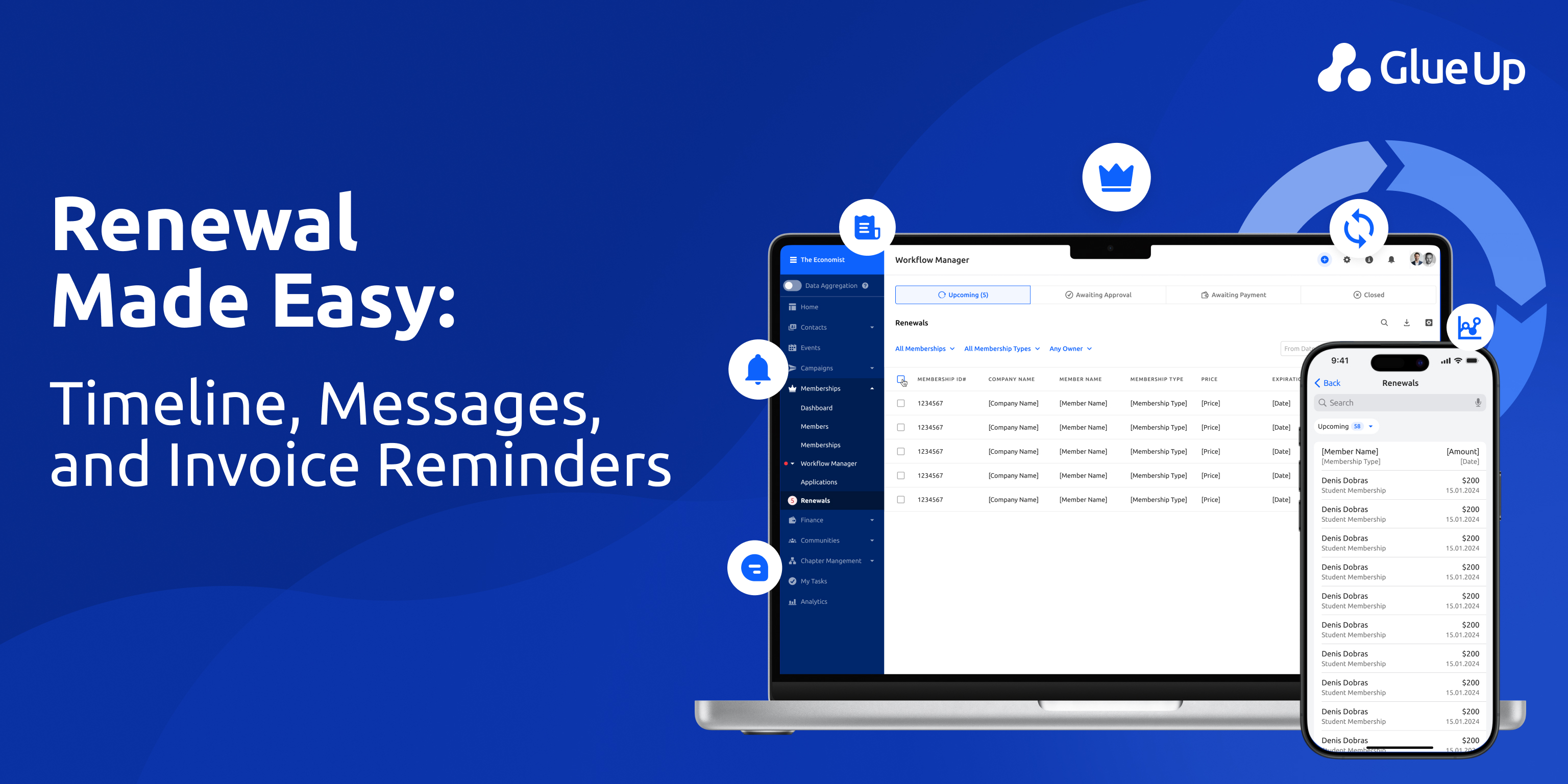
Glue Up is the infrastructure that turns the member renewal timeline into daily reality. It unifies membership data, events, finance, community activity, and communication in one platform. It automates renewal workflows. It schedules value messages and invoice reminders with precision.
It allows membership teams to write better messages, finance teams to send cleaner invoices, and CIOs and COOs to trust the data behind the renewal cycle. Most of all, Glue Up helps associations deliver renewal experiences that feel smooth for members and sustainable for staff.
How to Measure and Improve Your Member Renewal Timeline
The member renewal timeline should evolve. What works this year should become the baseline for what gets refined next year.
These metrics guide the improvement process:
Renewal Rate by Segment
See which groups renew early, late, or not at all. Adapt your member renewal timeline for each segment.
Message Performance
Track open rates, clicks, and conversions at each stage. If your thirty-day message underperforms, test new content.
Time to Renew
Measure how long before or after expiry members take action. This helps you tighten the member renewal timeline for the next cycle.
Invoice Payment Trends
Track payment failures, processing delays, and method preferences.
Member Feedback
Ask a random sample how renewal felt. Easy. Confusing. Too many reminders. Too few. This insight is gold.
When associations commit to iterative improvement, the member renewal timeline becomes a strategic advantage instead of an administrative task.
Renewal Made Easy When the Member Renewal Timeline Becomes the Backbone
The harder truth is this. Associations fail because there is no structure that carries the relationship through the year. They fail because they rely on last minute reminders, scattered spreadsheets, outdated templates, and wishful thinking.
But associations that build a clear member renewal timeline begin to experience something different. They see renewals come in earlier. They see fewer support tickets. They see more satisfied members. They see calmer staff. They see more confident board meetings.
Renewal made easy is about creating a timeline that respects human behavior, supports staff capacity, and connects value messages with clean invoices in a rhythm that members understand. It is the foundation for predictable revenue, predictable engagement, predictable operations, and predictable leadership decisions.
And when that member renewal timeline is supported by a system designed for modern associations, everything changes. Glue Up gives associations the full infrastructure to run renewals with precision. Automated workflows. Unified data. Finance and membership signals in the same place. Mobile ready renewal paths. Dashboards executives can trust. A platform CIOs and COOs can rely on. And an experience members feel good returning to year after year.
Renewal feels complicated only when the timeline does not exist. Build the timeline. Support it with the right system. And watch renewals become the calmest part of your year instead of the most chaotic.