Something is happening across membership organizations, and it is not subtle anymore. You can see it in budget conversations, renewal forecasts, marketing reports, and the way members behave online. It is not a trend and it is not a wave you can wait out. It is the new structure of how membership actually works in 2026.
Acquisition keeps getting pricier. Retention keeps getting more valuable. Everyone feels it.
Harvard Business Review puts the cost of getting a new customer at anywhere from 5 to 25 times the cost of keeping someone you already have. That gap gets wider every time digital ad prices climb. Meta and Google have both seen steady increases in ad costs over the past two years, and that forces every organization to pay more to reach fewer people who are willing to give less of their attention.
Loyalty is thinning out, too. Accenture’s 2024 switching study shows a 34 percent drop in loyalty across industries. People move faster. They commit slower. They cancel without hesitation. Membership organizations feel it immediately because their revenue depends on renewal behavior.
Subscription data backs the same pattern. Zuora’s Subscription Index shows that organizations with strong retention grow 3.5 times faster than the S&P 500. Growth becomes predictable only when the base stays put. Acquisition moves in straight lines and burns cash. Retention compounds.
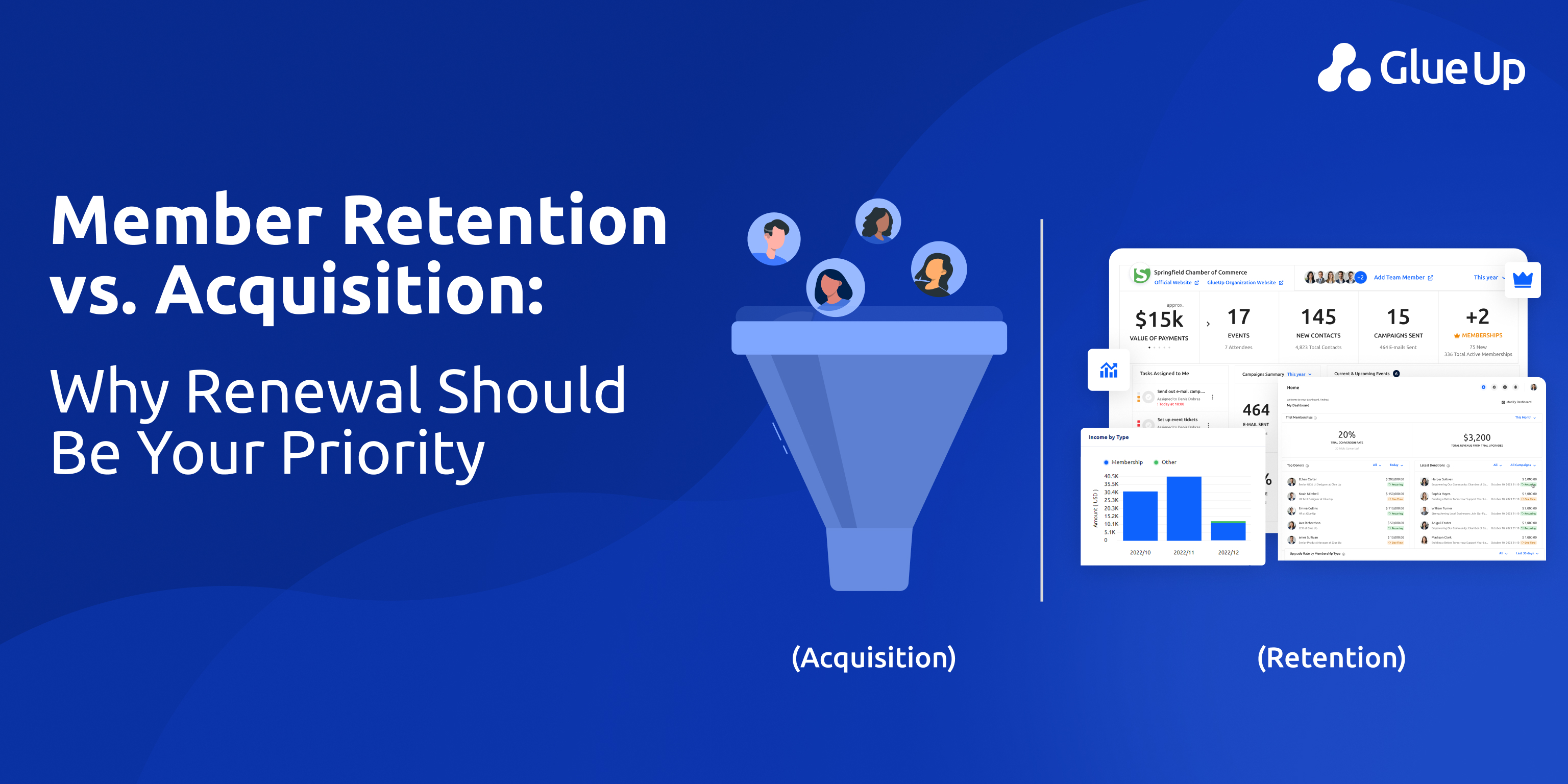
At this point, the conversation is not theoretical. Member retention vs acquisition is the metric that separates organizations that are prepared for the next few years from those that are holding onto a model that no longer matches reality.
The ones who shift early, who invest in the people already inside their ecosystem, who build real digital engagement, who design value that stays visible year-round, end up with steadier revenue, stronger member connections, and the kind of resilience everyone else tries to build later when it is much harder.
Key Takeaways
- Retention is the real measure of value. Renewal decisions reveal whether members actually experienced progress, connection, and relevance. Acquisition may fill the top of the funnel, but retention determines whether any of that growth becomes meaningful or sustainable.
- Acquisition is becoming too expensive to be your primary strategy. Digital advertising costs are rising, loyalty is declining, and attention spans are shrinking. The economics of member retention vs acquisition now overwhelmingly favor investing in long-term member relationships instead of constant top-of-funnel expansion.
- Engagement is the leading indicator of renewal. Renewal is not an annual moment. It forms gradually through consistent communication, personalized experiences, and community interactions that help members feel seen, supported, and connected.
- Retention creates compounding revenue, while acquisition creates linear growth. A small lift in retention can translate into dramatically higher lifetime value, stronger event participation, more referrals, and far more stable forecasting. Loyal members underpin the entire financial health of a membership organization.
- Technology makes a retention-first strategy achievable at scale. Modern platforms like Glue Up turn retention into a predictable, trackable, and operationalized system by unifying CRM, community, events, automation, engagement scoring, and renewal workflows into one ecosystem. Strategy becomes executable. Engagement becomes visible. Renewal becomes reliable.
Quick Reads
- How Smart Associations Monetize with Glue Up
- Chambers' Best Free Membership Management Software
- What Is All-In-One Association Software?
- Features of Best CRM for Membership Organisations
- Smart Checklist for Your Membership CRM
- Free Membership Management Software
- How AI Membership Boosts Retention ROI
- How to Pick the Best CRM for Associations
- Integrating AI into CRM for Membership Growth
- Event Sponsorship Dues Vs. Membership Dues
- Use These Smart Association Software Features
- Top Features of Association Software You Need
- Using AI Membership Software to Boost Retention
- Community Association Software Behind Retention
- Member Retention is the Lifeblood of Associations
The Hidden Cost of Chasing New Members
Acquisition feels rewarding. It produces instant gratification. A new signup lands. A number moves up. The board claps. There is your dopamine hit. Behavioral science actually proves this: humans prefer immediate, visible wins even if long-term outcomes are less favorable.
Retention does not provide that dopamine. It provides something better: predictability.
But predictability does not feel exciting, so organizations chase novelty. They push campaigns. They start promotions. They cut prices. They widen funnels. They do anything to make the top of the pyramid look bigger, even if the bottom is eroding.
Here is the part no one says out loud: Acquisition is not inherently bad. It is just massively overrated when your foundation is unstable.
When organizations over-index on acquisition without fixing retention systems, they accidentally create:
recycled churn cycles
rising costs per member
lower lifetime value
higher staff burnout
deteriorating event participation
declining sponsorship value
unpredictable renewal seasons
Every acquisition dollar becomes a bandage.
Most associations are already feeling this pain. Community Brands’ 2024 Benchmark Report found that 63 percent of membership organizations overspend on acquisition and underinvest in retention. They chase volume, but volume without loyalty does not fuel long-term growth. It simply delays the reckoning.
Why Renewal Reveals Everything About Your Value
There is something deeply honest about renewal behavior. It cuts through messaging, marketing, branding, or surface-level engagement. Renewal is the moment where your value proposition meets a member’s lived experience. It is a yes, a no, or a silent “not enough.”
Renewal answers questions that organizations rarely ask directly:
Did the member feel progress?
Did they build meaningful relationships?
Did they see a future they wanted to be part of?
Did they feel seen, recognized, and understood?
Did they experience relevance when it mattered most?
Behavioral research from MIT Sloan reveals that loyalty is almost always emotional before it is rational. Members stay because they feel connected. They feel growth. They feel anchored. They feel part of something that aligns with their identity or goals.
They leave for simple reasons. They stopped seeing value. They felt invisible. They did not feel connected to people or progress.
The data supports this over and over again. Higher Logic found that members active in an online community renew at 73 percent higher rates. Gartner notes that personalization increases renewal probability by as much as 40 percent. McKinsey’s “Growth Triple Play” shows organizations prioritizing retention grow 2.5 times faster.
Renewal is not a transaction. It is a reflection of the relationship. It is the emotional summary of the entire year.
The Psychological Reality Behind Member Retention vs Acquisition
This is where things get interesting, because the debate between member retention vs acquisition is not just an operational decision. It is a psychological one.
Humans renew for three interconnected reasons:
1. Emotional Bond
People renew when they feel emotionally connected to the community. Emotion beats logic every time.
2. Perceived Progress
People renew when they believe they are moving toward something, better career, better network, better outcomes.
3. Identity Alignment
People renew when membership becomes part of their personal or professional identity.
Acquisition does not produce those three things. Only sustained engagement does. Only community does. Only intentional relationship-building does.
This is why organizations with high retention have:
consistent communication
active communities
predictable events
personalized touchpoints
easy digital access
clear pathways for growth
fewer data silos
You cannot outsource belonging to marketing. You cannot automate identity. But you can build the infrastructure where those things flourish.
The Economics of Retention: The Compounding Advantage
If the emotional case does not convince the board, the financial case should.
Here is what the numbers say:
A 5 percent increase in retention can boost profits by 25 to 95 percent.
Loyal members spend 67 percent more over time.
Upsells and event registrations are higher in year two and year three.
Predictable renewal allows predictable forecasting.
CLV expands exponentially each additional year a member stays.
Organizations that prioritize retention gain:
more stable sponsorship revenue
higher event attendance
stronger advocacy pipelines
deeper volunteer engagement
more referrals
higher brand equity
This is why the subscription economy exploded. Not because companies got better at attracting new customers. But because they learned that LTV is the real revenue engine.
Associations are no different. Membership models thrive when loyalty thrives.
Engagement as the Leading Indicator of Renewal
Every renewal cycle begins long before dues notices go out. Renewal is a delayed reflection of everyday engagement.
The engagement you see on day 300 began forming on day 3. The decision to renew formed gradually through:
the first welcome email
the first event attended
the first meaningful peer connection
the first moment they felt heard
the first benefit that actually solved a problem
Engagement is the driver. Renewal is the outcome.
When organizations treat engagement as a year-round practice, renewal becomes easy. When engagement is sporadic or reactive, renewal becomes a gamble.
And in 2026, gambling is becoming too expensive.
The 2026 Turning Point: Why Retention Has Become Urgent
There is a reason associations, chambers, and membership organizations are rethinking everything right now.
1. Acquisition Costs Are Rising
Digital ad costs keep climbing. Competition is intense. Attention is shrinking.
2. Loyalty Is Declining
Younger members switch quickly and require emotional connection to stay.
3. Expectations Are Higher
Members compare your digital experience to banks, apps, and ecommerce platforms.
4. Value Must Be Continuous
If value appears only at events or annual moments, renewal drops.
5. Boards Want Predictability
Leaders want stability, not last-minute renewal heroics.
6. The Market Is Getting Smarter
Organizations are learning to optimize retention, not just acquisition. The competition is not the association next door. It is the one with the stronger engagement ecosystem.
2026 is the year renewal becomes the strategic priority because the cost of ignoring it is now impossible to absorb.
The New Growth Model: Retention First, Acquisition Second
When you break down successful membership organizations, they all share one pattern:
Retention strengthens engagement. Engagement drives advocacy. Advocacy brings referrals. Referrals create warm acquisition. Warm acquisition converts at higher rates. Higher retention compounds.
This is the real growth loop.
Retention powers the system. Acquisition simply feeds it.
Organizations that get this right stop chasing numbers and start building momentum.
What Technology Can Make Possible Now
This is the turning point in the conversation where strategy becomes real. Because retention is not just a philosophy. It is a system.
Technology is what transforms abstract retention theory into:
automated renewal cycles
personalized communication
predictive churn analysis
centralized engagement intelligence
active online communities
unified membership data
simplified workflows
consistent member experiences
This is where Glue Up comes into the picture as the practical expression of everything modern retention strategy requires.
Glue Up brings all the essential pieces together under one ecosystem:
Community
Events
Membership management
Invoicing and payments
Engagement scoring
Renewal automation
AI-driven insights
Mobile apps for staff and members
For organizations trying to shift from an acquisition-heavy model to a retention-powered model, this unified infrastructure is what makes it possible.
Retention becomes measurable. Engagement becomes visible. Renewal becomes predictable. Members feel progress. Staff feel relief. Boards feel confidence.
Technology does not replace the human side of membership. It amplifies it. It supports it. It clears the path so relationships can thrive.
What High Retention Organizations Understand That Others Do Not
There is a pattern across organizations that consistently renew above industry averages.
1. Retention begins at onboarding
The first ninety days shape the next nine months.
2. Engagement is a habit
They create a rhythm of connection.
3. Renewal starts 120 days before it is due
Not two weeks before.
4. Personalization is not optional
Members expect relevance.
5. Community is the most powerful retention engine
Members stay for people, not PDFs.
6. Value must be ongoing
Events alone cannot carry a membership model.
7. Technology is an ecosystem
Data must be connected to produce insight.
8. Loyalty is earned through consistency
Not just benefits.
9. Renewal is a shared responsibility
Not the sole job of one department.
10. CLV is the north star
Everything else becomes supporting evidence.
These organizations understand that retention is a culture.
Why Renewal Is Becoming the Most Important Metric in Membership
The more you analyze the landscape, the clearer the truth becomes:
Retention is the real evidence of value.
Retention is the emotional signature of your community.
Retention is the financial stabilizer.
Retention is the only metric that compounds.
Retention is the difference between surviving and scaling.
Acquisition helps you grow. Retention determines whether that growth means anything.
And as 2026 approaches, the organizations separating from the rest are the ones investing not in more outreach, but in deeper connection.
The Quiet Power of Renewal
There is always a quiet moment before the renewal spreadsheet appears. The room softens. People settle. Someone holds their breath.
That moment feels heavy because it tells you what marketing cannot. It tells you what branding cannot. It tells you what campaigns cannot. It tells you, with sharp precision, whether your members felt progress, connection, and belonging over the past year.
It tells you whether your organization is building something durable or rebuilding every year. It tells you whether your model is a cycle of chase or a cycle of compounding loyalty. It tells you whether your future is predictable or precarious.
The organizations rising in 2026 will be the ones that understand this. The ones that shift from asking, “How do we get more members?” To the far more powerful question: “How do we help more members stay?”
That shift changes everything. The numbers. The strategy. The culture. The stability. The identity. The future.
Because the truth is simple: Acquisition builds noise. Retention builds legacy.

Retention drives compounding revenue. Existing members purchase more, renew at higher rates, and convert more easily into event attendees, advocates, and volunteers. Research from Harvard Business Review shows that keeping a member can cost up to twenty times less than bringing in a new one. When analyzing member retention vs acquisition, retention consistently outperforms acquisition because it builds loyalty and increases lifetime value without the escalating costs of marketing and outreach.
When you prioritize retention, you build a stable foundation that amplifies every other part of your membership model. Retained members deepen community engagement, fill events, strengthen sponsorship value, and generate warm referrals that reduce acquisition costs. High retention organizations operate with predictable revenue instead of scrambling to replace churn each year. This is why experts see retention as the true growth strategy in the member retention vs acquisition debate.
Acquisition costs continue to rise due to digital advertising inflation, increased competition, and declining attention spans. Studies consistently show it costs five to twenty five times more to acquire a new member than to retain an existing one. Retention, on the other hand, primarily requires strong engagement, personalized communication, and operational consistency. This financial gap sits at the heart of the member retention vs acquisition discussion and explains why retention delivers a stronger return on investment.
The most effective retention strategies rely on a mix of behavioral and financial indicators. Track engagement scores, event participation, community activity, renewal lead time, payment patterns, churn rate, Net Promoter Score, and Customer Lifetime Value. These metrics reveal whether your members feel connected and supported. They also show whether your organization is improving in the areas that matter most in member retention vs acquisition strategies.
Healthy membership organizations flip the traditional funnel. Instead of chasing new members first, they create a strong retention engine through engagement, personalization, and community. Once that system is stable, acquisition becomes easier, cheaper, and more sustainable. Think of retention as the engine and acquisition as the fuel. One is not better than the other, but retention must come first in the member retention vs acquisition balance.
Members who feel emotionally connected to your organization naturally invite others into the experience. They become event ambassadors, community participants, and storytellers who validate your value in ways advertising never can. Loyalty transforms members into advocates, and advocacy dramatically increases acquisition efficiency. This is one reason why the strongest organizations see advocacy as a natural extension of retention in the member retention vs acquisition model.
Members leave when they stop seeing value, feel disconnected, or do not believe they are progressing toward their goals. They also leave when engagement is inconsistent or benefits feel generic. Preventing this requires continuous communication, year-round engagement, personalized experiences, and a clear value narrative. Organizations that focus on these areas dramatically improve outcomes in the member retention vs acquisition landscape.
Technology consolidates data, automates renewal touchpoints, simplifies communication, and makes engagement measurable. Modern AMS platforms help teams personalize outreach, identify early signs of churn, and connect members with relevant opportunities. Tools like Glue Up turn retention from guesswork into a measurable, repeatable system, which is essential when navigating the realities of member retention vs acquisition in 2026 and beyond.