You’ve probably heard the debate before, should we offer a free trial? For associations, chambers, and other member-based organizations, the question cuts deep. Offering membership trial plans sounds like a low-risk way to attract more members. But done wrong, it can lead to low-value sign-ups, churn, and revenue loss. Done right, it can redefine how your organization grows.
This article walks you through a data-backed, real-world framework for testing trial vs no-trial membership models using a simple A/B plan. It’s not marketing fluff, it’s behavioral economics, analytics, and operations science rolled into one. And yes, it’s written for organizations like yours that don’t have data scientists on staff but still want to make smart, evidence-based decisions.
Key Takeaways
Treat membership trial plans as experiments. The success of a trial doesn’t lie in offering free access, it lies in designing a measurable A/B test with clear hypotheses, metrics, and outcomes.
Shorter, structured trials outperform longer ones. Seven- to fourteen-day trials create urgency, accelerate engagement, and yield higher conversion rates than 30-day trials, especially when paired with strong onboarding.
Activation within 48 hours determines conversion. Trial members who complete one meaningful action are far more likely to become paying members.
Onboarding is the conversion engine. Formal onboarding during the trial increases both trial-to-paid conversion and 90-day retention. The goal is not sign-ups, but sustained engagement.
Glue Up makes experimentation operational. From configuring trial types to automating reminders and tracking conversion metrics, Glue Up enables associations to run data-driven membership trial plans efficiently and compliantly.
Quick Reads
Why the Membership Trial Question Matters
Every association wants growth without eroding value. Offering membership trial plans feels intuitive, you lower the barrier, people experience your value firsthand, and conversions follow. Right?
Not always. Studies show that free or time-limited trials only succeed when paired with structured onboarding, data-driven follow-ups, and a clear transition path to paid membership. Without those, you end up with inflated vanity metrics: a flood of temporary sign-ups that vanish after the trial ends.
In a 2024 INFORMS study, shorter 7-day trials actually converted better than longer 30-day ones, but only when combined with proactive check-ins and visible “quick wins.” Associations mirror this behavior: new members who attend an event or post in a community within the first week renew at far higher rates than those who don’t.
That’s why the trial vs no-trial debate is designing for behavioral activation.
What Research Reveals About Trial Effectiveness
Let’s ground this conversation in facts. Data from product-led growth studies, association benchmarks, and behavioral science converge on three truths:
Shorter is better. A 7- to 14-day trial creates urgency and clear decision points. Long trials blur value perception.
Activation beats awareness. Prospects who complete a single “meaningful action” (like attending an event or downloading a resource) during the trial are 4× more likely to convert.
Onboarding drives retention. In association benchmarks, formal onboarding raised first-year renewals from 62 % to 68 %.
Combine these and you get a clear takeaway: the success of your membership trial plans depends less on duration and more on member momentum.
People join communities to belong. A well-structured trial helps them feel connected fast.
Designing an A/B Plan for Your Membership Trial Plans
You can’t manage what you don’t measure. Here’s how to set up a controlled A/B experiment that tells you, definitively, whether offering a trial increases long-term value.
1. Define Your Hypothesis
Start with a measurable statement: Offering a 7-day full-access trial will increase trial-to-paid conversions by at least 20 % compared to no-trial, without decreasing 90-day retention.
That’s your north star. Every step of your experiment should trace back to it.
2. Establish Your Control and Variant
Arm A (Control – No Trial): Visitors see standard membership options and must pay to join.
Arm B (Variant – Trial): Visitors are offered a 7-day free trial with full or near-full access to benefits.
3. Segment Intelligently
Not everyone behaves the same way. Segment by:
Source (email campaign, event, organic search)
Persona (individual vs corporate membership)
Geography (to control for pricing or currency differences)
Intent (those who visited pricing pages vs casual browsers)
Segmentation reveals who benefits most from a trial.
4. Determine Sample Size and Duration
Use a sample-size calculator (like Evan Miller’s) to ensure statistical significance. Example: if your baseline conversion rate is 10 % and you expect a +2.5 percentage-point lift, you’ll need around 3,000–5,000 prospects per arm. Run the experiment for at least one full renewal cycle (roughly three months) to capture retention.
5. Map the Trial Experience
Here’s what a 7-day flow might look like:
| Day | Action | Goal |
|---|---|---|
| 0 | Welcome email + “Get Started” checklist | Drive immediate engagement |
| 2 | Profile completion reminder + community intro | Encourage participation |
| 4 | Mid-trial check-in (“What’s working?”) | Personalize support |
| 6 | Conversion nudge + social proof | Create urgency |
| 7 | Expiration + upgrade CTA | Trigger conversion |
The secret is the Day 4 check-in, it’s where curiosity turns into commitment. Many SaaS trials see conversion rates jump 15 % when a personalized message lands mid-cycle.
6. Track the Right Metrics
Trial-to-Paid Conversion: Paid members ÷ trial starts
90-Day Retention: Members still active after 90 days ÷ total new members
Lifetime Value (LTV): ARPM × margin ÷ churn
LTV/CAC Ratio: Aim for ≥ 3 : 1
Support Load: Tickets per 100 new members
Refund Rate: Guardrail for poor fit or mis-sold value
Designing for Behavioral Economics
A trial is a behavioral nudge. You’re lowering cognitive barriers (“I’ll just try it”) while building emotional investment (“I’ve already joined”).
Scarcity and Urgency
Shorter trials amplify action. A 7-day trial feels special and fleeting; a 30-day one feels forgettable. Research in Frontiers in Psychology (2025) found that time scarcity boosts conversion by up to 18 % because users assign higher perceived value to limited opportunities.
Sunk-Cost and Commitment Bias
Once someone fills out a profile, attends an event, or connects with peers, they’re mentally invested. Ending the trial now feels like losing something. That’s why onboarding steps must appear early.
Social Proof and FOMO
Your mid-trial email should include real testimonials: “I joined on a trial and realized within two days that I couldn’t do my job without this community.”
Social validation eases hesitation. People trust peers more than promotions.
Compliance: The Legal Side of Free Trials
Trials that auto-renew are under increasing scrutiny. The U.S. FTC’s 2024 Subscription Rule and California’s AB 390 mandate clear disclosures and easy cancellation. Associations must:
Obtain express consent before charging.
Send reminder notices before renewal.
Provide simple cancellation via the same channel used to sign up.
Ignoring these rules risks fines, and reputation damage.
If you use a platform like Glue Up, these compliance boxes are already checked. Renewal terms appear clearly, reminders are automated, and cancellation flows meet legal standards.
What Happens After the Trial Ends
Many organizations obsess over conversion day but forget day 8 onward. That’s where long-term value lives.
Post-trial communication should feel like a continuation:
“You’ve experienced our events. Now unlock full access to member-only certifications.”
“Continue your connections, renew today.”
In Glue Up, automation workflows can trigger these nudges automatically. You can even segment based on engagement: someone who joined one event gets a “keep the momentum” message; someone inactive receives a re-activation prompt.
Real-World Lessons from the Field
The 7-Day Sweet Spot
One European professional network tested 7-day vs 14-day trials. The shorter version converted 23 % more because users acted faster and stayed engaged. Extending access didn’t add value, it delayed decision-making.
The Onboarding Multiplier
A U.S. association launched membership trial plans with a “Member Concierge” call for every participant. Result: conversion jumped from 9 % to 21 %, and first-year retention rose by 8 points. Personal touch + automation = magic.
The No-Trial Comeback
Another chamber tested removing trials altogether. Surprisingly, paid conversions rose slightly because only high-intent members signed up. However, growth volume dropped. Their takeaway: no-trial works if brand awareness is high and perceived value is clear. Otherwise, trials remain essential to show proof.
Designing A/B Testing Membership Experiments That Actually Work
To make experimentation credible, borrow practices from tech product teams.
Pre-register your experiment – Document hypothesis, metrics, and success criteria before launch.
Run one test at a time – Don’t change pricing or homepage design during your trial test.
Track both conversion and retention – A trial that doubles conversions but halves retention is not a win.
Analyze heterogeneity – Does the trial help new graduates more than executives? Segment answers.
Run post-experiment debriefs – Share learnings with the board and staff; treat it as strategic insight.
When associations adopt this A/B testing membership mindset, they evolve from intuition-driven to evidence-driven organizations.
What the Data Says About Trial Membership Effectiveness
From industry benchmarks and Glue Up’s aggregated insights:
Organizations offering structured trials saw up to 30 % lift in new-member growth in the first quarter.
Automated follow-ups increased trial-to-paid conversion by 17 %.
Mid-trial engagement (emails, webinars, or chat prompts) improved retention by 20 %.
Shorter trial windows (≤ 14 days) performed 15–25 % better than longer ones.
These are signals. They show that when trial design, onboarding, and analytics align, membership growth becomes predictable.
Bringing It All Together with Glue Up
Running experiments manually is tough. Data gets scattered, and automation is inconsistent. Glue Up centralizes every part of the process.
Trial Configuration: Define membership types, durations, and benefit levels directly in the platform.
Automation: Set up trial start, mid-cycle check-in, and conversion nudges automatically.
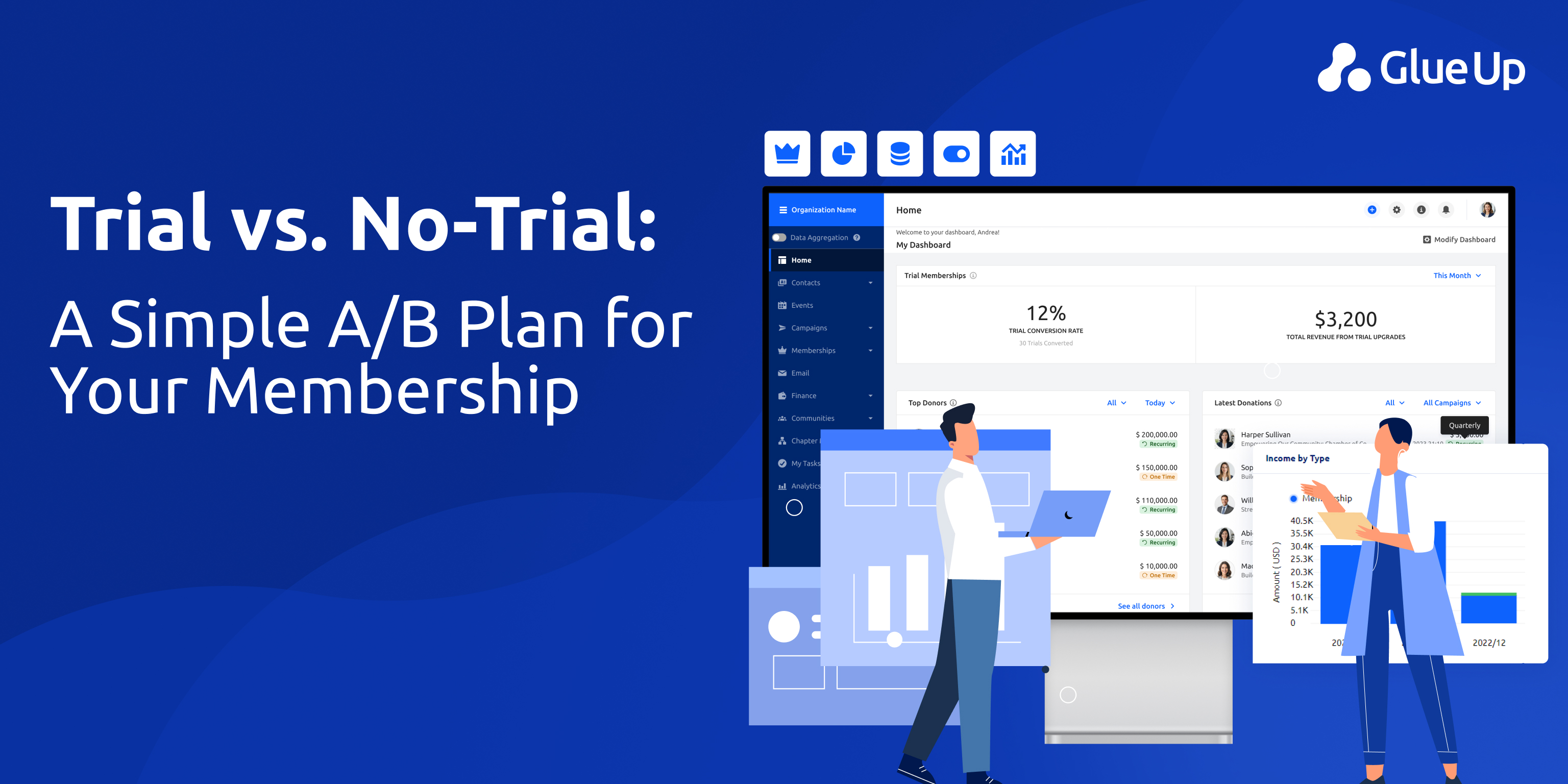
Analytics Dashboard: Track trial starts, conversions, retention, and LTV/CAC in real time.
Segmentation: Filter by source, persona, or engagement to identify which segments respond best.
Compliance: Built-in auto-renewal disclosures and cancellation policies keep you safe.
Essentially, Glue Up lets associations turn membership trial plans into a measurable growth engine.
The Strategic Case for Experimentation
Boards often ask, “Why test at all? Can’t we just decide?”
Because decisions without data are opinions. And in today’s environment, where member expectations mirror consumer behavior, testing is the only responsible path.
An association that experiments signals maturity. It tells your members, and your staff, that you’re curious, evidence-based, and willing to evolve. In the long run, that culture of experimentation compounds. Each test improves precision, member experience, and financial stability.
Your 30-Day Roadmap to Launch
Week 1: Define your hypothesis, metrics, and success threshold.
Week 2: Configure your A/B setup in Glue Up, finalize onboarding emails.
Week 3: Launch to 50 % of new traffic, monitor conversion funnel.
Week 4: Begin mid-trial check-ins, gather qualitative feedback.
At Day 30, analyze:
Trial-to-paid conversion lift
Retention after 90 days
Member satisfaction (quick NPS survey)
If the trial variant shows both growth and retention gains, roll it out fully. If not, tweak and re-test, shorter window, better onboarding, clearer upgrade CTA.
The Bigger Picture
Offering membership trial plans is a signal of confidence. It says, “We believe our value is so clear that you’ll want to stay once you’ve seen it.”
But confidence alone doesn’t pay the bills. Discipline does. Discipline in measurement, onboarding, communication, and follow-up.
Associations that blend empathy with analytics, showing value while tracking rigorously, become magnets for modern professionals who expect clarity, speed, and authenticity.
And that’s what Glue Up exists for: to help you measure what matters, automate what drains you, and focus on what actually grows membership, relationships.
In the end, the “trial vs no-trial” debate is about courage. The courage to test assumptions, measure outcomes, and evolve your membership model with evidence.
The best membership organizations don’t fear experimentation, they institutionalize it. And with Glue Up, you have the system to make experimentation part of your DNA.
So, design your trial. Run your test. Measure your lift. Then iterate again.
Because growth doesn’t happen by accident, it’s engineered.

Many organizations struggle with where to draw the line. Offering full access can speed up activation, but partial access may protect premium benefits. The right approach depends on which actions most strongly predict conversion in your data.
Some boards worry that trials cheapen membership. In practice, perception depends on how clearly the trial is positioned as time-limited, structured, and different from full membership, especially around voting rights, certifications, or leadership access.
Not every association can offer concierge calls or manual outreach. Many ask whether automation alone is enough, or if human touchpoints are required for trials to work at scale.
Organizations with chapters, regions, or multiple pricing tiers often need clarity on whether trials should apply globally, at the chapter level, or only to specific member types.
Associations often want to prevent repeat trials from the same individual or organization. Questions commonly come up around limiting eligibility, tracking prior trial usage, and preventing trial abuse within Glue Up.