The last five years have reshaped event strategy across the association sector. Your members experienced virtual fatigue in 2021, hybrid fragmentation in 2022, escalating cost pressures in 2023, volatile attendance patterns in 2024, and shifting value expectations throughout 2025. This shift is redefining how event planning is done across the association sector, from agenda design to engagement measurement.
These cycles created a landscape where legacy event formats no longer match how members evaluate relevance, participation, or ROI. As you move into 2026 event planning, the gap between how you do things and what members expect becomes the central driver of attendance, engagement, and sponsorship performance. What’s emerging is a move toward strategic event planning, where data, member behavior, and revenue outcomes shape every decision.
As a result, you cannot rely on intuition or historical programming patterns anymore. The 2026 event season demands a member-centric architecture built on data-driven decision making, behavioral signals, and a clear understanding of the future member priorities shaping participation. So, if you want your events to retain strategic influence across your membership model, you need to shift from episodic planning to continuous alignment.
In this guide, you will reframe your 2026 event strategy through member analytics, evolving expectations, and the operational discipline required to deliver an updated member-centric event strategy.
Or, you can skip the read and speak to an expert. Get a quick glimpse of our event management software and book a demo today.
Key Takeaways
- Member priorities in 2026 demand personalization, relevance, and measurable ROI.
- Data-driven decision making must replace legacy assumptions.
- Segmentation is central to building tailored event experiences.
- Community engagement is no longer optional for event-driven retention.
- Glue Up unifies event operations, analytics, community, and financial tools into one ecosystem.
Understanding the New Member Priorities for 2026
Before you restructure formats, agendas, or engagement pathways, you need clarity on what your audience values right now. Member behaviors from 2023 to 2025 revealed several structural changes. Below is a strategic overview to anchor where your planning must begin.
A Demand for Personalization and Relevance
Members want agendas aligned with their roles, industries, and learning objectives. Navigation through general sessions is no longer enough. They expect curated content journeys, segmented communications, and experiences that adapt to their behavior and interests.
Higher Standards for Time-to-Value
Members weigh events against the opportunity cost of attendance. They look for fast-moving sessions, tactical insights, and high-value interactions. Every part of the experience must justify the expense of participation.
Stronger Emphasis on Community and Peer Exchange
Events are no longer standalone. They act as catalysts for year-round engagement. Members want structured networking, peer-to-peer learning, and opportunities to remain connected after the event. That continuity depends on association event management platforms that connect events with community, communication, and member data.
Hybrid Expectations Are No Longer Optional
Even for fully in-person events, members expect digital layers. On-demand content, mobile accessibility, digital notes, and integrated communication channels have become baseline expectations.
Clear ROI for Both Attendees and Sponsors
Members want measurable outcomes from attendance. Sponsors expect data-backed visibility. Your event must demonstrate value through engagement reporting, post-event metrics, and transparent performance insights. This is where event analytics software becomes essential, turning engagement, visibility, and outcomes into trackable metrics.
Together, these priorities frame the foundation of a member-centric 2026 event strategy.
How to Realign Your 2026 Events Around Member Priorities
If you’re using Q4 to build a roadmap for event success in 2026 and beyond, here’s how to realign your event calendar, structure, and content around member priorities:
Start with Real Member Data Instead of Legacy Assumptions
Most associations still build programs based on what worked previously, not what members value now. Your decisions should be anchored in behavioral data, not anecdotal input. Review participation trends, session analytics, registration history, and community discussions to identify what resonates. This will shape content tracks, session lengths, networking formats, and post-event assets.
Segment Audiences and Personalize Journeys
Members do not experience your event in one uniform way. Segment your audience by role, seniority, region, and engagement patterns. Tailor communications, agenda recommendations, and content tracks to match their priorities. Segmentation creates a personalized journey that increases satisfaction and drives stronger renewal intent. This approach transforms traditional event planning into data-driven event management built around member behavior.
Redesign Formats with Flexibility and Accessibility
Your members expect agile event structures. Offer shorter sessions, micro-learning formats, clearly defined networking blocks, hybrid viewing options, and structured speed networking sessions. Flexibility respects attendee time and recognizes how diversified member preferences have become. Flexible formats are now a defining feature of modern association event management, not an experimental add-on.
Integrate Community Building into the Experience
Community is not a switch you turn on when the event begins. It must start before the first session and continue after the last session ends. Encourage pre-event introductions, in-app discussions, peer recommendations, and post-event community touchpoints. This builds momentum and extends the event’s lifespan beyond the conference hall.
Demonstrate ROI with Transparent Metrics
Members and sponsors want outcomes, not anecdotes. Leverage event analytics to report engagement performance, satisfaction scores, attendance heatmaps, and content demand. Clear metrics close the value loop for both audiences and strengthen the justification for future participation.
How Glue Up Helps Execute a Member-Centric 2026 Event Strategy
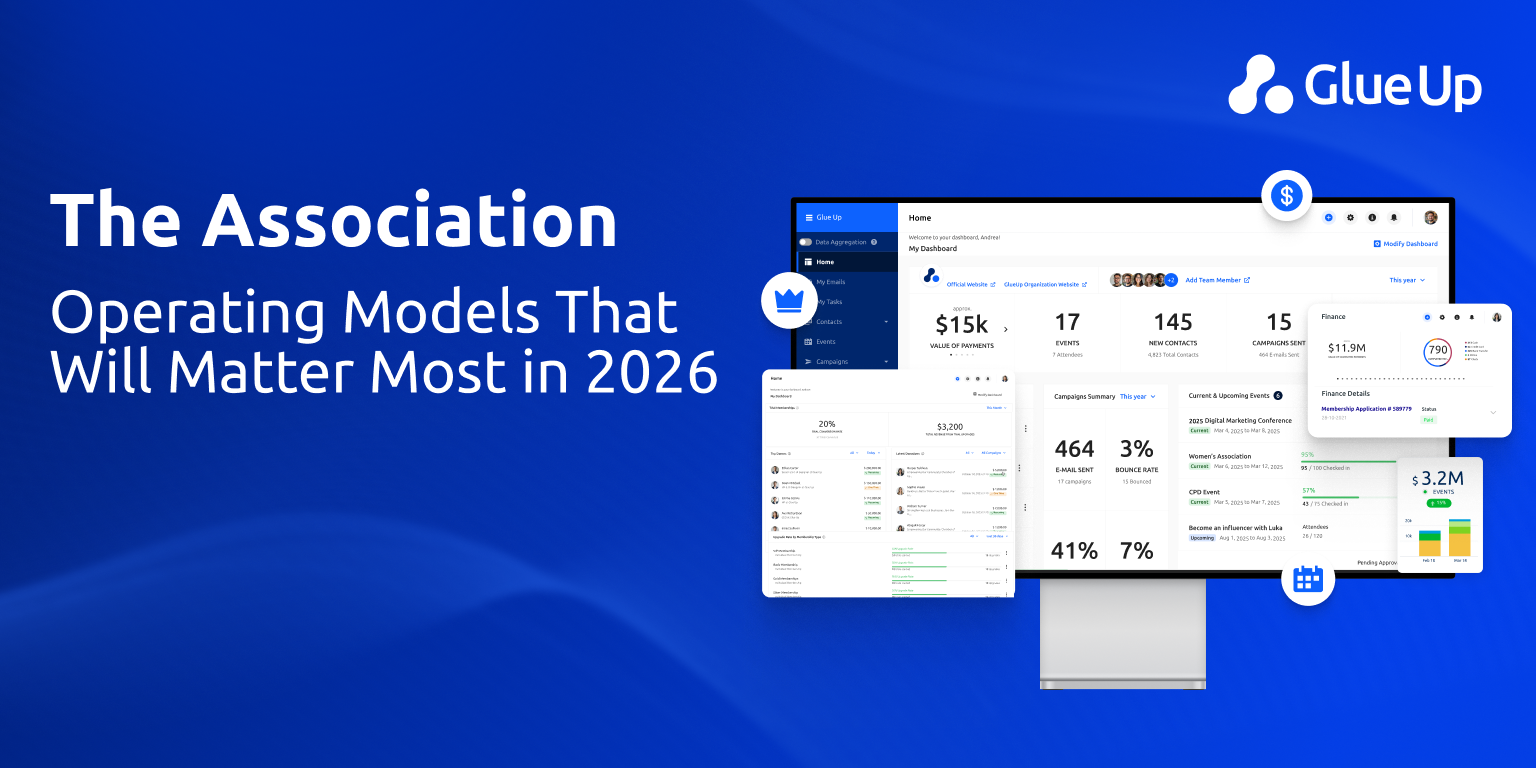
Glue Up brings the entire event ecosystem into one membership management platform. The value is not in overselling features but in reducing operational friction and strengthening the link between your events and member priorities. Here is how:
Centralized Event Data Across All Touchpoints
Registration activity, attendance data, engagement history, and session analytics live in one unified record. This supports segmentation, forecasting, and strategic reporting.
Integrated Event Management from Registration to Reporting
Create branded pages, manage speakers, schedule sessions, and handle both in-person and online logistics in a single place. You do not need multiple vendors to run one program.
Advanced Mobile Experience with My Glue
Give attendees mobile access to agendas, reminders, networking tools, community threads, and post-event recordings with the My Glue App. This ensures a continuous and accessible experience.
Community Integration Before, During, and After Events
Use the Community module (add-on) to activate discussions ahead of the meeting, sustain interactions between sessions, and keep the conversation alive long after the event concludes.
Finance and Sponsorship Tracking That Supports ROI Conversations
Track revenue, sponsorship performance, payments, invoices, and financial outcomes with a built-in finance module. Our platform also supports native integration with Sage Intacct, Xero, and QuickBooks. This strengthens your value narrative to finance teams and sponsors.
We built Glue Up to simplify execution, strengthen decision-making, and connect your events directly to member value.
Build Events Members Want to Return To
You are entering a planning cycle that requires sharper judgment, stronger data discipline, and a deeper understanding of your members’ priorities. When you align formats, content, and community pathways with what your audience values, your events stop feeling seasonal and start becoming essential.
If you want a platform that supports data-driven event planning, integrated community engagement, and a full lifecycle view of your members, see how Glue Up brings it all together.
Book a demo to see how your 2026 events can deliver the outcomes your members expect.
Quick Reads
- How to Build a Revenue Engine with Association Management Software
- Add-On Cart for Member Retention & Growth
- Simplify Multi-Currency Payment Posting for Community Chapters With Glue Up + Paygage
- AI Automation for Event Registration & Beyond
- Integrating AI into CRM for Membership Growth
- How to Build a Chapter Event Calendar
- What Is All-In-One Association Software?
- AI-Powered Member Check-In Software

Relevance, personalization, community engagement, time-efficient learning, and outcome-driven experiences.
Review engagement data, registration patterns, session analytics, and post-event feedback to identify gaps.
Yes. Even if they attend in person, they expect digital options for convenience and continuity.
Satisfaction scores, session attendance, registration conversion, revenue performance, and post-event engagement.
Through centralized event management, integrated community tools, unified analytics, and financial tracking.