Association management companies aren’t dealing with a sudden market shift. What they’re dealing with is sustained operational pressure that compounds quietly.
Client expectations haven’t changed dramatically on the surface. Associations still want reliable membership management, successful events, clean financials, and timely reporting. However, what has changed is tolerance. Tolerance for delayed answers. Tolerance for reconciled explanations. Tolerance for “we’ll need to follow up on that.”
At the same time, AMC portfolios are growing more complex. Chapter structures are expanding. Hybrid and virtual programs now sit alongside physical events. Non-dues revenue streams are becoming more varied. Reporting requests are becoming more granular and more frequent.
In 2026, the firms that continue to grow comfortably won’t be the ones offering more services. They’ll be the ones operating on models that absorb complexity without slowing execution, increasing risk, or burning out senior staff.
In this post, you’ll see how AMC operating models are shifting under scale pressure, why chapter-based clients surface delivery risk earlier than most firms expect, and how partnership-driven AMS like Glue Up is becoming part of modern association management.
Key Takeaways
Traditional AMC delivery models struggle as portfolios scale and complexity increases
Standardized internal execution improves reliability without reducing client flexibility
Chapter-based associations accelerate operating model breakdown when structure is weak
Platform partnerships are becoming part of how services are delivered, not just supported
Technology choices now define delivery capacity, reporting quality, and margin protection
Why Traditional AMC Operating Models Are Reaching Their Limits
For decades, AMC delivery models were built around adaptability. Each client had its own workflows, systems, timelines, and reporting formats. Teams relied heavily on experience and institutional knowledge to keep everything running smoothly.
That model still works under certain conditions. It works when portfolios are small. It works when reporting expectations are modest. And it works when staff tenure is long and turnover is minimal.
However, once those conditions change, strain appears.
How Strain Manifests in Daily Operations
The early signals are subtle:
Onboarding new associations takes longer than planned
Financial and engagement reports require follow-up explanations
Senior staff become bottlenecks because only they understand certain client setups
For example, consider a firm managing eight associations, each using different combinations of CRMs, event tools, payment processors, and reporting spreadsheets. When leadership asks for a cross-portfolio view of renewal performance or event profitability, staff can’t answer without manual consolidation. That work isn’t visible to clients, but it consumes hours every reporting cycle.
Over time, delivery quality doesn’t collapse. Instead, it slows. Coordination replaces execution. Exceptions become normal. And margin erosion begins quietly.
This isn’t a staffing issue. It’s an operating model issue that surfaces when scale outpaces structure.
The Shift Toward Standardized Delivery Across Client Portfolios
As these pressures increase, many AMCs are adjusting how they operate internally. Rather than customizing execution for every client, firms are standardizing how workflows behind the scenes.
This shift doesn’t reduce service quality. It reduces operational variance.
What Standardization Means in Practice
Standardization shows up in several concrete ways:
Membership records follow the same data structure across associations
Events are created using shared templates, timelines, and pricing logic
Financial data is categorized consistently, enabling comparable reporting
For example, when all client events use the same registration framework and payment logic, staff can support more associations without additional training. Errors decrease because processes are familiar. Reporting becomes repeatable instead of bespoke.
Moreover, when a staff member leaves, the knowledge doesn’t disappear with them. It stays embedded in systems and workflows.
Why Standardization Improves Resilience
Standardized delivery creates resilience in three ways:
Training Efficiency: New hires can become productive faster because they’re learning one system of execution, not eight.
Reporting Reliability: Leadership questions can be answered without data reconciliation projects.
Capacity Without Burnout: Teams can manage more clients without relying on heroics or overtime.
Firms that resist this shift often compensate through manual work. That approach doesn’t scale.
Why Chapter-Based Clients Force Operating Model Decisions
Chapter-based associations don’t simply add complexity. They multiply it.
Each chapter introduces its own events, payments, approvals, and local priorities. At the same time, national leadership expects centralized visibility, consistent reporting, and financial clarity.
Where Weak Operating Models Break
Without centralized systems, AMCs manage chapter activity through exception handling. Staff chase missing data. Reports arrive late. Leadership questions accuracy.
For example, if chapters run events independently using different tools, reconciling revenue across regions becomes a quarterly manual exercise. If payments are collected locally, finance teams spend weeks aligning records before reports can be finalized.
This work isn’t visible in proposals or invoices, but it drains margin and capacity.
How Strong Models Contain Complexity
Successful firms constrain variability without eliminating flexibility. Chapters retain autonomy over programming, but activity flows through shared systems that enforce structure.
This allows local execution while preserving central oversight. Data stays clean. Reporting stays timely. Staff focus on delivery instead of correction.
Chapter-based clients don’t tolerate weak operating models for long. They expose them quickly.
Partnership-Driven Operating Models Are Becoming the Norm
Another shift is becoming harder to ignore. AMCs can’t build and maintain every capability internally anymore.
As a result, operating models are evolving to include strategic platform partnerships as part of delivery.
Why This Shift Is Structural, Not Tactical
Maintaining separate CRMs, event platforms, finance tools, and reporting layers across clients increases overhead and risk. Every integration introduces failure points. Every workaround adds fragility.
By contrast, firms that choose shared platforms reduce fragmentation. Data flows consistently. Reporting is reliable. Staff spend time delivering outcomes rather than reconciling systems.
For example, when membership, events, payments, and communications live in one environment, onboarding new associations becomes a configuration exercise instead of a rebuild.
These partnerships aren’t resale agreements. They’re operating decisions that shape how services are delivered.
How Glue Up Supports Modern AMC Operating Models
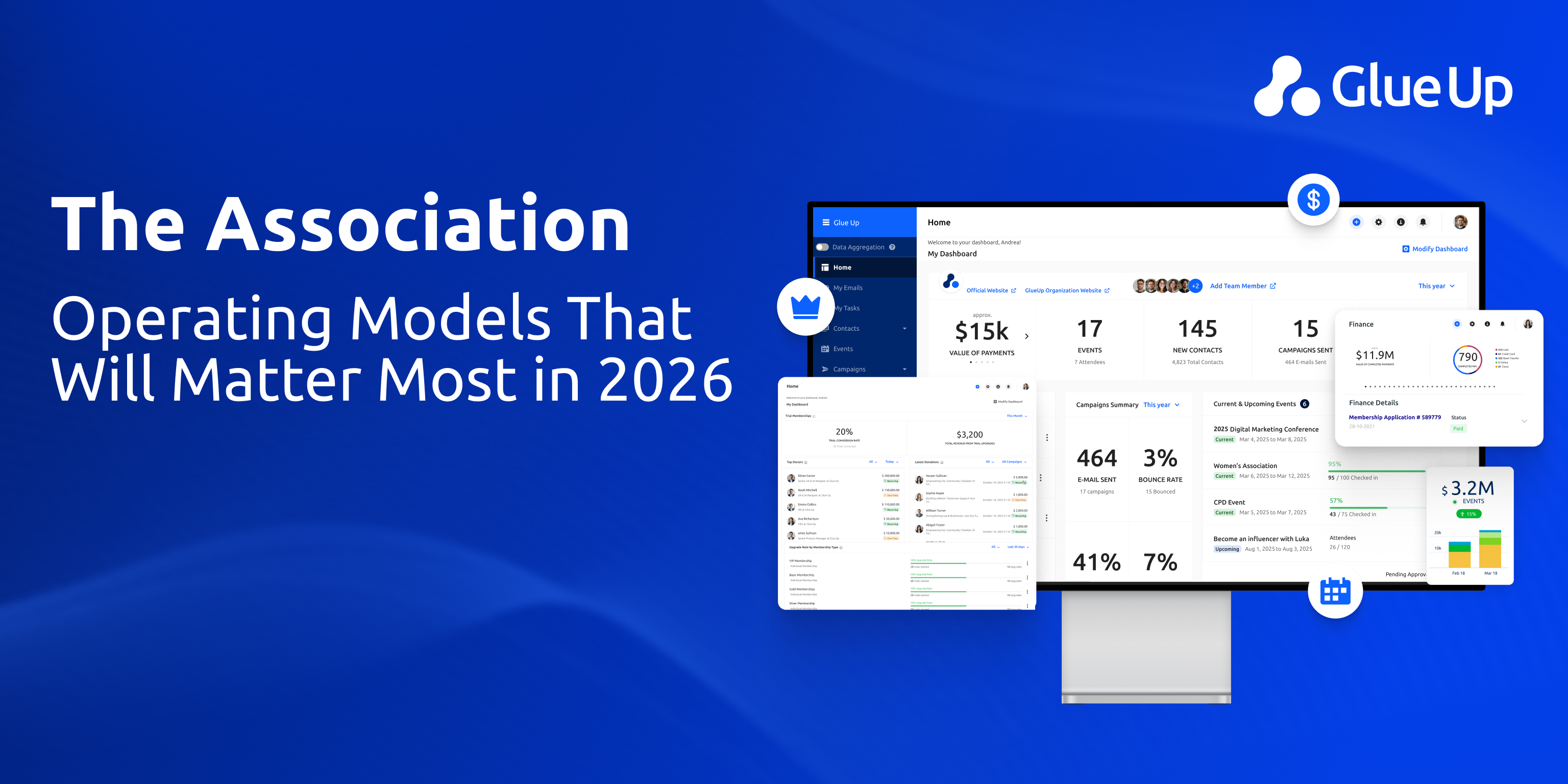
Earlier, we outlined where AMC operating models begin to strain, how standardization stabilizes delivery, why chapter-based clients accelerate breakdown, and why partnership-driven structures are becoming unavoidable. Glue Up maps directly to those realities by acting as shared operational infrastructure rather than an overlay of tools.
Each capability below connects to a specific pressure point already discussed.
Supporting The Shift Away from Client-Specific Execution
In the section on traditional operating models reaching their limits, we described how client-specific workflows increase dependency on memory, senior staff, and manual coordination.
Glue Up directly addresses that issue by giving AMCs one operating environment across all managed associations. While each association remains distinct in branding, permissions, and governance, the underlying execution model stays consistent.
For example, staff don’t relearn how membership records behave or how events are configured every time they switch clients. Membership status, renewal logic, event setup, invoicing, and reporting follow the same structure across portfolios. This is how flexibility is preserved without recreating execution from scratch.
As a result, the firm moves from people-driven execution to system-driven execution, which is exactly the shift described earlier.
Enabling Standardized Delivery Without Reducing Client Flexibility
When we discussed standardized delivery across portfolios, the focus wasn’t uniformity of services. It was consistency of execution.
Glue Up enables that distinction clearly. Membership models can vary by association, but the workflows that govern applications, approvals, renewals, and expirations remain predictable for staff.
For example, one client may use tiered memberships while another uses flat pricing. In both cases, renewal reminders, grace periods, payment handling, and status changes behave the same operationally. That consistency allows teams to manage more clients without increasing error rates or relying on individual expertise.
This is how standardization strengthens delivery rather than flattening it.
Containing Chapter Complexity Without Micromanagement
In the section on chapter-based associations, we noted that weak operating models break under chapter pressure because data fragments and visibility disappears.
Glue Up supports chapter-heavy portfolios by allowing local execution within centralized structure. Chapters can manage events, communications, and member interactions locally, while data flows automatically into central dashboards.
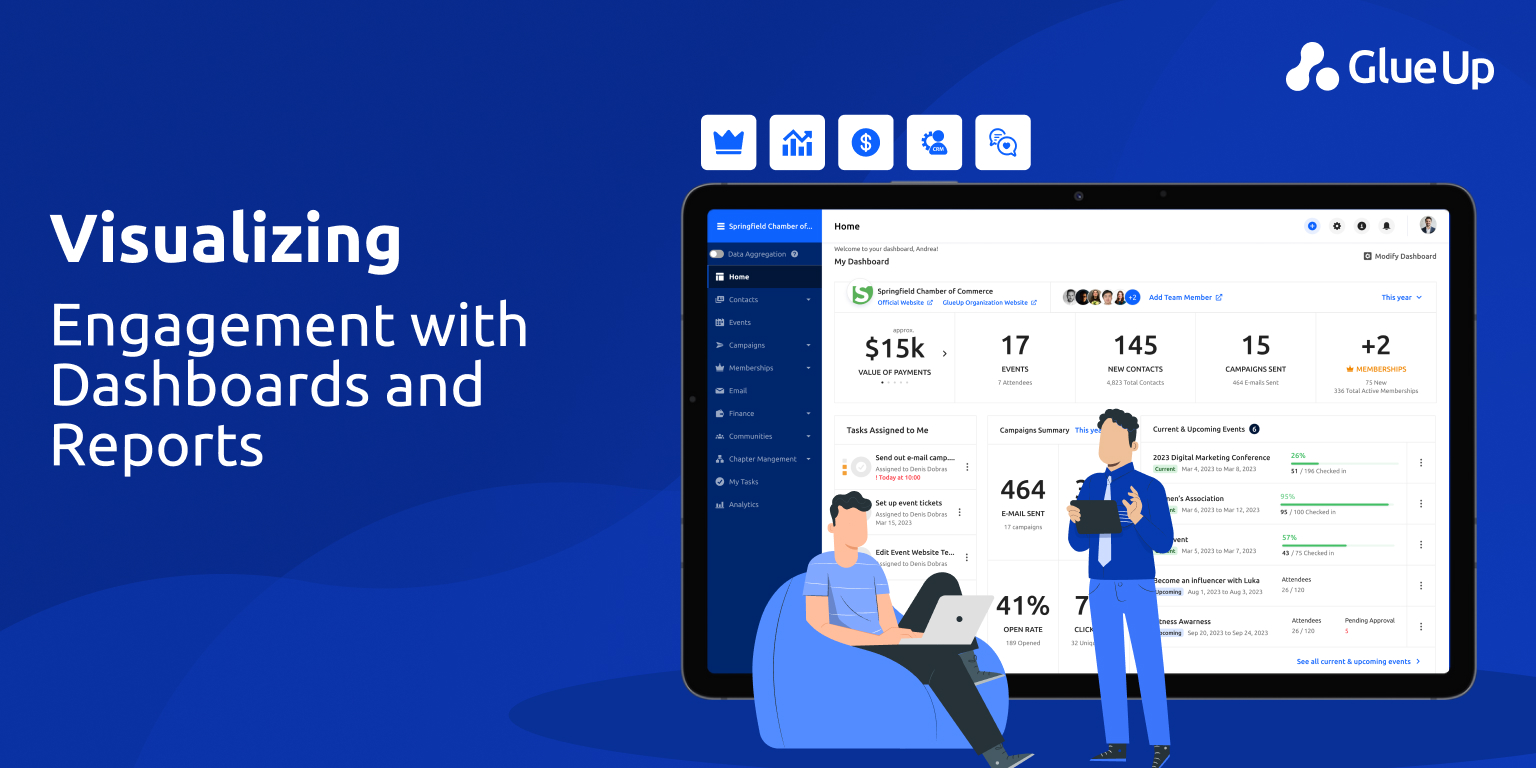
For example, chapter-level event registrations and payments roll-up into consolidated reporting without manual aggregation. National leadership and AMC teams can see participation, revenue, and engagement trends across regions in real time.
This directly addresses the earlier point that successful firms constrain variability rather than eliminate autonomy.
Reducing Financial Friction as Portfolios Scale
We also highlighted how finance becomes the quiet failure point when operating models don’t scale.
Glue Up integrates payments, invoicing, and financial records directly into membership and event workflows. Revenue is captured at the source and categorized consistently across clients.
For example, event registrations, sponsorship invoices, and membership dues don’t require reconciliation across disconnected systems. Payment status updates automatically. Revenue reports align with operational activity.
This supports the earlier argument that operating models fail when staff spend more time explaining numbers than delivering outcomes.
Reinforcing Partnership-Driven Operating Models
When we discussed partnership-driven operating models, the emphasis was on infrastructure rather than vendor stacking.
Glue Up fits into that model by functioning as a delivery backbone. AMCs don’t need to rebuild their service offering around the platform. Instead, the platform supports how firms already operate while removing fragmentation.
For example, onboarding a new association becomes configuration work inside an existing framework rather than a multi-system rebuild. That’s the difference between a tool and infrastructure, and it’s why platform choice becomes an operating decision, not a tactical one.
Protecting Against Knowledge Concentration and Turnover Risk
Finally, we noted earlier that many firms rely too heavily on experienced staff who understand client-specific setups.
By enforcing consistent workflows and centralized data, Glue Up reduces that dependency. Processes live in the system. Data behaves predictably. New staff can step into accounts without rebuilding context from memory or notes.
This directly supports operating resilience, especially during growth, turnover, or internal restructuring.
What Association Management Companies Should Act on in 2026
Operating models rarely fail suddenly. They erode through small inefficiencies that compound over time.
Firms should assess where delivery depends on individual memory instead of systems, where reporting requires explanation instead of visibility, and where growth adds friction rather than leverage.
For example, if onboarding a new association requires creating entirely new workflows, or if quarterly reports consistently trigger clarification meetings, the operating model is already under strain.
The firms that act early standardize execution, choose shared infrastructure, and define partnerships deliberately. Those decisions compound into stability, margin protection, and client confidence.
Quick Reads

No. They standardize internal execution, not client strategy or programming.
Because chapters multiply variance. Without shared systems, coordination and reporting degrade quickly.
At scale, yes. Platforms reduce fragmentation and increase delivery capacity per staff member.
Unified systems reduce manual work, rework, and error correction, which directly protects margin.
When growth increases workload without increasing clarity, speed, or reliability.