Association software acquisitions rarely feel disruptive at first. The product still works. The login still exists. Support still answers tickets.
What changes is not the interface. It is the operating reality behind it.
Teams begin to notice slower answers, less certainty around roadmaps, and more manual work filling gaps between systems. Over time, these small frictions compound into operational drag that affects members, reporting confidence, and budget predictability.
This article is not about one vendor. It is about what typically happens when association software becomes part of a larger portfolio, and how those changes surface inside real organizations.
Key Takeaways
Not all “all-in-one” platforms are built as one system
Acquisition-driven platforms often introduce operational uncertainty over time
Fragmented data models slow reporting and delay intervention
Ownership and architecture influence long-term cost and service stability
Platform structure matters more than feature breadth
Why Platform Acquisitions Change Operational Reality
In acquisition terms, software companies are often classified as platforms or add-ons.
A platform investment typically becomes the core system that future growth builds around. An add-on investment is folded into an existing structure to expand reach, cross-sell, or standardize operations.
This distinction matters because it shapes decision-making authority, product priorities, and accountability.
How This Shows Up Inside Associations
When a platform becomes part of a broader portfolio, associations often experience:
Longer decision cycles for product changes
Less clarity around roadmap ownership
Support processes that evolve without warning
For example, a membership team requests a change to event registration logic that affects conversion. Instead of a committed timeline, the response becomes directional. The issue stays unresolved, and staff compensate manually.
The product still functions, but execution slows. This is not a failure event. It is structural drift.
What Changes After Ownership Shifts
Most organizations expect dramatic changes like forced migrations or sudden price increases.
In practice, the more common impact is gradual erosion of clarity.
Roadmaps Become Harder to Commit To
Product conversations shift from commitments to positioning. Teams hear phrases like “under review” or “future consideration,” without concrete delivery paths.
Operationally, this pushes staff toward workarounds that increase administrative load.
Support Becomes Less Predictable
Even when service quality remains high, changing escalation paths and ownership boundaries increase resolution time.
For example, a billing error that once took hours now takes days, not because teams are unhelpful, but because responsibility is spread across systems and groups.
Budgets Lose Predictability
Costs increase quietly through new packaging, add-ons, or services that were previously bundled. The financial impact is not just higher spend. It is reduced planning confidence.
The Hidden Risk of Fragmented Data Models
Associations depend on timely, accurate reporting to manage renewals, engagement, and governance. When platforms are assembled from multiple products, data integration replaces data unity.
Why Reporting Slows Before Anything Else
Engagement, payments, and events may live in different systems. Even when integrated, updates lag.
For example, when leadership asks which members are at renewal risk and what behaviors predict churn, staff must export, reconcile, and interpret data manually.
By the time insights are delivered, they are already outdated. This is not a reporting issue. It is an operating risk.
What To Evaluate When Considering Alternatives
Feature comparisons rarely surface these risks. Instead, evaluate structure in these ways.
Ownership And Direction
Who controls the roadmap? How close are decision-makers to customer feedback? Shorter feedback loops reduce operational uncertainty.
Data Architecture
Is there one member record across memberships, events, payments, and communications, or multiple synchronized records?
Unity enables action. Integration creates delay.
Decision Velocity
When your team needs an answer, can the platform deliver clarity quickly, or does it require escalation through layers?
These questions determine long-term stability more than feature parity.
Glue Up as Operational Infrastructure
If you are evaluating alternatives, the goal is not to avoid change. It is to reduce uncertainty.
Glue Up is built as a single platform for membership organizations, with memberships, events, payments, communications, and reporting operating on one data model.
This structure allows teams to act earlier, report faster, and reduce manual reconciliation. The platform supports growth without introducing fragmentation.
The product fits because the structure fits.
How Glue Up Functions as Operating Infrastructure, Not an Overlay
Earlier, we outlined how acquisitions introduce operational uncertainty, how fragmented data models slow execution, and why reporting degrades before teams realize risk has accumulated. Glue Up addresses those pressures not by adding tools, but by changing how execution is structured.
The distinction matters. Glue Up is designed as infrastructure, meaning operational logic lives inside the platform rather than being stitched together across systems. The subsections below connect directly to the failure points discussed earlier.
One Member Record Across the Entire Lifecycle
In the section on fragmented data models, we described how associations lose visibility when engagement, payments, and events live in separate systems. Glue Up avoids that fragmentation by maintaining one member record across the full lifecycle.
Membership status, event participation, payment history, communications, and engagement activity all reference the same underlying profile. There is no syncing layer deciding which data is “current.” Updates propagate immediately because they originate from the same source.
For example, when a member registers for an event, makes a payment, or lapses at renewal, that change is reflected instantly in engagement and financial views. Staff do not reconcile records, and leadership does not wait for consolidated reports.
This directly resolves the reporting delays described earlier, where insights arrive too late to act on.
Reporting That Reflects Reality, Not Reconciliation
Earlier, we described how reporting becomes the first casualty of platform fragmentation. Leaders ask questions that require exports, explanations, and follow-up meetings.
Glue Up changes that dynamic by tying reporting directly to live operational data.
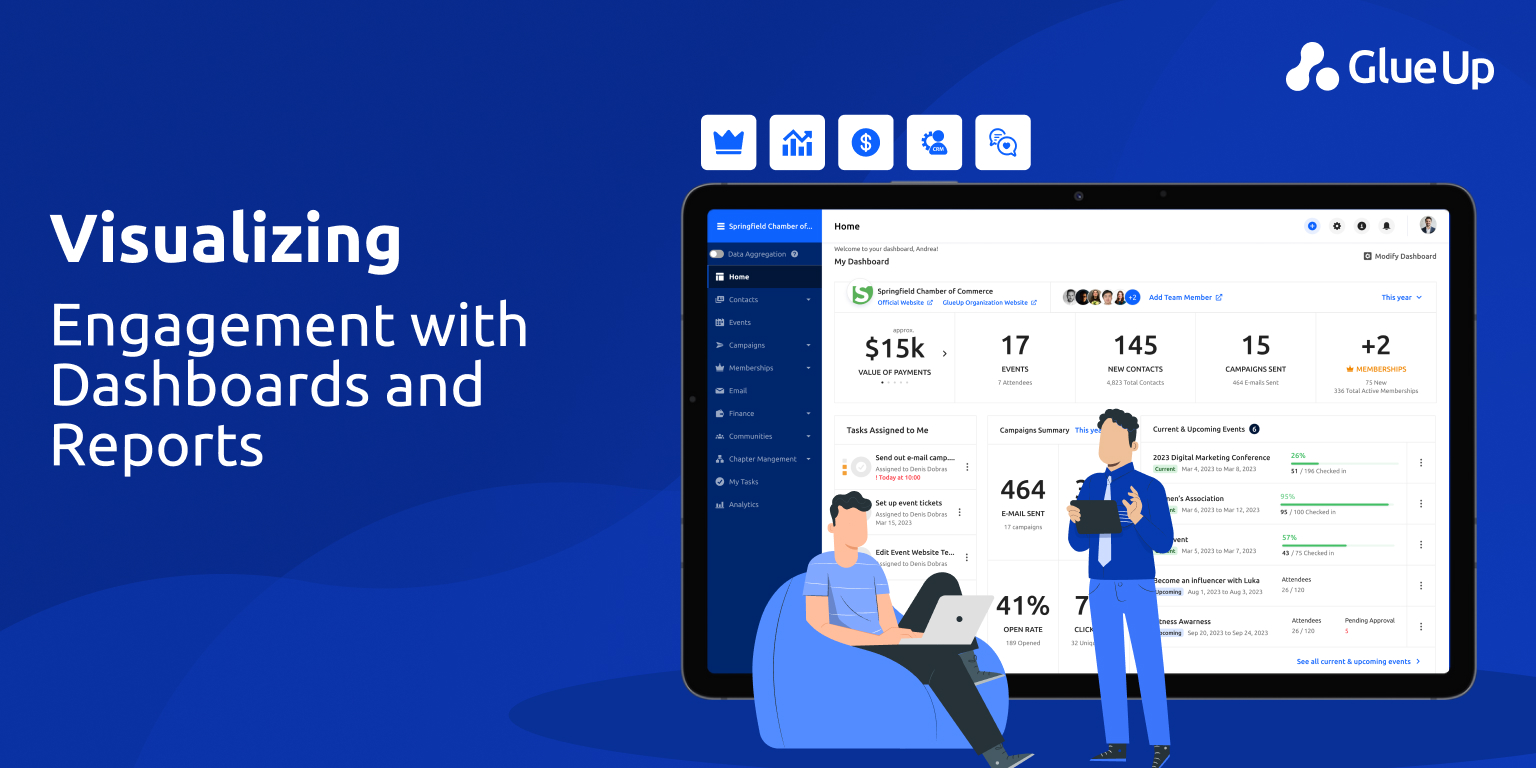
Because memberships, events, and payments operate on one model, reports reflect current reality without manual consolidation. Engagement trends, renewal performance, and revenue breakdowns update as activity happens.
For example, if leadership wants to understand which behaviors correlate with renewals, staff can surface that information without building spreadsheets or reconciling systems.
Reporting becomes a decision tool rather than a defensive exercise.
Infrastructure That Preserves Decision Velocity
In acquisition scenarios, we noted that roadmaps slow and answers become less certain. Operationally, this forces teams to wait or work around limitations.
Glue Up’s model emphasizes decision velocity by minimizing layers between user needs and platform behavior.
Because the system is built as one environment, changes do not require coordination across disconnected products. Configuration replaces customization. Adjustments happen within a defined framework.
For example, onboarding a new association or program involves configuring membership structures, events, and payments inside an existing architecture rather than rebuilding workflows from scratch.
This preserves momentum as organizations evolve, instead of introducing drag with every change.
Stability That Compounds Over Time
One of the quiet risks discussed earlier is how uncertainty compounds. Small delays turn into habitual workarounds. Manual steps become normal. Staff burnout increases without a clear failure event.
Glue Up counters that pattern by making stability cumulative.
As teams use the platform, processes become more consistent, data stays cleaner, and reporting improves. Knowledge accumulates in the system rather than in individuals.
This supports long-term operating confidence, especially for organizations managing growth, governance complexity, or multi-program portfolios.
Why Structure Matters More Than Feature Breadth
Throughout the article, the core argument has been structural, not tactical.
Glue Up fits into this conversation not because it replaces tools, but because it replaces fragmentation. The platform’s value comes from how execution is organized, not how many features exist.
That distinction is what separates infrastructure from add-ons, and it is why platform choice becomes an operating decision rather than a procurement task.
Reassess Structure Before It Becomes Risk
Acquisitions do not break platforms overnight. They introduce uncertainty that compounds quietly.
Reassess whether your current system gives you clarity or forces explanation. Whether it supports early intervention or reactive reporting. Whether growth adds leverage or friction.
Your next decision should focus on architecture, accountability, and operating coherence.
That is how you protect member experience, data integrity, and budget confidence over time.
Quick Reads