AI adoption is no longer a question of “if” but “how efficiently.” Associations worldwide are actively investing in AI features in AMS platforms to automate workflows, forecast renewals, and personalize member experiences. Yet one question continues to surface in board meetings and finance reviews: what’s the real return on investment?
This article breaks down the true cost and measurable ROI of AI in AMS environments. You’ll see how to calculate value using realistic benchmarks, identify which AI features deliver the highest returns, and understand how solutions like Glue Up's association management software convert automation into tangible financial performance.
Understanding the Real Cost of AI in AMS Platforms
Implementing AI in association systems involves far more than licensing fees. True cost includes infrastructure, integration, training, and governance. Associations that fail to anticipate these variables risk underestimating total investment and misreporting ROI.
Core Cost Components
- Licensing and Subscription – Most AMS providers package AI tools as modular add-ons. As a result, pricing scales by feature—chatbots, predictive analytics, or NLP-based personalization. However, platforms like Glue Up have automation integrated across all core modules.
- Integration and Data Preparation – AI relies on structured, high-quality data. Associations often spend a significant portion of their AI budget on cleaning legacy data, connecting APIs, and ensuring compliance.
- Cloud and Storage Costs – Machine learning features process large datasets. Cloud hosting and compute usage can fluctuate, adding operational expenses that need forecasting.
- Change Management and Training – Teams need to learn how to use, trust, and interpret AI outputs. Training and onboarding represent real cost drivers that must be included in TCO calculations.
- Governance and Maintenance – As AI matures, ongoing monitoring for accuracy, bias, and data protection is essential. Associations must budget for governance audits or compliance reviews.
Industry analyses confirm that upfront costs vary widely depending on scope, but most organizations recoup their investment through productivity gains within 12–24 months once systems stabilize.
Measuring ROI: What Associations Should Actually Track Using Glue Up AMS
AI ROI isn’t purely financial; it’s operational. The strongest returns come from measurable efficiency, improved forecasting accuracy, and retention outcomes. Associations should track both quantitative and qualitative metrics across three categories.
Glue Up’s AI-powered membership management software provides associations with a complete ecosystem to manage data, automate decision-making, and improve forecasting accuracy, all from a single connected platform. Every feature, from finance to community, works together to reduce manual work, increase member retention, and make financial performance measurable in real-time.
Efficiency and Cost Savings
AI reduces manual workload by automating membership renewals, financial reporting, and communication campaigns. Time saved translates into reduced administrative costs. For example, replacing manual data entry with AI-based automation can improve staff productivity by over 30%, leading to measurable budget reallocation.
Revenue Impact and Churn Reduction
Data-driven analytics help identify renewal trends and member behavior patterns early, enabling targeted retention campaigns. Glue Up’s membership dashboards track renewal health, churned memberships, and recently renewed members, giving associations the insight to reduce attrition and improve member loyalty. Over time, stronger retention and engagement translate into higher renewal rates, event participation, and sustainable non-dues revenue growth.
Financial Visibility
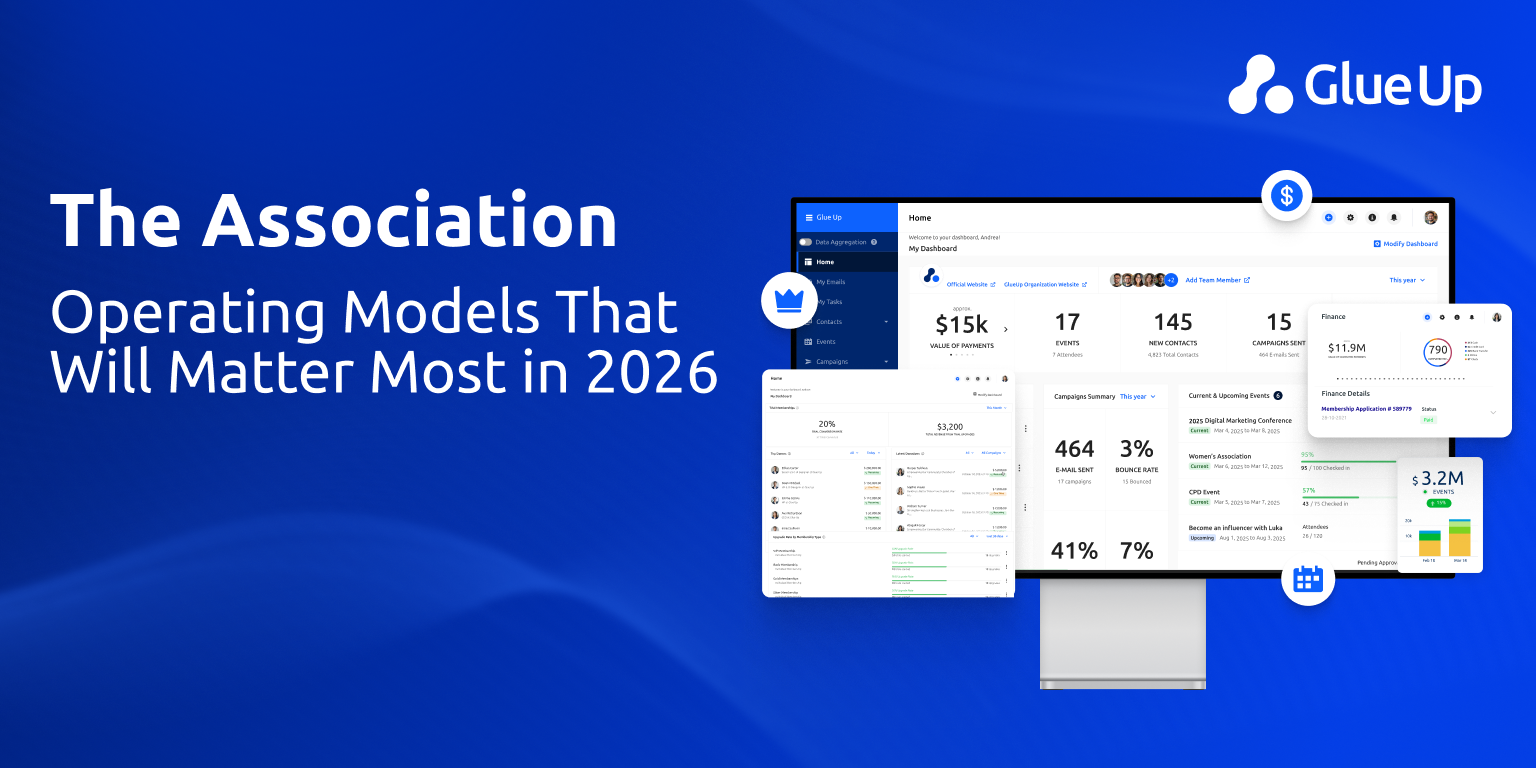
Finance teams gain the most value when financial data is centralized and visible. Glue Up’s Finance Module provides real-time dashboards to track revenue, expenses, and payments across events and memberships. By consolidating this data into one view, teams can easily identify trends, monitor budget alignment, and make better strategic decisions backed by transparent financial reporting.
Industry reports suggest most organizations achieve 150–200% ROI within the first two years when AI implementation aligns with measurable KPIs.
Cost Efficiency and Zero Integration Overhead
Unlike third-party AI tools, Glue Up’s AI capabilities are built into its AMS platform. That means zero additional infrastructure, storage, or integration expenses. Associations can implement AI-driven insights immediately without consultants or external data warehouses. The result is a faster payback period and a more efficient return on software investment.
Benchmarks for Evaluating AI ROI in AMS Platforms
Every association is different in terms of size, processes, and performance benchmarks. However, you can evaluate AI ROI in your AMS platform by considering the factors below:
Time to Payback
Typical AI projects in association systems reach break-even within 12–18 months, depending on adoption speed and the depth of process automation. Early automation of renewals, billing, and member segmentation accelerates ROI.
Productivity Multipliers
The average AMS team handles multiple systems—CRM, finance, and events. AI unifies these processes. Each AI-automated workflow typically yields a 25–40% efficiency improvement. This multiplier compounds across membership, finance, and communication units.
Member Retention Correlation
Associations with AI-based personalization or predictive analytics often see 5–10% higher renewal rates. This correlation arises from earlier intervention in at-risk segments and improved member experience consistency.
Decision-Making Speed
When finance dashboards integrate AI-driven forecasting, decision turnaround times drop significantly. Real-time variance detection allows executives to act on risk or opportunity before the next reporting cycle.
Benchmarks from enterprise AI adoption studies reinforce these metrics: ROI accelerates as data maturity improves and AI embeds deeper into core workflows.
Making the Case to Your Board Today
Boards want proof, not potential. The best way to justify AI spend is by linking it to measurable business outcomes. Present it as a capital efficiency strategy rather than a technology upgrade.
- Quantify Labor Savings: Convert staff time saved into cost equivalents.
- Project Retention Impact: Model renewal improvements from predictive analytics.
- Demonstrate Decision ROI: Show how faster insights improve budgeting and cash flow.
- Include Total Cost of Ownership: Cover licenses, integration, training, and governance to avoid underreporting.
Once you connect those metrics, AI’s financial logic becomes clear; it’s not a cost center but a growth multiplier.
Book a demo with Glue Up to see how our all-in-one association software, powered by AI, simplifies forecasting, automates operations, and turns your AMS investment into measurable financial growth.
Frequently Asked Questions
What’s the average cost of AI features in an AMS platform?
Most AMS platforms price AI modules as add-ons, scaling with features such as chatbots, analytics, or personalization. Costs vary by vendor and integration complexity.
How long does it take to see ROI from AI in associations?
Associations typically see measurable ROI within 12–18 months once automation and forecasting tools are fully adopted.
How can I calculate ROI for my association?
Track time saved, cost avoided, and revenue gained from automation and improved retention. Compare that to total implementation and operational costs.
Quick Reads
- How to Build a Revenue Engine with Association Management Software
- Add-On Cart for Member Retention & Growth
- Simplify Multi-Currency Payment Posting for Community Chapters With Glue Up + Paygage
- AI Automation for Event Registration & Beyond
- Integrating AI into CRM for Membership Growth
- How to Build a Chapter Event Calendar
- What Is All-In-One Association Software?
- AI-Powered Member Check-In Software