By the time most membership teams sit down to plan for 2026, the problem is no longer ambition. It is capacity. Expectations have gone up. Communications have multiplied. Events have become more frequent and more complex. Boards want clearer reporting. Members expect timely, thoughtful outreach. And teams are being asked to deliver all of this with the same staff size they had years ago. That is why AI Copilot Use Cases have moved from a curiosity to a practical operating conversation for associations entering the next fiscal year.
This article is about how AI Copilot Use Cases are quietly reshaping daily work inside membership organizations by removing friction from the most time-consuming tasks. Drafting emails. Writing event pages. Creating surveys. Polishing content before it goes out the door. Glue Up AI Copilot sits inside those moments and helps teams work smarter without changing how decisions are made or who remains accountable.
As we move into 2026, the most effective AI for membership teams is assistive. It supports work instead of attempting to replace judgment. That distinction is exactly why Glue Up AI Copilot fits how associations actually operate.
Key Takeaways
For membership teams entering the next fiscal year, the challenge is no longer ambition but capacity. AI Copilot use cases have shifted from curiosity to practical infrastructure, helping teams keep up with rising expectations without adding headcount.
The strongest impact of AI for membership teams comes from assistive work like drafting, editing, and structuring content. Glue Up AI Copilot helps teams move faster once priorities are clear, without making decisions or predicting outcomes.
Emails, event pages, surveys, and campaign copy consume more time than most teams realize. By reducing manual content creation time, AI Copilot use cases relieve daily friction, reduce burnout, and create space for relationship building and strategy.
Unlike generic AI tools, Glue Up AI Copilot works inside an AI powered CRM for associations, using historical information teams already manage. It keeps humans in control, preserves accountability, and supports staff instead of bypassing them.
AI Copilot use cases define smarter work by helping teams write faster, edit cleaner, launch sooner, and follow up consistently. The real productivity advantage comes from better preparation, allowing plans to turn into execution without friction.
Quick Reads
AI Copilot Use Cases Matter More Than AI Promises In 2026
Every technology wave comes with its own mythology. Artificial intelligence is no different. The loudest stories often focus on forecasting behavior, automating decisions, or replacing human roles. That framing misses where AI is already delivering real value, especially for knowledge workers.
Research on generative AI shows its strongest productivity gains appear in drafting, summarizing, editing, and structuring content. A widely cited study published through arXiv found that AI support improved output quality and speed when humans remained in control of final decisions. The gains were about preparation and execution.
That aligns directly with how AI Copilot Use Cases function inside Glue Up.
Membership teams need help getting work done faster once priorities are already clear. They need relief from repetitive writing tasks that drain time and attention. They need consistency without rewriting the same message ten different ways.
This is where AI Copilot Use Cases in 2026 shift from theoretical value to operational necessity.
Where The Real Work Piles Up for Membership Teams
If you ask a membership professional where time disappears, the answer is rarely strategic planning. It is writing. Writing emails. Writing event descriptions. Writing reminders. Writing follow ups. Writing surveys. Editing drafts to sound professional. Rewriting drafts to sound human.
None of this work is glamorous. All of it is essential.
Small teams feel this pressure most. When there are only two or three people managing communications, events, renewals, and engagement, every new campaign creates a ripple of writing tasks that must be completed before anything else can move forward. The administrative burden compounds quickly.
This is the context where AI Copilot Use Cases begin to matter emotionally. Reducing manual content creation time reduces burnout. It creates breathing room. It allows professionals to focus on relationships rather than drafts.
Glue Up AI Copilot was designed for exactly this reality.
Practical AI Copilot Use Cases That Change the Workday
AI Copilot Use Cases for Member Communications and Invitations
One of the most immediate and relatable AI Copilot Use Cases is drafting member communications. Whether it is an event invitation, a renewal reminder, or a general announcement, the blank page slows teams down.
Glue Up AI Copilot helps generate first drafts of member emails using context that already exists in the system. Teams remain fully in control. They review, adjust tone, and send when ready. The value is removal of friction.
For membership teams facing writer’s block or time pressure, this use case alone can save hours each week. It also supports consistency in brand voice across communications, which is increasingly important as associations scale activity without expanding staff.
AI Copilot Use Cases for Automated Event Page Drafting
Event setup has quietly become one of the most content heavy responsibilities in membership organizations. Every event requires a description, agenda framing, value statements, and logistical explanations. Writing this repeatedly slows launches and increases stress.
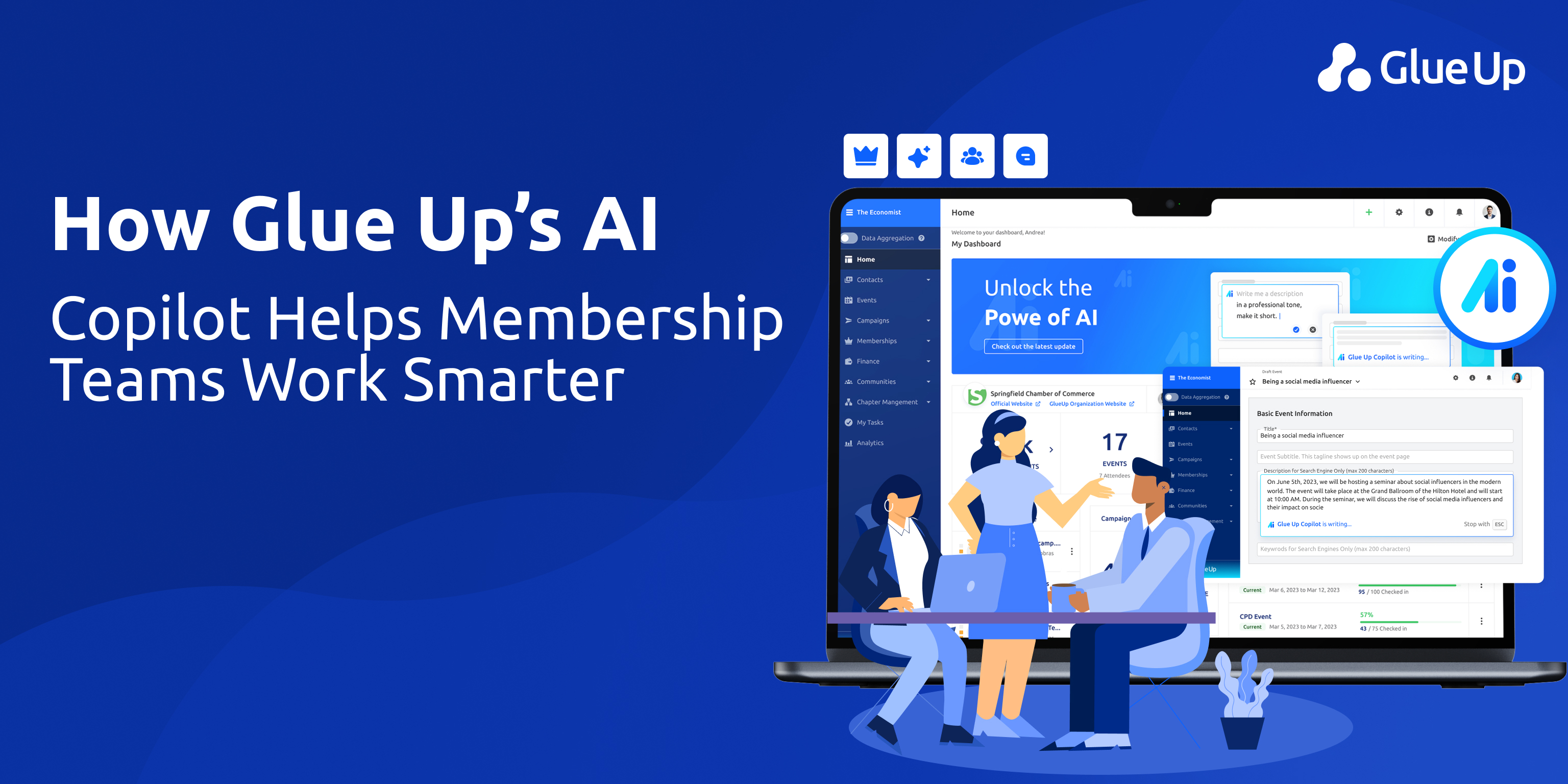
Another practical AI Copilot Use Case is automated event page drafting. Glue Up AI Copilot assists by generating a structured starting point for event content. Teams can refine details, adjust language, and publish faster.
This simply eliminates the repetitive labor that keeps teams stuck in drafting mode instead of execution mode.
AI Copilot Use Cases for Smart Content Editing
Most membership teams are struggling because everything they write has to be right.
Emails need the right tone. Event pages need clarity without sounding cold. Announcements need to be concise but not abrupt. By the time a draft is “good enough,” it has usually been rewritten multiple times, reviewed by more than one person, and delayed longer than planned.
This is where AI Copilot Use Cases for smart content editing quietly change the rhythm of the workday.
When the Draft Exists, but Confidence Does Not
Not all writing starts from scratch. In fact, most membership communications begin as rough drafts pulled together quickly between meetings, deadlines, and inbox interruptions. The real work happens afterward.
Teams ask themselves questions like:
Does this sound professional enough?
Is the message clear to members who are skimming?
Does the tone match who we are as an organization?
Is this too long for an email, or too short for an event page?
These micro decisions consume time and mental energy, especially for small teams where one message going out poorly reflects on the entire organization.
How Glue up AI Copilot Supports Smart Content Editing
One of the most practical AI Copilot Use Cases inside Glue Up is content refinement. Instead of rewriting from scratch, teams can use Glue Up AI Copilot to edit existing text for clarity, flow, and tone.
The Copilot helps:
Tighten language so messages are easier to read
Improve sentence structure without changing meaning
Adjust tone to feel more professional, warm, or direct
Reduce unnecessary length while preserving key points
This is not automated publishing. Every edit remains visible and reviewable. The human stays in control of what is sent.
Why This Matters for Membership Organizations
Member communications carry reputational weight. A confusing email can trigger unnecessary questions. A poorly worded announcement can cause frustration. An unclear event description can reduce registrations.
Smart content editing reduces those risks.
By using AI Copilot Use Cases to refine language before messages go out, teams increase consistency and professionalism without adding another review layer or slowing down delivery. That balance matters more in 2026, when expectations for clarity are higher and patience for confusion is lower.
Reducing Friction Without Removing Judgment
The value of AI assisted editing is confidence.
Glue Up AI Copilot helps membership teams feel more certain about what they are sending, especially when time is tight. It removes the friction of second guessing while preserving human judgment, approval, and accountability.
For associations entering the next fiscal year with growing communication demands, this use case supports better outcomes without changing how decisions are made.
In practice, smart content editing becomes one of the most relied upon AI Copilot Use Cases, because it quietly makes every day work feel more manageable.
AI Copilot Use Cases for Survey Question Generation
Surveys sit at the center of member feedback, yet they are often treated as an afterthought. Teams know they should collect input after events, renewals, or major initiatives, but the work of crafting good questions usually happens at the last minute. The result is familiar. Vague questions. Inconsistent formats. Responses that are difficult to interpret or act on.
This is where AI Copilot Use Cases for survey question generation become quietly valuable for membership organizations.
The Hidden Cost of Rushed Surveys
Poorly written survey questions do not just limit insight. They waste trust. Members take the time to respond, but unclear wording leads to shallow answers or skipped questions. Teams are left with feedback that confirms little and explains less.
For small membership teams, the problem is rarely a lack of interest in listening. It is a lack of time to design surveys thoughtfully while managing everything else on the calendar.
How Glue Up AI Copilot Supports Better Survey Design
Glue Up AI Copilot helps membership teams draft survey questions that are clear, purposeful, and structured. Instead of starting with a blank form, teams can generate questions aligned to what they are trying to learn, whether that is post event feedback, program evaluation, or general member experience.
The Copilot supports:
Clear wording that is easy for members to understand
Logical question flow that reduces confusion
Consistent tone across surveys
Questions that invite specific, usable responses
This assistance improves survey quality without extending preparation time, which is critical during busy reporting periods or event cycles.
Staying Within Assistive Boundaries
One of the most important aspects of this AI Copilot Use Case is what it does not do. Glue Up AI Copilot does not analyze responses, score sentiment, or draw conclusions. It does not replace human interpretation or decision making.
The Copilot helps with preparation. Humans remain responsible for reading responses, identifying patterns, and deciding how feedback informs next steps.
This clear division of responsibility reinforces trust and accountability while still delivering efficiency.
Why This Matters More in 2026
As associations move into the next fiscal year, expectations for listening are rising. Members want to feel heard, but they also want surveys to respect their time. Clear questions lead to better responses. Better responses lead to more informed discussions.
By using AI Copilot Use Cases for survey question generation, membership teams can gather higher quality feedback without adding strain to already full schedules.
In practice, this use case becomes less about technology and more about improving the conversation between organizations and the people they serve.
AI Copilot Use Cases for Campaign Drafting Support
Campaigns rarely fail because strategy is unclear. They fail because execution breaks down. A reminder is missed. A follow up is delayed. Copy is unfinished.
Another practical AI Copilot Use Case is campaign drafting support. Glue Up AI Copilot helps teams prepare the content required for onboarding sequences, renewal communications, or event follow ups. This reduces administrative burden and supports consistency across touchpoints.
For teams entering the new fiscal year with aggressive goals but limited capacity, this use case provides stability.
Why These AI Copilot Use Cases Fit Membership Organizations
Most AI tools are built for speed. They assume work happens in isolation, content lives in documents, and decisions are made independently. That assumption breaks down quickly inside membership organizations, where work is collective, historical, and governed by accountability.
Generic AI tools struggle in association environments because they lack context. Membership work is shaped by trust, governance, and institutional memory. Communications are not one-off messages. They sit within a long relationship between the organization and its members. When AI operates outside that system, it creates fragmentation instead of efficiency.
This is where AI Copilot Use Cases inside Glue Up differ in a meaningful way.
Membership Work Depends on Continuity
Associations do not reset every campaign. Member history matters. Past events matter. Previous communications matter. Decisions are rarely made in isolation, and accountability extends beyond a single department or role.
Standalone AI writing tools cannot see that context. They generate content, but they do not understand where that content fits within a broader membership journey. That gap forces teams to constantly translate between systems, increasing risk and workload.
Glue Up AI Copilot avoids this problem by operating inside the system membership teams already use.
How Glue Up AI Copilot Aligns with Association Governance
Glue Up AI Copilot is embedded within an AI powered CRM for associations. It works with historical information that teams already manage, rather than pulling content away from it. This design matters because governance in membership organizations depends on traceability and oversight.
Key characteristics that make these AI Copilot Use Cases fit associations include:
Content drafting happens within existing workflows
Edits remain reviewable and controllable by staff
No automated decisions bypass human approval
Historical data is used as reference
This preserves clear lines of responsibility while still improving productivity.
Supporting Staff Instead of Bypassing Them
One of the biggest concerns leaders have about AI is loss of control. In membership organizations, that concern is amplified by fiduciary responsibility and member trust.
Glue Up AI Copilot does not replace staff judgment. It supports it.
By assisting with drafting, editing, and preparation, the Copilot reduces workload without shifting authority. Staff remain accountable for what is sent, what is published, and how feedback is interpreted. This balance is essential for organizations that answer to boards, committees, and members.
Why AI Copilot Use Cases Feel Different Inside Glue Up
Because Glue Up AI Copilot understands the workflows teams already use, it feels less like an external tool and more like a virtual association assistant. It helps teams move faster within familiar processes instead of forcing them to adopt new ones.
That is why these AI Copilot Use Cases feel practical rather than experimental. They respect how membership organizations operate today while quietly supporting smarter work as teams prepare for 2026 and the new fiscal year.
In environments where trust and continuity matter as much as efficiency, that difference is foundational.
AI Copilot Use Cases as a Staffing Strategy For 2026
Staffing conversations are difficult for membership organizations. Hiring is expensive. Budgets are scrutinized. Yet workloads continue to grow.
In this environment, AI Copilot Use Cases in 2026 function as a capacity strategy rather than a technology upgrade. They allow teams to absorb more work without adding headcount. They help protect institutional knowledge by reducing burnout. They create predictability in execution.
Boards ask for efficiency, consistency, and risk reduction. AI Copilot use cases support those outcomes quietly and effectively.
What Research Tells Us About Assistive AI And Productivity
The strongest evidence supporting assistive AI comes from studies on knowledge work productivity. Research summarized by MIT Sloan Management Review highlights that AI tools deliver the most value when they reduce preparation time and cognitive load while leaving final decisions to humans.
This reinforces why Glue Up AI Copilot avoids predictive analytics or automated decision making. The tool exists to support professionals.
For associations entering 2026, this design philosophy aligns with regulatory expectations, governance standards, and organizational culture.
Why AI Copilot Use Cases Will Define Smarter Work Next Year
The future of membership work is about removing the invisible friction that slows everything down. Drafts that take too long. Edits that never feel finished. Campaigns that launch later than planned. Follow ups that slip because something else demanded attention first.
Working smarter in 2026 means doing the same work with fewer bottlenecks. Writing faster without rushing. Editing cleaner without overthinking. Launching sooner without sacrificing quality. Following up consistently without burning out the people responsible for it.
That is the quiet power of AI Copilot Use Cases.
Preparation Is the Real Productivity Advantage
Most delays in membership operations happen before execution even begins. The work stalls at preparation. Content needs to be written. Language needs to be reviewed. Questions need to be framed correctly. Once those steps are done, teams usually know exactly what to do next.
Glue Up AI Copilot focuses on preparation. It gives teams reliable starting points for emails, event pages, surveys, and campaigns so work can move forward without hesitation.
In practice, that preparation becomes the difference between a good plan and an executed one.
Why This Matters More as Teams Enter the Next Fiscal Year
As associations plan for the new fiscal year, expectations will continue to rise while resources remain constrained. Boards will ask for clarity. Members will expect responsiveness. Staff will be asked to deliver more without expanding headcount.
In that environment, AI Copilot Use Cases become less about innovation and more about operational resilience. They help teams absorb increased demand without lowering standards or exhausting people.
This is especially important for membership organizations where consistency and trust matter as much as speed.
Tools That Respect How Work Actually Happens
The question for association leaders is no longer whether AI belongs in membership operations. That debate has passed. The more important question is whether teams will adopt tools that respect how their work actually happens.
Glue Up AI Copilot fits because it does not force new behaviors. It does not bypass governance. It does not replace human judgment. It supports the work teams are already doing, inside the systems they already rely on.
That alignment is why AI Copilot Use Cases inside Glue Up feel sustainable rather than disruptive.
As 2026 approaches, smarter work will be defined by how quietly it helps teams stay prepared, consistent, and confident in the work they do every day.
Final Thought
As 2026 approaches, membership teams are looking for tools that respect their time, reduce friction, and help them show up prepared.
That is why AI Copilot Use Cases are becoming a defining operational advantage for associations that want to work smarter without pretending the work disappears.
Glue Up AI Copilot fits that reality.

AI Copilot use cases help membership teams reduce time spent on drafting, editing, and preparing content. Instead of starting from scratch, teams get reliable first drafts for emails, event pages, surveys, and campaigns, allowing them to focus on execution, relationships, and decision making.
The most practical AI Copilot use cases include drafting member communications, automated event page drafting, smart content editing, survey question generation, and campaign drafting support. These use cases target everyday work that slows teams down rather than strategic planning.
No. Glue Up AI Copilot is strictly assistive. It helps prepare content and reduce manual work, but humans remain responsible for reviewing, approving, interpreting feedback, and making decisions. Accountability and governance stay with the team.
Yes. Glue Up AI Copilot helps draft member emails and event page content using information already managed in the system. Teams can edit, refine tone, and publish when ready, keeping full control over messaging.
Glue Up AI Copilot assists by drafting clear, structured survey questions aligned with the purpose of the survey. It does not analyze responses, score sentiment, or draw conclusions. Teams interpret results and decide next steps themselves.
Generic AI tools operate outside membership systems and lack historical context. Glue Up AI Copilot is embedded within an AI powered CRM for associations, works inside existing workflows, and uses historical information as reference. This reduces fragmentation and supports governance.
No. Glue Up AI Copilot does not use predictive analytics, forecasting, or automated recommendations. It focuses on preparation tasks such as drafting, editing, and structuring content to support human led decisions.
As associations enter the next fiscal year with stable or shrinking teams and rising expectations, AI Copilot use cases function as a capacity strategy. They help teams absorb more work without adding headcount while maintaining consistency and professionalism.