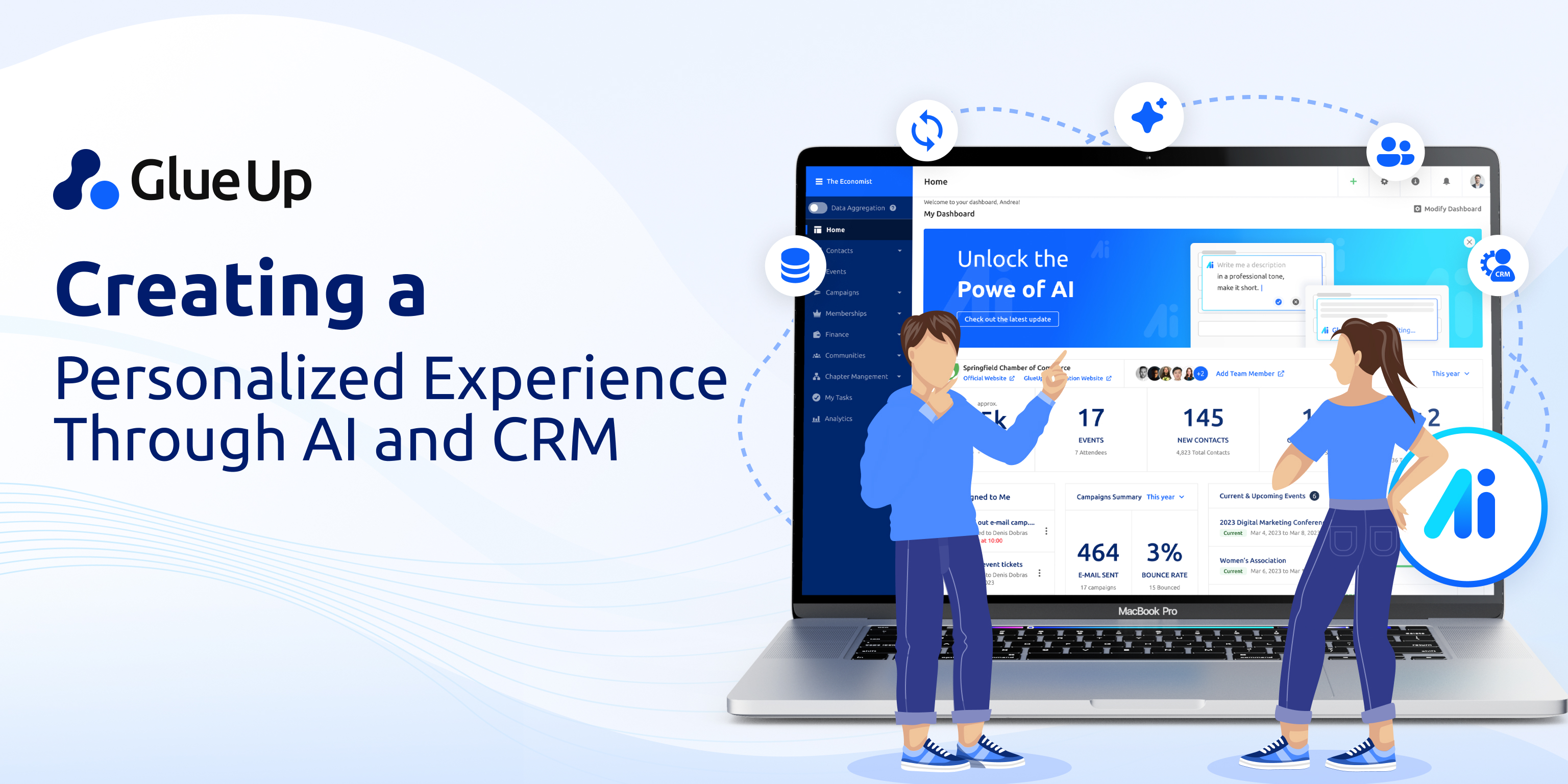
Imagine you’re a member of your organization. You log in to the portal, and before you’ve clicked anything, you see an event invite that aligns precisely with your career stage, your organization’s size, and your interests. Then you get a friendly e-mail suggesting a community discussion that matches the topic you posted about two weeks ago. That feeling of being known, of being relevant, of being considered is what CRM experience is all about.
For many associations, chambers and member-based organizations, the term CRM still conjures spreadsheets and admin tasks, rather than something that shapes every interaction. But times have changed. With artificial intelligence (AI) embedded in CRM systems, the CRM experience is shifting from back-office utility to front-line relationship engine.
This blog explores how you can harness AI and CRM to deliver personalized, emotionally resonant experiences that drive engagement, retention and renewal, in a world where members expect more than generic outreach.
Key Takeaways
CRM experience is how members feel every time the system remembers, responds, and recommends. When AI and CRM work together, personalization becomes an emotional connector that builds trust and loyalty.
Artificial intelligence transforms CRM data from a record-keeping tool into a predictive, learning system. By using behavior-based segmentation, real-time triggers, and contextual messaging, associations can anticipate member needs instead of reacting to them, redefining the CRM experience from transactional to relational.
Personalization without transparency erodes credibility. The most successful organizations create CRM experiences that prioritize consent, clarity, and fairness. Ethical AI and clear data governance are now part of what members expect from any modern membership system.
When associations integrate AI into CRM workflows, they see measurable impact, higher event participation, faster renewals, and deeper community engagement. Every data point becomes an opportunity to make the member’s journey more relevant, reinforcing that CRM experience is the new engine of retention.
A truly mature CRM experience fades into the background. The technology quietly powers empathy at scale, creating a member journey that feels natural, intuitive, and deeply personal. When that happens, the CRM stops being software and starts being part of the relationship itself.
Quick Reads
What is CRM Experience?
At its simplest, CRM experience is the sum of how a member perceives every interaction made possible by the CRM system: the ease, the relevance, the consistency across touchpoints. It’s how the system holds memory, draws inference, makes suggestions, and supports the human relationship.
Historically, a CRM (customer, actually member, relationship management) system was a database, or a contact list, or a tool to track finances. But when we talk about CRM experience, we’re elevating that system into a sense-making layer: it anticipates needs, surfaces next steps, connects dots between events, content and community.
What is a CRM with examples? Think of platforms like Salesforce that track member interactions, or HubSpot that capture lead journeys, but for associations you might use something like Glue Up which unifies membership, events, community and CRM in one. In those systems “CRM experience” becomes the member’s lived perception.
When someone asks, “How do you describe your CRM experience?” you want to hear: it feels seamless, it knows me, I don’t have to repeat myself, it offers what I need at the moment I need it. That’s the shift.
In terms of skills, a high-performing CRM user in this context has more than basic platform navigation: they’ve mastered member-journey mapping, data literacy, predictive analytics, persona design, and real-time workflow orchestration.
CRM software examples abound, Salesforce, Microsoft Dynamics 365, HubSpot, Zoho; but for member-based organizations the right membership CRM software integrates community, events, invoicing, mobile apps and AI-driven personalization.
How Do You Personalize Customer Journeys with CRM?
The path from generic to personalized journeys begins with the recognition that each member has a story. You capture their data: event attendance, content downloads, survey responses, community interactions; and you convert that data into context. Step by step:
Map the journey: For a typical member this might include joining, onboarding, event participation, volunteer engagement, renewal, advocacy. Align your CRM data to those stages.
Segment beyond demographics: Not just “industry” or “location”, but behavior, interest, tenure, engagement patterns. That means the CRM experience becomes dynamic.
Trigger personalized actions: Member attends webinar → CRM knows topic → AI suggests relevant article + peer discussion + invite to next event.
Loop feedback to refine: Monitor what works (clicks, responses, renewals), feed back into your model, adjust the journey.
When your member logs in, the portal says, “Here’s the next relevant step for you,” instead of “Here’s everything we offer, pick what you want.”
Which CRM Platforms Best Support AI-Driven Personalization?
If you’re serious about the CRM experience, you need a CRM platform that is AI-capable. Here are key features to look for:
Predictive analytics and next-best action: The system anticipates what a member might do next and offers support or invitation.
Real-time data integration: Events, community posts, mobile app activity feed into the CRM immediately.
Unified view of member profile: Instead of fragmented systems, you have one profile that spans membership status, event history, community engagement, preferences.
Built-in AI or AI-ready architecture: The platform either includes AI modules or allows integration of predictive engines, NLP, recommendation systems.
For instance, research indicates that AI-driven CRM frameworks can leverage metrics like Recency-Frequency-Monetary (RFM) combined with machine-learning clustering (e.g., K-Means) to yield predictive accuracy of about 84.3% in identifying engagement/retention segments.
In another study of how AI improves CRM systems, four key themes emerged: personalized service, improved engagement, data-driven strategy and intelligent decision-making.
Platforms that deliver those capabilities, especially when built for memberships and community, are rare. That’s one reason organizations using Glue Up’s all-in-one ecosystem see meaningful shifts in how CRM experience drives member loyalty.
How to Design an AI Data Model for Customer Profiles
You’ve decided you want to upgrade your CRM experience. You’ve chosen a platform or you’re at the selection phase. Next comes data-model design:
Step 1: Audit your data
Inventory: member fields, event attendance, community posts, website interactions, finance invoices, renewal history.
Cleanse: remove duplicates, standardize fields, ensure consent.
Read research: AI models depend on high-quality data.
Step 2: Define your member‐profile schema
Include: demographics, organization type, tenure, preferred content topics, event behavior, community engagement score, digital footprint (web/app behavior), predicted lifetime value, churn risk.
Step 3: Segment behaviorally
Use ML techniques: cluster members based on engagement patterns (e.g., RFM + engagement + content interest) so your system sees clusters like “champion volunteer”, “early career participant”, “renewal-at‐risk”. Studies show advanced segmentation yields stronger personalization.
Step 4: Apply real‐time personalization workflows
Trigger: A community post by a new member → system logs topic → CRM flags likely interest → AI recommends content and peer-match → CRM sends a personalized invite. This real‐time loop is what shifts your CRM experience from static to fluid.
Step 5: Ethical data practices
You must build trust: make member consent clear, allow privacy controls, be transparent about AI use. Research highlights that poor ethical practices weaken personalization’s value.
Steps to Implement Real-Time Personalization Workflows
Design the trigger matrix: Map key events/actions (e.g., registration, session attendance, content download, community comment).
Define the personalization rules: What should happen when a trigger fires? Use the CRM + AI combination.
Set human hand–off points: While AI powers the workflow, ensure humans intervene when complexity or nuance is needed (for example, board-level members, high-value donors).
Test and iterate: Use A/B testing, monitor click-throughs, engagement, renewal lifts.
Scale and maintain: Keep refining as your data grows; ensure the system evolves with member behaviors.
When implemented well, the result is an enhanced CRM experience where each member feels known, valued and offered the right next step because your system knew.
Ways to Measure CRM Experience Effectiveness
You can’t call something an exceptional CRM experience if you can’t measure it. Here are key metrics:
Engagement lift: e.g., increase in event attendance from personalized invites.
Renewal rate growth: segmenting by behavior and sending personalized renewal reminders should move the renewal needle.
Response rate to touchpoints: what % of personalized communications get clicked or acted on.
Time-to-value: how quickly a new member receives relevant content or action through the CRM.
Member satisfaction/NPS: ask “Did you feel the organization understood me?”
AI-recommendation performance: percentage of recommended items (event, content) accepted.
Cost/time savings: automation replaces manual outreach; staff can focus on high-value interactions.
By tracking these, you treat CRM experience a core metric of organizational performance.
Top CRM Features That Improve Customer Experience
What should you expect from your CRM if you’re serious about improving CRM experience? Here are the features:
Unified member profile: everything in one place: membership status, events, community, finance.
Multi-channel integration: portal, mobile app, email, community platform; each touchpoint feeds into the CRM and draws from it.
Predictive next-best action engine: Suggesting what the member should do next.
Segmented workflows and automation: Automate personalized journeys without losing human feel.
AI-driven insights and recommendations: Content, events, peer-matches suggested based on data.
Member self-service and mobile access: Members expect immediate access on their terms.
Human hand-off orchestration: When the system flags something, humans step in with high-touch support.
Feedback loops and learning system: The CRM learns from member responses and adapts.
All of these contribute to a superior CRM experience.
Steps to Align Sales and Support Around CRM Data
In associations, “sales” might translate to membership acquisition and “support” to member services. Often, they work in silos. To deliver a consistent CRM experience you must align them:
Use the same CRM system for acquisition and retention: membership team and support team see the same profile.
Create shared dashboards: both teams track engagement, renewal risk, high-value members.
Standardize data capture: ensure every interaction is logged consistently.
Establish next-best-action workflows that span teams: e.g., acquisition → onboarding → support check-in → community invite → renewal.
Foster a culture of member lifecycle thinking: Teams understand they’re building relationships.
When alignment is achieved, your CRM experience becomes seamless across the lifecycle.
Ethical Data Practices for AI-Powered CRM Personalization
Personalization is powerful, but with power comes responsibility. As research shows, implementing AI in CRM without ethical guardrails undermines trust.
Here’s what you need to watch:
Transparency: Let members know how their data is used.
Consent: Give opt-in but also opt-out.
Bias mitigation: Make sure AI models don’t unfairly favor or ignore certain member groups.
Data minimization: Only collect what you need.
Explainability: Be able to explain why a recommendation or invite was sent.
Privacy and governance: Secure data and comply with regulations (GDPR, CCPA etc.).
When you get this right, your members feel respected. That’s the heart of a strong CRM experience.
AI-Powered Marketing: What, Where and How
In your member-organization context, AI-powered marketing via CRM means using member data + AI to send the right message to the right person at the right time. Where do you see this?
Website: dynamic content based on CRM profile (how to use CRM data for personalized website experiences).
Email: personalized subject lines, topics, event invites.
Mobile app: push notifications tailored to interests.
Community platform: matched peer groups, discussion threads surfaced.
Events: session suggestions, networking recommendations, automated follow-up.
How? By building that data model, feeding interactions into CRM, triggering AI-driven actions, monitoring results, refining the logic. When you tie marketing, operations and service through the CRM, you elevate the CRM experience beyond marketing into relationship architecture.
CRM Experience Examples (For Membership Organisations)
A volunteer logs in late at night, books a training module. The next morning the system sends a “thanks for booking” message, suggests discussion groups based on module topic and lists upcoming events in that subject area. That’s CRM experience.
A member attended three events last year, but none this year. The CRM flags them as “at risk” and automatically sends a tailored renewal invitation: “We’ve missed you. Based on your past interest in topic X, here’s a special offer…”
A new member signs up. Immediately the portal shows “You might like: Community breakfast for early-career professionals (you)”. That’s personalized website experience powered by CRM data and AI.
The support team notices an invoice is overdue. The CRM triggers a friendly reminder, offers to schedule a call if there’s an issue, and flags potential churn risk. That combined automation + human hand-off is key.
Each of these shows how the CRM system does more than store data, it creates a feeling of being known, valued, anticipated.
How to Get CRM Experience: Practical Checklist
Select a CRM platform built for member-based organizations and capable of AI-driven personalization.
Clean and unify your data, remove silos between membership, events, community, finance.
Map your member journeys and define triggers for automation.
Build member segments not by static labels but by behavior, interest and engagement.
Implement personalized workflows (via CRM + AI) that span website, email, mobile, community.
Set metrics and measure: engagement, renewal, satisfaction, time-to-value.
Align sales/acquisition and support/retention teams around one CRM and shared goals.
Ensure ethical data practices: consent, transparency, bias-check, privacy.
Iterate: feed insights back into your system, let it learn and evolve with your members.
Communicate the human story: let your members know that behind the AI and CRM there’s a purpose to support their growth.
Why CRM Experience Matters for Associations
In member-based organizations the most valuable asset is the relationship. And when your CRM can deliver a personalized experience, you’re cultivating belonging, trust and loyalty.
Using AI + CRM to achieve that will change how your members feel about your organization. They’ll say: “They know me. They get me. They value me.” And that feeling leads to deeper engagement, higher renewal rates, stronger advocacy.
So, when someone asks, “What is CRM experience?” you can answer: it’s the moment your member realizes they’re part of a network, a mission, a community that remembers them, supports them and helps them grow. And that shift is what will set your organization apart in the years ahead.