Every membership organization eventually reaches a moment when the work that matters most keeps getting crowded out by the work that simply has to get done. Invoices need to go out. Payments need to be checked. Renewal lists need to be reconciled. Member questions need answers. None of it feels strategic. All of it consumes hours. That is why automated invoicing for associations has become one of the quiet operational shifts defining 2026. It shows up as something far more valuable: time returning to the people who serve members every day.
Across associations, chambers, and professional networks, leaders already know the real constraint inside their organizations. Budgets stay tight. Teams stay lean. Expectations from members keep rising. Boards want clearer reporting. Sponsors want faster turnaround. Members want easier ways to pay and instant confirmation. In that environment, productivity gains come from removing friction in the places where staff energy quietly disappears. Billing remains one of the most persistent of those places.
Automated invoicing for associations reframes the question. Instead of asking how fast an invoice can be sent, it asks where human attention belongs in a modern membership organization. The answer points in a direction that feels obvious once seen toward relationships, programs, strategy, and the moments that determine whether members continue year after year.
Key Takeaways
Automated invoicing for associations returns staff time where it matters most. Routine billing tasks no longer consume attention, allowing teams to focus on member relationships, programs, and strategy.
2026 demands systems that scale without adding complexity. As renewal cycles, events, and sponsorships grow, automated billing creates consistency across financial workflows without increasing workload.
Member experience improves when billing feels simple and professional. Clear invoices, easy payments, and instant receipts build trust and reduce friction that quietly affects retention.
Integrated financial operations strengthen leadership and governance. Centralized invoicing and real-time reporting provide clarity for boards and executives, supporting better decisions using historical data.
Automation reshapes culture. By removing administrative noise, teams regain focus, energy, and capacity to deliver higher-value work that aligns with the organization’s mission.
Quick Reads
Automated Invoicing for Associations and the Hidden Economics of Time
Time rarely shows up as a line item in a financial report, yet it shapes every outcome those reports attempt to measure. Staff hours determine how quickly a member receives help. Staff focus determines whether renewal conversations feel personal or transactional. Staff availability determines whether leadership sees real insight or a stack of numbers.
Inside many organizations, the billing process consumes time in ways that feel small in isolation and heavy in aggregate. A dues invoice generated manually for different membership tiers. A sponsorship invoice customized for one partner. A batch of event invoices sent after registration closes. Follow-up emails for balances. Payment confirmations checked against spreadsheets. Reports assembled by hand for leadership meetings.
None of these tasks feel complex. Each one takes minutes. Yet across weeks and months, those minutes compound. They shape how staff experience their workday. They decide whether attention goes toward member relationships or administrative routines.
Automated invoicing for associations enters at precisely that point of compounding. It standardizes what repeats. It systematizes what drains attention. It centralizes what used to live across email threads, documents, and disconnected tools. The result remains simple: people regain time without losing control.
For many organizations preparing for the new fiscal year in 2026, that return of time becomes the difference between managing growth and simply keeping pace.
Automated Invoicing For Associations And The New Rhythm Of 2026
The calendar of a membership organization already follows a predictable rhythm. Renewals cluster around set months. Conferences create billing spikes. Sponsorships align with program cycles. Committees operate on annual plans. Each phase brings its own financial workload.
In past years, those cycles placed real pressure on staff. Peaks of invoicing often coincided with peaks of programming and member engagement. The same people responsible for delivering value to members also carried the administrative weight of collecting revenue.
In 2026, organizations approach this rhythm differently. Automated invoicing for associations transforms financial cycles into background systems rather than foreground tasks. Dues renewals generate invoices based on membership type. Event registrations trigger billing automatically. Sponsorship agreements create structured payment schedules. Reminders go out at consistent intervals. Payment status updates in real time.
The work still exists. The burden of manually managing each step fades. Staff experience a steadier workload. Leadership receives clearer financial visibility. Members interact with a process that feels modern and professional rather than procedural.
This shift matters because 2026 brings heightened expectations. Digital convenience remains the standard across industries. Members compare their association experience to every other service they use. Organizations that rely on manual billing processes feel increasingly out of step with that reality.
Automated invoicing for associations meets the moment without disrupting the culture of service that defines membership organizations. It reinforces that culture by freeing the people behind it.
Automated Invoicing For Associations And Where Staff Time Truly Goes
To understand the value of automation, it helps to look closely at where time actually flows inside a finance and operations team.
Consider a typical renewal cycle. Staff export membership lists. They adjust amounts based on tier or status. They generate invoices. They send them manually or through email templates. Payments arrive through various channels. Each payment requires matching to the right record. Questions arrive from members asking for copies, clarifications, or confirmation. Reports must be assembled for leadership and boards.
Each step demands attention. Each step pulls focus away from engagement work that strengthens retention.
Now consider event billing. Registration opens. Invoices go out. Some attendees require adjustments. Others need receipts. Sponsors request consolidated statements. After the event, reconciliation begins. None of this work is difficult. All of it accumulates.
Automated invoicing for associations redesigns that flow. Instead of moving through disconnected tools and manual checks, staff operate inside a single system where invoices, payments, and member records remain connected. Invoices generate based on predefined rules. Payments reconcile automatically. Member portals provide instant access to billing history and receipts. Reports draw from live data rather than compiled spreadsheets.
The effect shows up in quiet places: fewer internal emails asking for payment status, fewer interruptions during strategic planning, fewer late evenings during renewal season.
Automated Invoicing for Associations and the Member Experience
Financial interactions shape how members perceive an organization more than many leaders realize. A smooth billing experience communicates professionalism, respect for time, and organizational competence. A confusing one erodes confidence, even when programming remains strong.
Members today expect clarity. They want invoices that reflect exactly what they signed up for. They want payment options that fit their preferences. They want immediate confirmation. They want access to their records without sending an email.
Automated invoicing for associations supports that experience by design. Invoices arrive consistently. Payment links remain clear. Receipts generate automatically. Member portals provide visibility into balances and history. Communication becomes proactive rather than reactive.
This matters deeply for retention. Renewal decisions often hinge on cumulative impressions rather than single interactions. When billing feels simple and transparent, it reinforces trust. When it feels fragmented, it introduces friction that members rarely articulate yet always register.
The result extends beyond convenience. It shapes whether members experience the organization as modern and responsive or procedural and time-consuming. In 2026, that distinction increasingly defines competitive advantage in the membership space.
Automated Invoicing For Associations And Organizational Capacity
Every leadership team speaks about capacity. What the organization can realistically take on. Which initiatives fit into the year. How much growth can be supported without adding headcount.
Capacity lives in systems as much as in people. When routine processes demand constant attention, they set an invisible ceiling on what an organization can accomplish.
Automated invoicing for associations lifts that ceiling. By reducing the operational weight of billing, organizations unlock space for new programs, expanded outreach, deeper member engagement, and more thoughtful strategic planning.
This shift shows up in subtle ways. Staff meetings focus less on administrative backlogs and more on member needs. Leadership conversations move from problem-solving toward opportunity design. Finance teams spend less time reconciling and more time analyzing historical trends that inform smarter decisions.
The work remains grounded in reality. Data reflects what has already occurred. Insights come from patterns across past renewals, event participation, and sponsorship performance. Automation supports clarity rather than replacing judgment.
That balance matters. Membership organizations thrive on trust, relationships, and accountability. Automated invoicing for associations strengthens those foundations by creating operational reliability.
Automated Invoicing For Associations And The Transition To Systemic Thinking
Many organizations adopt new tools incrementally. A payment platform here. A spreadsheet there. A CRM for contacts. An event system for registrations. Over time, the ecosystem grows fragmented. Staff become experts in moving information between systems.
The next phase of operational maturity looks different. It centers on integrated systems that treat financial activity as part of the membership lifecycle rather than a separate administrative function.
Automated invoicing for associations functions best inside that integrated environment. Billing connects directly to member records, event registrations, and sponsorship agreements. Every transaction updates the same source of truth. Reporting draws from one dataset. Audit trails remain complete. Compliance becomes easier to manage.
This systemic approach reshapes how organizations think about operations. Processes stop living in people’s heads. Knowledge becomes institutional rather than individual. Continuity strengthens even as staff roles evolve.
In 2026, organizations that embrace this integration gain resilience. They scale without complexity. They maintain service quality as programs expand. They support governance with clear, consistent financial reporting.
Automated Invoicing for Associations and the Human Dimension
Technology conversations often focus on features. What matters more is how those features change the experience of work.
Staff inside associations care deeply about their members. They enter this field to build professional communities, advance causes, and create value. Administrative overload erodes that sense of purpose over time. It turns meaningful roles into reactive ones.
Automated invoicing for associations restores alignment between daily tasks and organizational mission. When billing runs smoothly in the background, staff engage more fully with members. Conversations become relational rather than transactional. Attention shifts from processing to understanding.
The emotional effect deserves recognition. Reduced cognitive load leads to better decision-making. Predictable workflows reduce stress during peak seasons. Teams regain the bandwidth to innovate, collaborate, and respond thoughtfully to emerging needs.
This is why automation resonates beyond efficiency metrics. It reshapes how people experience their work.
Automated Invoicing For Associations And What It Replaces
Every operational upgrade implicitly replaces something. In this case, it replaces the patchwork of manual steps that once defined billing.
It replaces:
- Individual invoice creation across disconnected files
- Manual tracking of payments
- Repeated follow-up emails
- Spreadsheet-based reconciliation
- Ad hoc reporting processes
In their place, it introduces consistency. The same rules apply every time. The same workflows operate regardless of volume. Data remains centralized. Oversight remains intact.
This transition does not remove human involvement. It elevates it. Staff intervene where judgment matters rather than where routine repeats.
Automated Invoicing For Associations And The Role Of Glue Up
This shift becomes tangible when supported by a platform designed for membership organizations. Glue Up approaches financial operations as part of the broader membership ecosystem rather than as a standalone accounting function.
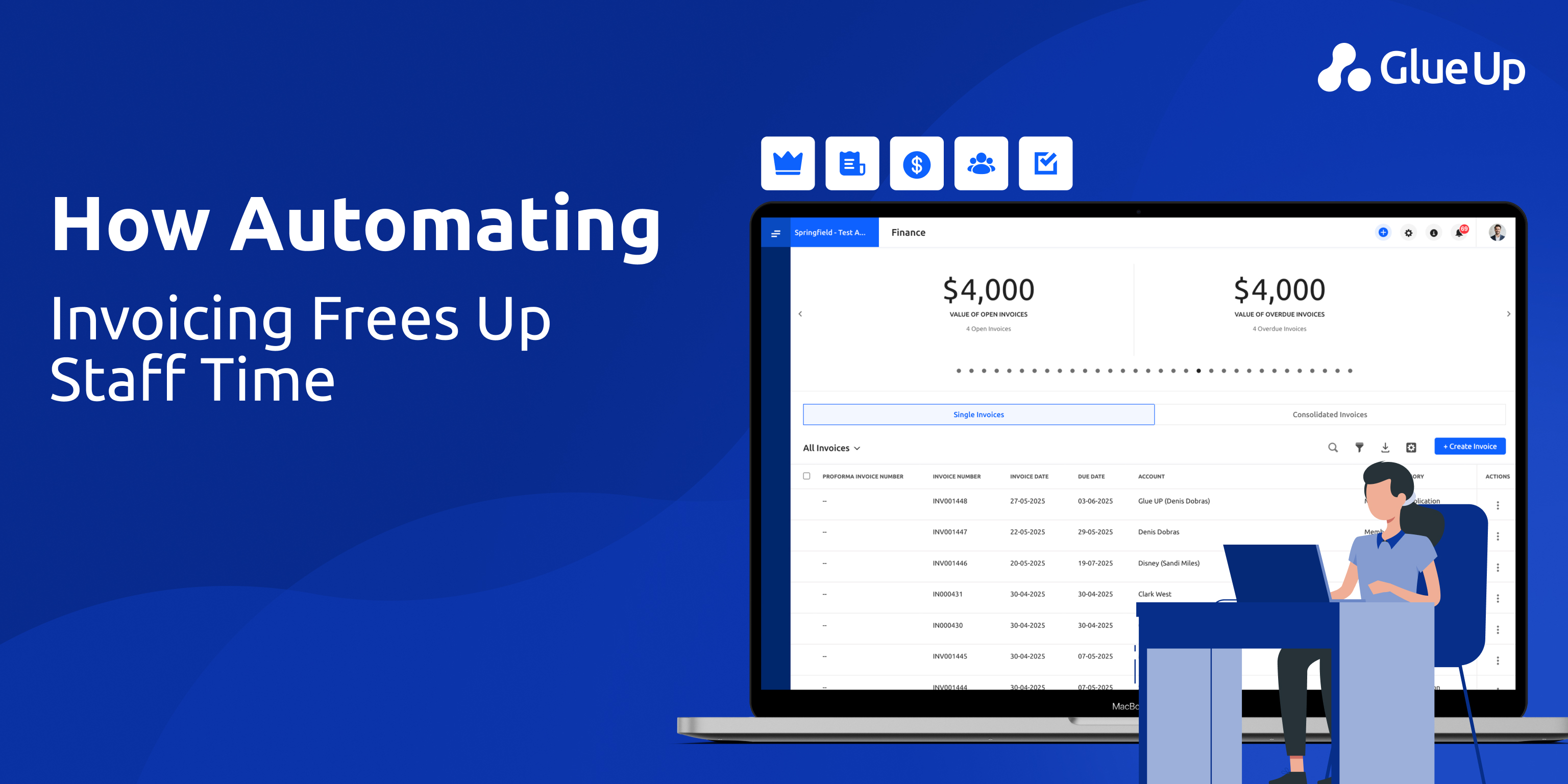
Within Glue Up, automated invoicing for associations connects directly to membership management, event registration, sponsorship programs, and communication tools. Dues invoices reflect membership status. Event invoices generate from registration data. Sponsorship billing aligns with contractual terms. Payments update member records in real time.
Finance teams gain:
- Centralized invoice management
- Integrated online payments
- Automated reminders
- Real-time reporting
- Clear audit trails
Leadership gains:
- Visibility across revenue streams
- Historical data for informed planning
- Consistency across departments
Members gain:
- Clear invoices
- Easy payment options
- Instant receipts
- Access to their financial history
Glue Up becomes infrastructure rather than an overlay. It allows organizations to operate as cohesive systems rather than collections of tools. In 2026, that cohesion defines operational maturity.
Automated Invoicing For Associations And Governance Expectations
Boards increasingly expect transparency. They want to understand how revenue flows. They want timely reports. They want confidence in compliance and controls.
Automated invoicing for associations supports governance by creating reliable, accessible records. Financial data reflects real activity rather than reconciled estimates. Reports draw from a single source. Audit processes become clearer.
This strengthens the relationship between operations and governance. Leadership discussions shift from questioning data accuracy to interpreting trends. Strategy benefits from clarity.
Automated Invoicing For Associations And The Broader Operational Stack
Billing never exists in isolation. It touches communications, programs, events, sponsorships, and member services. When it integrates smoothly, the entire organization feels more responsive.
This is where secondary perspectives reinforce the core idea. Many organizations explore invoice automation for associations as part of broader digital transformation. Others view it through the lens of automated billing for membership organizations when addressing renewals and recurring revenue. Still others focus on invoicing automation for nonprofits and associations when modernizing financial operations without altering mission.
Each lens points toward the same outcome: reduced administrative friction and reclaimed human capacity.
Automated Invoicing For Associations And Preparing For The New Fiscal Year
As organizations plan for the new fiscal year, they evaluate where resources produce the greatest return. Hiring additional staff carries cost and complexity. Improving systems offers leverage.
Automated invoicing for associations represents one of the highest leverage changes available. It does not require cultural overhaul. It does not alter program delivery. It quietly improves how existing work gets done.
In 2026, organizations that adopt this approach enter the year with a different posture. They anticipate renewal cycles with confidence rather than concern. They manage events without administrative bottlenecks. They engage members without the constant background noise of billing tasks.
The benefits compound across months. Time saved in January supports initiatives in March. Clarity in June informs strategy in September. By year’s end, the organization operates at a different rhythm.
Automated Invoicing for Associations and Measuring What Matters
While automation reduces manual effort, it also enhances insight. Historical financial data becomes easier to analyze. Trends across renewals, events, and sponsorships surface more clearly. Leadership decisions gain context.
Importantly, this insight remains grounded in what has already occurred. It supports reflection and planning rather than replacing judgment. Organizations maintain control over strategy while benefiting from improved information quality.
Automated Invoicing for Associations and Cultural Impact
Culture emerges from daily experience. When staff spend significant time on administrative work, the culture becomes reactive. When systems support routine processes, the culture becomes proactive.
Automated invoicing for associations contributes to a culture of professionalism, clarity, and focus. Teams engage in meaningful work. Members receive consistent service. Leadership operates with confidence.
This cultural shift often proves more valuable than any single efficiency metric. It shapes how people feel about their organization. It influences retention among staff as well as among members.
Automated Invoicing for Associations and the Long View
Trends come and go. Sound operations endure. Automated invoicing for associations belongs to the category of enduring infrastructure rather than temporary optimization.
It aligns with broader movements toward digital integration, member-centric design, and sustainable growth. It respects the realities of limited resources while expanding what those resources can achieve.
In the years ahead, organizations will continue to evolve. Programs will diversify. Engagement models will adapt. Technology will advance. The need for reliable, efficient financial operations will remain constant.
By investing in automated invoicing for associations today, organizations prepare themselves for whatever tomorrow brings.
Automated Invoicing for Associations and the Quiet Redefinition of Work
The most meaningful operational shifts rarely announce themselves. They unfold in everyday moments. A staff member ends the day with energy rather than exhaustion. A member completes payment without confusion. A board meeting focuses on strategy rather than reconciliation.
Automated invoicing for associations creates those moments. It does so without spectacle. It simply allows people to work where their impact matters most.
As 2026 approaches, the question facing membership organizations becomes clear. How much of your team’s time will remain tied to routines that systems can handle, and how much will return to the work that defines your mission?
The answer will shape the experience of everyone who belongs to your organization.

Automated invoicing for associations is a system-driven way to create, send, track, and record invoices for membership dues, events, sponsorships, and programs without manual processing. Invoices are generated based on membership rules, registrations, or agreements, then updated automatically as payments are made.
It removes repetitive tasks such as manual invoice creation, follow-up emails, payment matching, and spreadsheet reconciliation. Staff no longer need to track each transaction by hand, which frees hours every week for member engagement, reporting, and strategic work.
No. Automated invoicing for associations benefits organizations of any size. Smaller teams gain capacity without adding headcount, while larger associations gain consistency across renewals, events, and sponsorship billing. The impact shows up in both time savings and operational clarity.
Members receive clear invoices, simple payment options, instant receipts, and easy access to their billing history. Fewer errors and faster confirmations create a more professional experience, which supports stronger renewals and long-term trust.
Yes. Automated invoicing for associations supports recurring dues, renewal cycles, event registrations, and sponsorship payments. Invoices are triggered by member status or registrations, keeping billing aligned with how associations operate year to year.
No. It reduces manual work but keeps staff in control. Teams review financial activity, manage exceptions, and use historical data to guide decisions. Automation supports consistency while preserving human judgment.
Because all invoices and payments live in one system, reports reflect real-time data rather than manually compiled records. This provides leadership and boards with clearer financial visibility, stronger audit trails, and easier compliance.
Key capabilities include centralized invoicing, online payments, automated reminders, real-time payment status, integration with membership and events, and clean historical reporting. Systems should fit how associations manage dues, programs, and sponsorships across the fiscal year.
Glue Up integrates invoicing directly into membership management, events, and sponsorships. Dues, registrations, and program fees generate invoices automatically, payments update member records in real time, and finance teams gain centralized reporting without relying on disconnected tools.
As organizations enter the new fiscal year with leaner teams and higher expectations, automated invoicing for associations helps manage renewals, events, and revenue with less administrative strain. It allows staff to focus on member value rather than routine billing tasks.