Budget planning defines how associations operate, not just financially but strategically. Yet, year after year, the same budget planning mistakes limit growth, restrict flexibility, and reduce transparency across departments. Most of these errors come from fragmented data, outdated systems, and processes that rely on manual tracking instead of connected financial operations.
In this article, we'll explore five of the most common budgeting pitfalls associations face and how the tools in Glue Up's Finance Management Software help teams and executives regain clarity, maintain consistency, and keep operations sustainable throughout the year.
Key Takeaways
- Financial integration builds control. Centralized budgeting systems outperform fragmented spreadsheets.
- Categorization equals clarity. Expense alignment improves accountability and performance evaluation.
- Timing dictates liquidity. Model cash flow monthly and maintain reserves to avoid shortfalls.
- Documentation defines credibility. Audit-ready records safeguard governance and compliance.
- Continuous reporting drives improvement. Real-time dashboards replace static reviews and reactive management.
Mistake 1: Operating with Financial Fragmentation
Let's start with the most common structural flaw in association management. When membership renewals, event revenues, and sponsorship income are handled separately, your operating budget becomes an incomplete narrative. This fragmentation invites reporting errors and inconsistent forecasting, making it difficult to tackle association finance management effectively.
Integrating all financial data into a single association management software environment eliminates manual reconciliation and improves visibility. When every department contributes to one centralized ledger, you move from reconciling numbers to managing performance. Strategic leaders treat integration not as convenience, but as control.
Mistake 2: Treating Expense Categorization as Administrative, Not Analytical
Inconsistent expense categorization is one of the most pervasive budgeting errors associations make. You've likely seen cost reports that itemize expenses but don't connect them to outcomes. When administrative, operational, and programmatic costs overlap, you lose insight into the true utilization of resources.
The solution lies in categorization discipline. Every transaction should align with a defined cost center or measurable outcome. This allows executives to evaluate the ROI of member programs, events, and marketing initiatives through accurate financial reporting. Budget data becomes intelligence, not just compliance documentation.
Mistake 3: Mismanaging the Temporal Aspect of Cash Flow
You might meet your annual targets and still face liquidity pressure midyear. That's not poor revenue generation—it's poor cash flow management. Many associations still build annual budgets that ignore revenue timing. Dues renewals, sponsorship payments, and event receipts rarely align with recurring expenses such as payroll, software renewals, or venue deposits.
Sophisticated associations model cash flow timing monthly, not annually. They account for fixed costs vs variable costs and allocate reserves accordingly. Building a contingency fund within your operating budget ensures fiscal stability even when revenue inflows fluctuate. Liquidity control is not a financial preference—it's a governance responsibility.
Mistake 4: Neglecting Documentation as a Governance Instrument
Documentation defines financial credibility. Yet many associations treat recordkeeping as clerical instead of strategic. Missing receipts, unverified expenses, and incomplete authorizations undermine transparency and audit readiness. In today's regulatory landscape, that's reputational risk, not just a nuisance.
Modern associations use all-in-one finance management software like Glue Up to automate documentation and ensure traceability. Every invoice, refund, or payment includes a timestamp, approver identity, and related cost center. These budget templates and audit trails turn documentation into proof of integrity.
Mistake 5: Treating Financial Reporting as Retrospective Instead of Continuous
Waiting until the end of the quarter to analyze performance is like steering with a rearview mirror. Most membership financial planning pitfalls come from delayed insights. Static quarterly reviews can't capture dynamic budget shifts or spending deviations in time to correct them.
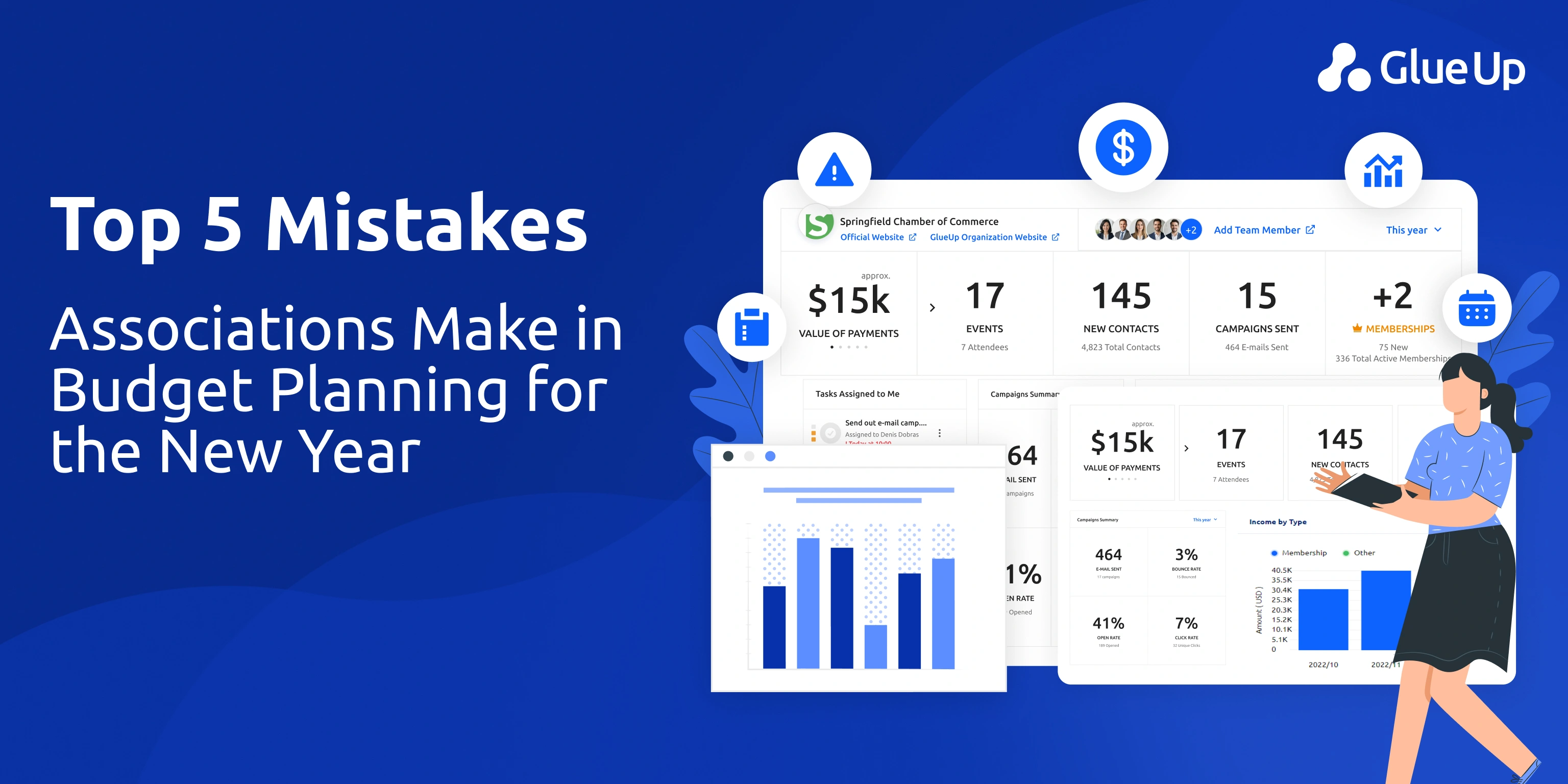
Real-time reporting through the Glue Up Finance Module enables continuous oversight. Dashboards update automatically as transactions occur, allowing executives to monitor revenue, expense ratios, and department-level variances in real time. This shift from retrospective to continuous budget management allows for immediate corrections and proactive decision-making.
How Glue Up Institutionalizes Financial Discipline
Glue Up's Finance Module provides structure, accountability, and precision across every phase of your financial cycle. It bridges operational silos, reduces manual work, and delivers decision-ready data to executive teams who demand accuracy over approximation.
Centralized Financial Oversight
Membership dues, sponsorships, and event payments flow into one system for comprehensive financial sustainability. You gain a complete picture of performance across all revenue streams.
Structured Expense Categorization
Each transaction can be tagged to a cost center, enabling leaders to track real ROI by program, initiative, or department.
Liquidity and Payment Controls
Automated cash tracking aligns incoming and outgoing payments, minimizing the risk of budget shortfalls and ensuring consistent liquidity.
Audit-Ready Documentation
Every entry includes a digital record, timestamp, and approval trail, enabling transparency and simplifying external reviews.
Continuous Reporting and Analytics
Dynamic dashboards visualize revenue flow, expense ratios, and key performance indicators in real time. Executives can identify inefficiencies and act before issues escalate.
Build Financial Precision Before the Next Fiscal Cycle
Effective association budget planning isn't about cutting costs; it's about engineering precision into every decision. Leaders who manage through structure, visibility, and accountability don't just avoid budget mistakes—they create operational predictability. However, when your budgeting framework connects data, timing, and analysis, you protect cash flow, sustain growth, and preserve member confidence.
Book a demo with Glue Up today to see how the Finance Module helps associations eliminate inefficiencies, align financial planning with strategy, and establish fiscal integrity that lasts.
Frequently Asked Questions
What causes the most budget planning mistakes in associations?
Fragmented financial systems and delayed reporting are the most common issues, creating incomplete or inaccurate financial visibility.
How does Glue Up's Finance Module help associations avoid these errors?
It centralizes income, expenses, and reporting, automating categorization, documentation, and cash flow tracking in one interface.
Why is categorization important in nonprofit budgeting?
Consistent categorization links financial data to strategic objectives, enabling leaders to assess ROI and operational efficiency.
What role does cash flow management play in budget stability?
Cash flow timing determines operational continuity. Proper scheduling of inflows and outflows prevents liquidity crises even in profitable organizations.
How does real-time reporting improve financial decision-making?
It eliminates lag between activity and analysis, allowing executives to identify issues early and allocate resources strategically.
Can Glue Up integrate with existing association management systems?
Yes. Glue Up's Finance Module connects with your existing AMS ecosystem, ensuring seamless data transfer across membership, events, and sponsorship revenue streams.
Quick Reads
- How to Build a Revenue Engine with Association Management Software
- Add-On Cart for Member Retention & Growth
- Simplify Multi-Currency Payment Posting for Community Chapters With Glue Up + Paygage
- AI Automation for Event Registration & Beyond
- Integrating AI into CRM for Membership Growth
- How to Build a Chapter Event Calendar
- What Is All-In-One Association Software?
- AI-Powered Member Check-In Software