Event KPIs have always existed, but for most associations, they have lived in spreadsheets, post-event decks, and dashboards that look impressive yet feel strangely hollow. Attendance numbers go up. Satisfaction scores look fine. Sponsors get their logos. And still, leadership leaves the room wondering whether the event truly mattered. That uncertainty is a failure of how event KPIs are defined, interpreted, and connected to real member behavior.
For decades, associations measured events the same way everyone else did. Count registrations. Track check-ins. Send a survey. Close the file. That approach worked when events were scarce, attention was abundant, and members organized their professional lives around annual gatherings. That world no longer exists. Members now decide value in real time, often during the event itself. Event KPIs that only look backward miss the most important signals happening in the moment and immediately after.
The shift now underway is understanding engagement as behavior. And it is where AI is beginning to reshape how associations measure what actually matters.
Key Takeaways
Event KPIs must measure behavior. Registration numbers and check-ins no longer reflect real event success. Modern event KPIs focus on how members participate, interact, and stay engaged before, during, and after an event. Depth of engagement reveals far more than presence alone.
AI turns fragmented event data into meaningful engagement signals. AI does not add complexity to event reporting. It connects patterns across sessions, interactions, and follow-up actions, helping associations understand engagement at scale and identify which behaviors actually lead to retention and long-term involvement.
Virtual and hybrid event KPIs expose engagement patterns that were previously invisible. Drop-off points, session switching, replay views, and interaction timing offer powerful insight into member intent. When interpreted correctly, these signals help associations design better experiences instead of guessing what worked.
Event KPIs lose strategic value when systems are disconnected. Tracking advanced metrics means little if event data, membership records, and financial outcomes live in separate platforms. Event KPIs become actionable only when engagement signals are tied to real members and real organizational outcomes.
Event KPIs are becoming a predictor of long-term member value. The most mature associations use event KPIs to anticipate renewal risk, identify emerging leaders, and guide future programming. When engagement is measured continuously, events shift from isolated moments to engines of sustained participation and growth.
Quick Reads
Why Traditional Event KPIs Stopped Telling the Truth
Most event KPIs were designed for a simpler era. Attendance was the primary signal because showing up required effort. Travel, time away from work, and limited alternatives made attendance a strong indicator of interest. Satisfaction surveys worked because expectations were lower and comparisons were fewer.
Today, attendance often signals convenience more than commitment. Virtual and hybrid formats lowered the barrier to entry. Members can log in, multitask, and leave without friction. A high registration count may hide shallow engagement. A strong satisfaction score may reflect polite feedback rather than lasting value.
Associations feel this disconnect most clearly when events fail to influence retention. Members attend, praise the speakers, and still do not renew. Sponsors report visibility without measurable outcomes. Staff sense that something is missing but struggle to articulate what.
The problem is that most associations are still measuring outputs instead of behaviors. Event KPIs that stop at surface metrics create the illusion of success while obscuring the deeper story.
Event KPIs As Signals
The most important shift happening in event measurement is conceptual. Event KPIs are no longer scores that declare success or failure. They are signals that reveal how members interact, decide, and commit over time.
Signals look different from traditional metrics. They are dynamic. They accumulate. They change meaning depending on context. A member who attends one session quietly is different from a member who asks questions, connects with peers, and returns for follow-up programming.
Modern event KPIs focus on depth. They ask how long members stay engaged. They look at patterns across sessions. They connect actions before and after the event.
This shift requires a different mindset. Instead of asking whether an event was successful, associations begin asking what the event revealed about their members.
Event KPIs and the Role of AI in Understanding Engagement
AI enters the conversation as a pattern interpreter. Associations generate enormous amounts of event data, especially in virtual and hybrid formats. Humans can review reports. AI can connect behaviors across time, sessions, and formats.
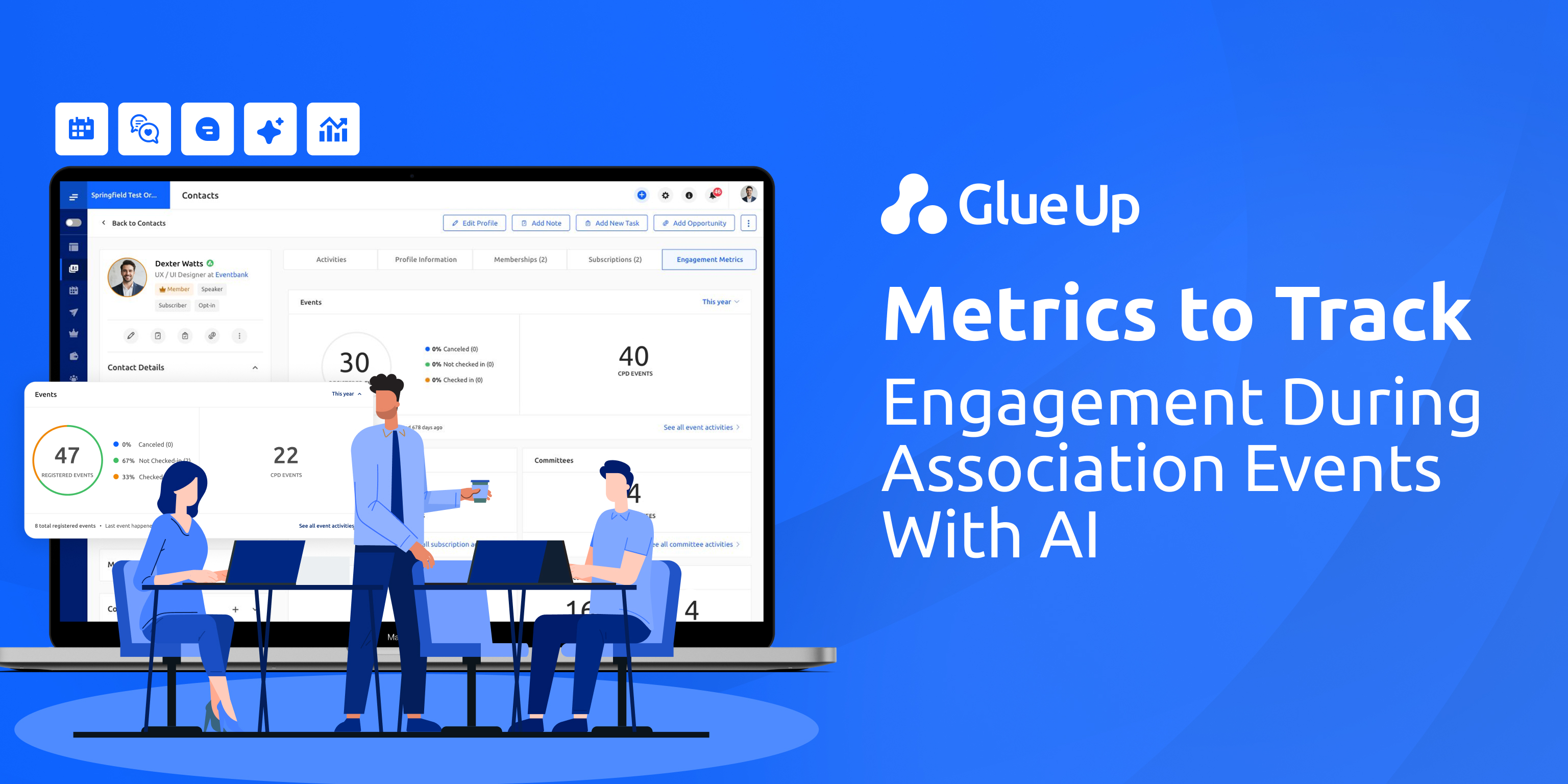
One of the most powerful contributions AI makes to event KPIs is engagement scoring. Rather than treating each interaction as a separate data point, AI evaluates combinations of behaviors. Session attendance, chat participation, polling responses, networking activity, and content interaction become part of a single engagement profile.
This does not reduce members to numbers. It does the opposite. It creates a more accurate picture of how different members engage in different ways. Some learn quietly. Some network aggressively. Some return repeatedly without speaking up. AI helps associations recognize these patterns without forcing everyone into the same definition of engagement.
AI also enables real-time interpretation of event KPIs. Instead of waiting weeks for post-event reports, teams can see engagement changes as they happen. Drop-off points in sessions. Peaks in interaction. Moments when attention fades. These signals allow organizers to respond while the event is still alive.
Over time, AI helps event KPIs move from descriptive to predictive. Associations can begin to see which engagement behaviors correlate with renewals, leadership participation, volunteerism, or advocacy. That connection changes how events are designed and evaluated.
Event KPIs That Actually Reflect Member Value
Associations that want meaningful insight focus on metrics that reflect how members experience value.
Session engagement depth matters more than session attendance. How long members stay in sessions, when they disengage, and whether they return to similar content reveals far more than a headcount ever could.
Interaction metrics provide another layer. Questions asked, polls answered, chats posted, and reactions shared indicate cognitive and emotional involvement. These signals show whether content resonates or merely fills time.
Networking behavior is often overlooked in traditional event KPIs. Who connects with whom. How many conversations occur. Whether interactions continue after the event. For associations built on relationships, these signals are foundational.
Content interaction extends engagement beyond live moments. Resource downloads, session replays, and follow-up content consumption show whether learning continues after the event ends.
Post-event actions complete the picture. Registration for future programs. Membership renewals. Volunteer sign-ups. Advocacy participation. These outcomes reveal whether event engagement translated into organizational impact.
When event KPIs are framed around these behaviors, they stop being abstract metrics and start becoming decision tools.
Event KPIs in Virtual and Hybrid Environments
Virtual and hybrid events often feel harder to measure because they generate more visible data. Logins, clicks, exits, and time stamps can overwhelm teams. The temptation is to track everything and understand nothing.
The reality is that virtual environments expose engagement signals that were always present but invisible in physical rooms. Session switching reveals curiosity and dissatisfaction. Drop-off curves show where content loses relevance. Replay views indicate delayed value.
Event KPIs in virtual settings require interpretation. A member leaving a session early may not be disengaged. They may be following a different learning path. AI helps distinguish between noise and meaningful behavior by comparing patterns across thousands of interactions.
Hybrid events add another layer. Comparing in-person and virtual engagement highlights differences in participation styles. Some members thrive in physical spaces. Others engage more deeply online. Event KPIs that respect these differences help associations design inclusive experiences without forcing uniformity.
Why Event KPIs Fail Without Connected Systems
Many associations already track advanced event KPIs. The problem is fragmentation. Event data lives in one system. Membership data in another. Financial data somewhere else. Engagement insights remain trapped in silos.
When systems do not talk to each other, event KPIs lose strategic value. Teams cannot see how event engagement affects retention. Finance cannot link sponsorship outcomes to participation. Leadership receives partial stories instead of complete narratives.
Manual reporting compounds the issue. Staff spend hours assembling data instead of interpreting it. By the time reports reach decision makers, the moment has passed.
This is where technology choice quietly shapes what associations can know about their events.
Event KPIs As a Continuous Engagement Loop with Glue Up
Glue Up approaches event KPIs as part of a broader engagement system. Events do not exist in isolation. They sit within ongoing relationships between associations and their members.
By centralizing event, membership, communication, and financial data in one platform, Glue Up allows event KPIs to remain connected to real people and outcomes. Engagement signals flow directly into member profiles. Post-event actions inform future outreach. Patterns emerge across an entire annual calendar.
AI within this environment supports practical decisions. Who needs follow-up. Which content themes resonate. Where engagement drops consistently. Which members are quietly becoming more involved.
For associations, this means event KPIs stop being retrospective artifacts and start becoming operational guidance.
Event KPIs and the End of the Post Event Report
One of the quiet benefits of modern event KPIs is cultural. When insights are timely, connected, and understandable, they stop being reserved for leadership decks. Staff across teams can act on them.
Programming teams adjust formats. Membership teams tailor outreach. Sponsorship teams align offerings with real engagement data. Boards move from anecdotes to evidence.
The post-event report changes purpose. Instead of justifying past effort, it informs future direction.
Events become part of a continuous engagement rhythm rather than isolated peaks.
Event KPIs As a Signal of Organizational Maturity
How an association measures events reveals how it thinks about its role. Organizations focused on visibility track attendance. Organizations focused on value track behavior. Organizations focused on long-term relevance connect engagement to outcomes.
Event KPIs are about learning what members care about, how they participate, and why they stay.
AI does not create this shift. It accelerates it. The deeper change is philosophical. Associations that embrace behavioral event KPIs accept that engagement is complex, varied, and dynamic.
That acceptance leads to better events, stronger relationships, and clearer strategic choices.
The Future of Event KPIs Is Human Centered
Despite the technology involved, the future of event KPIs is deeply human. It is about attention, curiosity, trust, and commitment. AI helps associations see these qualities more clearly, but it does not replace judgment.
The associations that thrive will be those that treat event KPIs as conversations with their members. They will design events as experiences that evolve over time. They will measure success by how participation grows.
Glue Up exists in that future as an operating layer that keeps insight close to action, clearer.
And clarity, in a world overwhelmed by data, may be the most valuable KPI of all.

Event KPIs are metrics that show how members engage with events, not just whether they attend. For associations, event KPIs matter because they reveal participation patterns, learning behavior, and long-term involvement that directly influence retention, revenue, and member value.
The most meaningful event KPIs focus on behavior, including session engagement depth, live interaction activity, networking behavior, content consumption, and post-event actions. These metrics show how members actually experience and use the event.
AI improves event KPI tracking by connecting multiple engagement signals into clear patterns. Instead of reviewing isolated metrics, associations can see engagement scores, identify drop-off points in real time, and predict which behaviors are linked to renewals or future participation.
Yes. Virtual and hybrid event KPIs include metrics like session duration, engagement timing, replay views, and interaction frequency. These formats reveal engagement signals that are harder to detect in in-person events, making AI interpretation especially valuable.
Event KPIs can be tied to retention and revenue by tracking post-event behavior such as renewals, repeat registrations, sponsorship engagement, and continued content interaction. When event data connects directly to member records, associations can see how engagement drives long-term outcomes.
Event management software centralizes registration, attendance, engagement, and follow-up data. When combined with AI, it allows associations to move from manual reporting to continuous insight, making event KPIs actionable rather than retrospective.