Your association finance team is carrying an analytical mandate in an environment that keeps tightening. Transactions scale, reporting expectations grow, and audits demand absolute accuracy even as resources stay flat. AI is reshaping that equation by converting high-friction workflows into intelligent, automated systems that increase financial bottom-line and improve efficiencies.
In this post, you'll learn how automation improves financial planning efficiency, how financial data extraction improves efficiency, and how AI-powered finance management software like Glue Up improves business efficiency without compromising governance.
If you want to see how this works inside an integrated AMS finance environment, book a quick demo right away!
Key Takeaways
- AI eliminates high-friction finance workflows and redirects staff time toward FP&A and strategic advising
- Predictive models increase the accuracy of budgeting, dues forecasting, and revenue planning
- Automation strengthens internal controls, reduces audit exposure, and increases financial data integrity
- Real-time visibility improves cash flow management and financial decision-making
- Glue Up’s finance automation and integrations operationalize these capabilities inside an AMS environment
How AI Strengthens Financial Efficiency in Modern Associations
Your team operates inside an environment where transaction volume scales but staffing levels rarely do. AI turns that imbalance into an opportunity by converting your most time-intensive tasks into automated, high-accuracy workflows.
Below are the five operational levers that consistently deliver the strongest returns:
Automating Invoice Processing and Data Extraction
Invoice processing is one of the highest-friction workflows in association finance. AI removes that burden by extracting invoice data, validating vendor details, and populating ledger fields without manual input.
You reduce cycle times, eliminate keying errors, remove reconciliation headaches, and start month-end with structured financial data instead of a backlog of PDFs. This is the foundation for a cleaner year-end close and a more reliable audit trail.
Strengthening Forecasting Through Predictive Analytics
Forecasting gains precision when AI models historical dues patterns, event profitability, cash flow rhythms, and sponsorship variability. Instead of building budgets around intuition or static Excel templates, you operate with projections that reflect real member behavior and seasonal volatility.
Your team frees itself from reactive corrections and begins planning resource allocations with confidence backed by probabilistic modeling.
Monitoring Cash Flow in Real Time
Cash flow is the single most sensitive indicator of organizational stability. AI gives you live visibility into receivables, open invoices, pending payments, and dues inflows.
You no longer wait for static monthly reports to understand runway, revenue pacing, or liquidity constraints. And real-time monitoring allows CFOs, CEOs, and finance committees to act with agility while maintaining governance rigor.
Enhancing Internal Controls with Intelligent Anomaly Detection
Human oversight can’t match the continuous pattern surveillance AI provides. Anomaly detection surfaces irregularities in transactions, vendor activity, reimbursements, and chapter-level financial behavior before they escalate.
For multi-chapter associations, this is a structural advantage. You maintain compliance consistency, reduce audit exposure, and strengthen fiduciary accountability across decentralized operations.
Compressing Month-End Close and Accelerating Reporting
AI accelerates the financial close by generating draft reconciliations, variance explanations, categorized ledger entries, and narrative summaries. The finance team regains time that would otherwise be spent stitching spreadsheets, formatting reports, and validating manual entries.
Boards receive faster reporting. Leadership dashboards stay current. FP&A finally becomes proactive rather than compensating for operational drag.
How Glue Up Improves Financial Planning Efficiency
Glue Up’s all-in-one finance management platform applies these automation principles directly inside an AMS framework built for associations and chapters. You work within an integrated environment where financial data, member records, event revenue, and payments connect naturally. Here’s what you can unlock:
Automated Invoicing
Glue Up automatically generates invoices for dues, renewals, events, and sponsorships with rules your team controls. This eliminates repetitive setup work and ensures consistency across every revenue stream.
Payment Processing and Reconciliation
Payments sync into the finance module instantly. Your records reflect real-time accuracy without manual dual entry, which reduces reconciliation friction and strengthens audit trails.
Real-Time Financial Reporting
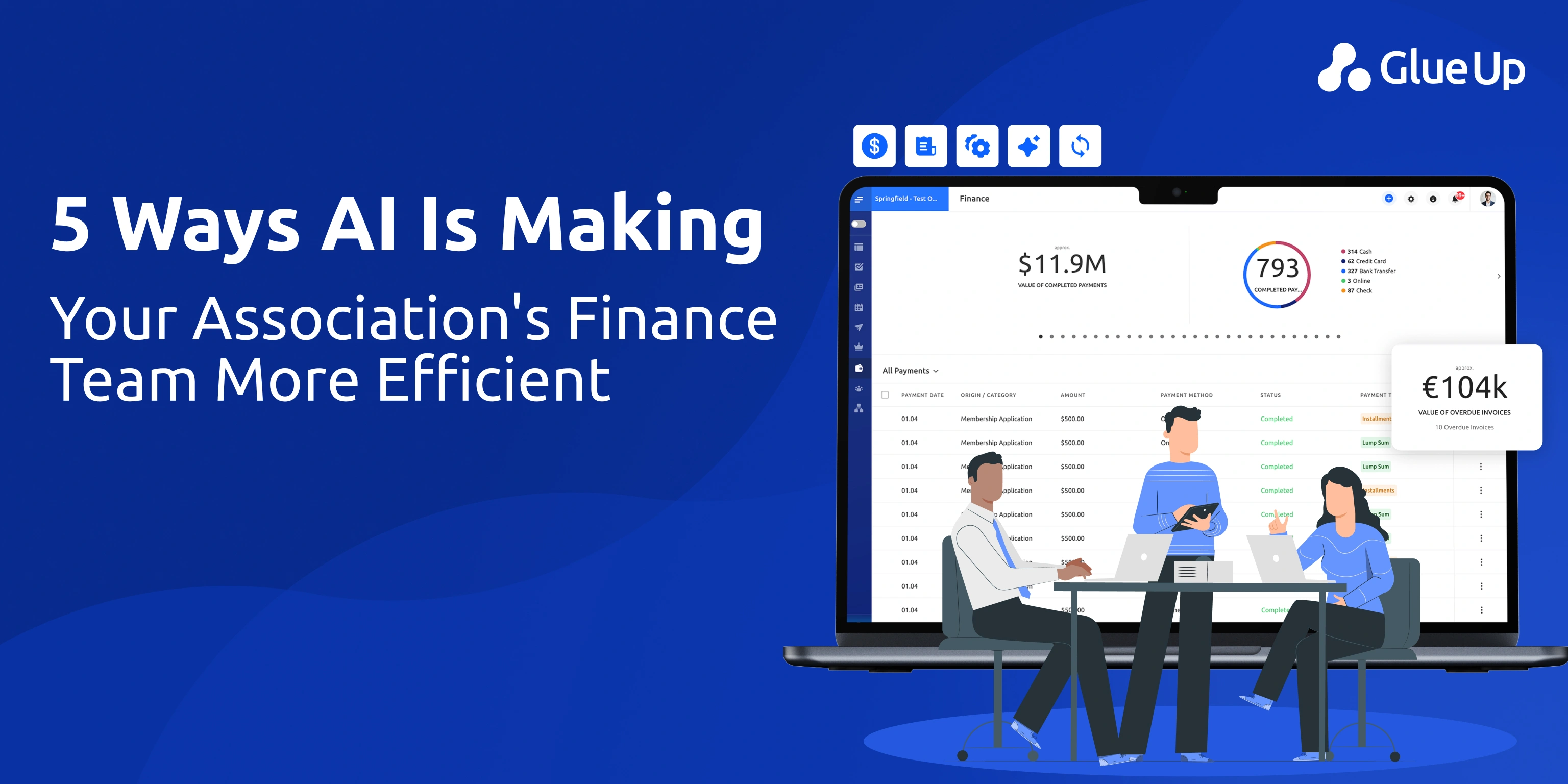
Dashboards surface revenue trends, dues performance, cash flow patterns, aging reports, and outstanding balances in one consolidated environment. FP&A efforts become more precise because the system provides immediate visibility.
Integrations with QuickBooks, Xero, and Sage Intacct
Glue Up integrates with QuickBooks, Xero, and Sage Intacct, so your accounting infrastructure stays intact. You avoid redundant processing, minimize reconciliation errors, and maintain a synchronized financial ecosystem across AMS and accounting systems.
Audit Support and Accuracy
Structured financial records, automated invoicing, and real-time reporting create the documentation auditors expect, reducing the stress and preparation required for year-end reviews.
Glue Up gives your finance team the automation base layer it needs to operate with accuracy, speed, and strategic influence.
Automate the Work That Slows Your Strategy
Automation is the fastest path to financial efficiency because it removes the operational drag that keeps your team from delivering strategic insights. If you want a finance environment where accuracy, speed, and executive visibility become standard, not aspirational, it’s time to modernize your workflows.
Book a quick demo to see how automation strengthens planning, reporting, and financial governance.
Quick Reads
- How to Build a Revenue Engine with Association Management Software
- Add-On Cart for Member Retention & Growth
- Simplify Multi-Currency Payment Posting for Community Chapters With Glue Up + Paygage
- AI Automation for Event Registration & Beyond
- Integrating AI into CRM for Membership Growth
- How to Build a Chapter Event Calendar
- What Is All-In-One Association Software?
- AI-Powered Member Check-In Software

Most associations reduce manual workload by 30 to 50 percent when invoice processing, reconciliation, and reporting workflows are automated.
AI automates invoice extraction, expense validation, reporting, anomaly detection, forecasting, and reconciliation.
Clean transaction trails, automated documentation, and real-time reporting reduce prep time and strengthen compliance across chapters.
Yes. Automation standardizes invoicing, reporting, and compliance across all chapters to ensure governance consistency.