Every board meeting begins with a question: “Do the numbers match last year’s?”
For association finance teams, that question is both simple and dangerous. Simple, because it sounds like routine due diligence. Dangerous, because when your numbers don’t line up, when last year’s membership dues look inflated, or your event revenue mysteriously dips without explanation, confidence unravels fast.
Annual financial reporting for associations is more than compliance. It’s the language of trust between your board, your members, and your funders. Consistency across years is a signal that your organization operates with transparency, discipline, and foresight.
Yet, too many associations still rely on scattered spreadsheets, manual reconciliations, and aging accounting tools that make year-to-year consistency nearly impossible. The result is audit delays, reporting discrepancies, and tense board reviews that could have been avoided with a structured, standardized process.
That’s where Standard Operating Procedures (SOPs), powered by smart, connected systems like Glue Up’s Association Management Software come into play.
Key Takeaways
Annual financial reporting for associations is a credibility mechanism.
Consistency depends on structure, standard charts, policies, close calendars, and documented changes.
Automation is the backbone of accuracy. Systems like Glue Up enforce the same logic across every transaction.
Transparency is trust. Audit trails, comparative dashboards, and variance analysis create board confidence.
Sustainable finance operations depend on technology that designs consistency into every process.
Quick Reads
Why Consistency Defines the Credibility of Annual Financial Reporting for Associations
Numbers tell stories, but only if the storyteller is consistent. In the nonprofit and association world, where memberships renew annually and funding depends on confidence, consistency is currency.
Under GAAP and IFRS, the consistency principle requires that organizations apply the same accounting methods, classifications, and presentation formats from one period to the next. This comparability ensures that when the board reads your latest statement of activities or a sponsor reviews your annual report, they’re looking at apples-to-apples data.
For associations, this principle defines how membership dues are recognized, how event revenue is deferred, and how multi-year sponsorships are recorded. A single policy change can distort years of performance trends if not properly documented and disclosed.
But consistency doesn’t happen by accident. It’s designed through operational discipline; the kind Glue Up’s integrated ecosystem makes easier to execute.
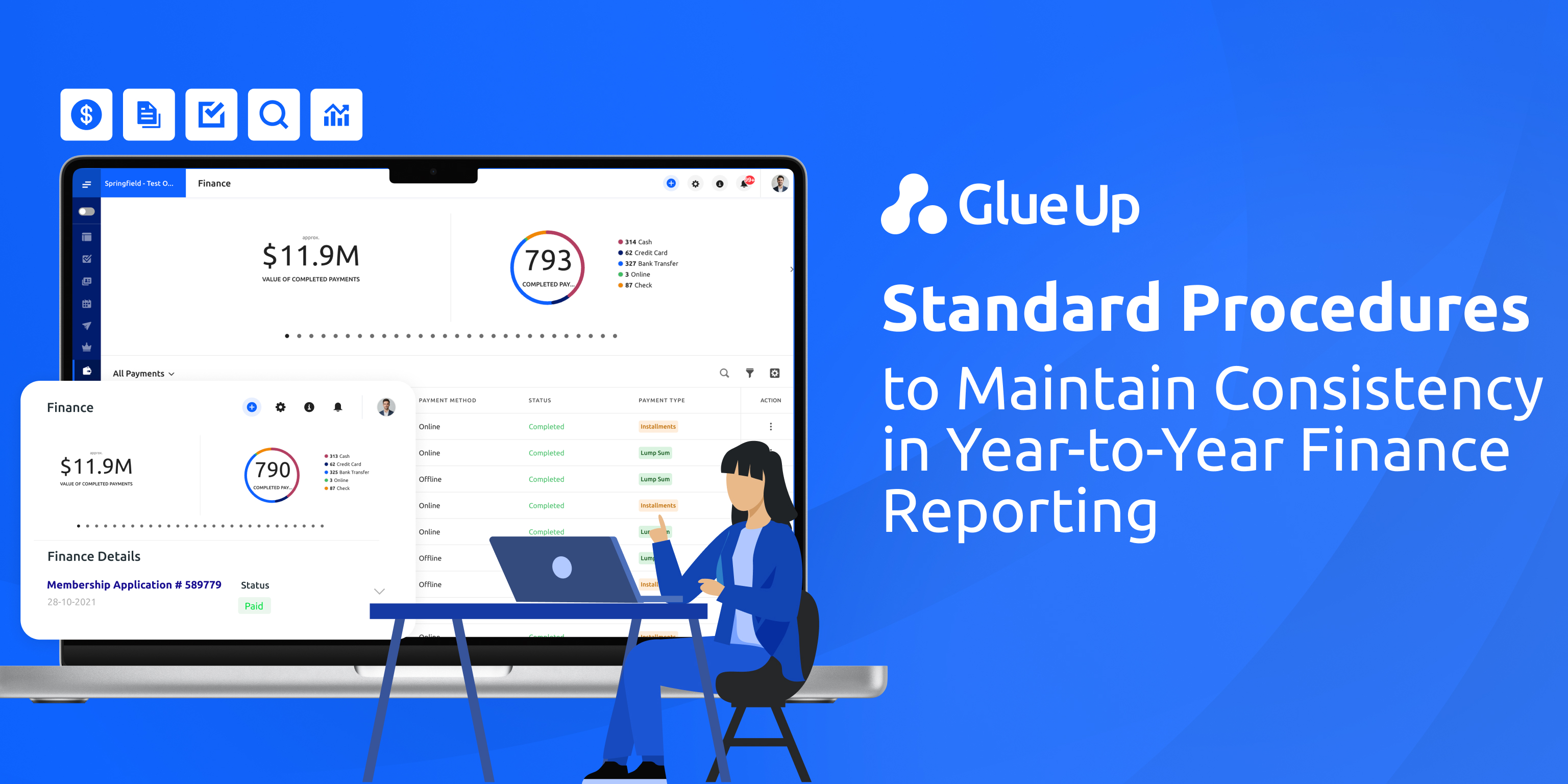
With Glue Up’s Finance Module, associations can create a single source of truth for invoices, payments, refunds, and reports. Because membership data, event registrations, and sponsorship transactions live in one ecosystem, every entry follows the same chart of accounts and classification logic automatically. That means fewer surprises at audit time, and financial narratives the board can actually trust.
Designing Consistency: The Foundation of Annual Financial Reporting for Associations
Most associations fail at design. Financial teams spend months cleaning data, reconciling mismatched ledgers, and explaining discrepancies instead of building systems that prevent them.
Designing for consistency begins long before year-end. It starts with structure:
A standardized chart of accounts (COA) that never changes without governance.
A monthly and annual close calendar that locks periods once reconciled.
A policy library that documents every accounting decision.
With Glue Up’s Finance Dashboard, this design philosophy becomes operational. Every transaction, from a member renewal to an event sponsorship, automatically posts to the correct category, maintaining the same structure year after year.
If you update your chart of accounts, version control ensures transparency. Reports can pull comparative views by default, giving finance leaders immediate visibility into trends and variances without manual cleanup.
This is about automation enforcing discipline.
Chart of Accounts Governance: Your Association’s Financial DNA
The chart of accounts is where financial consistency lives or dies. Each account defines how you record income, expenses, and equity. When associations casually insert new account codes or rename categories mid-year, they lose comparability and confuse both auditors and their boards.
A best-practice approach involves three key rules:
Define a structure once — align with GAAP, segment by function (programs, events, admin).
Document every change — note reasons, dates, and authorizations.
Version your chart annually — use controlled evolution.
Glue Up simplifies this governance. By linking finance operations directly to membership and event data, the platform ensures every transaction follows a predefined category map. Associations can lock codes during the fiscal year, ensuring that if a new event or revenue stream emerges, it’s classified according to pre-approved financial structures.
Think of it as version control for your finances, not unlike how software teams manage their source code. Every iteration is logged, reviewed, and consistent.
Monthly and Year-End Close Calendars: Turning Chaos into Cadence
Ask any association CFO what the hardest part of financial reporting is, and they’ll likely say, “closing the books on time.” That’s because association finances are fluid, renewals come late, event refunds trickle in, and sponsor payments cross fiscal years.
Establishing a close calendar is how consistency becomes muscle memory. It’s the operational heartbeat of annual financial reporting for associations.
A well-designed close process includes:
Task ownership: Each process step has a designated preparer and reviewer.
Cutoff rules: Clear guidelines for accruals, deferrals, and post-period adjustments.
Documentation: Checklists and reconciliation templates standardized across periods.
Review cadence: Internal audits or peer reviews before board submission.
Inside Glue Up’s platform, close activities are trackable. Finance managers can assign workflow stages, review, approval, reconciliation, through the Membership Workflow Manager and Finance Module. These modules eliminate the “who’s responsible” chaos that often derails reporting timelines.
Consistency is a leadership signal. A predictable close rhythm tells your board, auditors, and staff that you have your financial house in order.
Accounting Policy Libraries and Change Control
Policy documentation is often treated as a compliance burden. In truth, it’s an association’s defense against inconsistency.
Every time you change how you recognize dues, allocate expenses, or depreciate assets, you create a potential comparability gap. If the rationale and impact aren’t documented, year-to-year financial reporting loses its integrity.
The solution is a living policy library, one that evolves through deliberate governance.
Glue Up helps associations maintain and communicate these policy updates through centralized document management. Notes from the finance dashboard can link directly to accounting policies, providing auditors and board members with context for any material changes.
This makes disclosures transparent and standardized, critical for compliance with ASC 250 (Accounting Changes and Error Corrections) and IAS 1 (Presentation of Financial Statements).
Revenue Recognition: The Core of Annual Financial Reporting for Associations
Membership dues, events, and sponsorships are the lifeblood of association finances, and the most common sources of inconsistency.
Revenue recognition errors typically occur when associations:
Recognize membership dues upfront instead of over time.
Fail to defer sponsorship income tied to future benefits.
Treat event revenue inconsistently across fiscal periods.
The ASC 606 five-step model helps fix this:
Identify contracts with members or sponsors.
Identify distinct performance obligations.
Determine the transaction price.
Allocate the price to obligations.
Recognize revenue as obligations are satisfied.
Glue Up operationalizes these steps. The Finance Module automatically defers revenue tied to unfulfilled obligations, like future event access or newsletter sponsorship placements, and recognizes it only when delivered. Because event, membership, and sponsorship data live in one platform, deferrals occur accurately and consistently.
That means your year-end financial statements tell the same story every year: what was earned, what was deferred, and what’s still in progress.
Internal Controls and Financial Integrity
No financial reporting framework works without control. Internal controls over financial reporting (ICFR) safeguard accuracy, reduce fraud risk, and create audit-ready transparency.
Associations should map their controls to the COSO Framework, focusing on:
Control environment: Clear roles, ethical standards, and accountability.
Risk assessment: Identify and monitor high-risk areas (membership renewals, event ticketing, sponsorship accounting).
Control activities: Reconciliations, segregation of duties, variance thresholds.
Information and communication: Real-time dashboards, automated alerts.
Monitoring: Regular internal audits and system checks.
Glue Up’s integrated infrastructure acts as a built-in control environment. User permissions define who can approve refunds, modify invoices, or export financial reports. Automated audit trails log every action: date, user, transaction. This digital transparency reduces the dependency on manual oversight while reinforcing governance discipline.
Variance Analysis and Board Reporting
A report without context is a missed opportunity. That’s why variance analysis is central to annual financial reporting for associations.
Boards want explanations. Why are renewal revenues down 8%? Why did event expenses spike compared to last year? Variance analysis connects these dots.
Using Glue Up’s Finance Dashboard, finance managers can create real-time comparisons of budget vs. actual, month-over-month, and year-over-year trends. Visuals make complex financial data easy to digest for non-finance board members.
Moreover, associations can integrate AI Copilot, Glue Up’s intelligent assistant, to generate plain-language variance summaries automatically. This turns financial data into board-ready insights, saving hours of manual analysis.
Example: “Renewal revenue decreased 8% YoY due to the new membership tier rollout in Q2, which deferred recognition until July.” That’s the kind of clarity that earns trust.
Audit Preparation and Regulatory Anchors
Every association must prepare for scrutiny, whether from auditors, regulators, or grant funders.
Under the Uniform Guidance, U.S. nonprofits and associations expending $1 million or more in federal funds must undergo a Single Audit. Beyond that, most associations conduct annual audits to meet governance or donor expectations.
Glue Up’s Finance Module simplifies this readiness. The system stores audit trails, PBC lists, and supporting documentation tied directly to transactions. When an auditor requests backup for a deferred revenue entry, the finance team can export the full document chain: invoice, payment, deferral logic, and fulfillment data, in seconds.
This level of preparedness not only shortens audit cycles but demonstrates professional control. Consistency breeds credibility, and credibility attracts funding.
Templates, Automation, and Close Discipline
Repetition is not the enemy, inconsistency is. Templates and automation keep the rhythm of financial reporting intact even as teams change or scale.
Glue Up automates recurring tasks such as:
Generating monthly and annual financial statements with identical formatting.
Pulling comparative data across fiscal years.
Sending reminders for reconciliation deadlines.
Enforcing policy-based journal approvals.
For finance teams, this automation is freedom, time recovered from repetitive data entry can instead go toward strategic forecasting, member retention analysis, and growth planning.
Consistency doesn’t reduce creativity; it enables it. When your processes are locked, you can focus on interpretation.
Where Glue Up Fits In
If you’re managing an association, you already know that financial accuracy, automation, and data transparency define credibility. That’s where Glue Up’s Association Management Software (AMS) helps you connect every process in one secure ecosystem.
As one of the most advanced AMS platforms serving associations worldwide, Glue Up brings finance, membership, and engagement under one infrastructure, enabling year-to-year consistency across every module.
Here’s how it supports your financial operations:
Centralized Finance Management: Manage invoices, payments, refunds, and reports in one dashboard. Configure tax rules, handle multi-currency operations, and generate audit-ready workflows without manual reconciliation.
Automated Invoicing and Billing: Automatically create and send invoices after renewals, registrations, or sponsorship confirmations. Automation ensures precision and saves hours of administrative time.
Membership and Event Integration: Connect financial data directly with your membership database and event modules. Every payment, discount, and renewal is tracked in real time.
AI Copilot Assistance: Receive insights on cash flow, revenue forecasting, and variance explanations directly within your dashboard.
Glue Up doesn’t replace your accounting software, it elevates it. By consolidating your financial data with your member engagement ecosystem, Glue Up ensures that your annual financial reporting for associations is consistent, credible, and complete.
The Future of Annual Financial Reporting for Associations
Imagine walking into your next board meeting armed with a year-over-year dashboard showing every key metric, renewal revenue, deferred event income, sponsorship performance, all aligned with standardized reporting logic.
That’s the future Glue Up enables. Associations that adopt structured SOPs, guided by integrated technology, they build institutional memory. When processes are standardized and embedded in software, knowledge doesn’t disappear when staff turns over.
The result is sustainable growth, smarter financial governance, and long-term trust with boards, auditors, and members alike.
FAQ
1. What is the consistency principle in financial reporting?
It’s the GAAP and IFRS requirement that accounting methods remain consistent year to year to ensure comparability across periods.
2. How can associations improve consistency in annual reports?
By using standardized charts of accounts, close calendars, policy libraries, and systems like Glue Up that automate revenue recognition and reporting.
3. What causes inconsistency in association financial statements?
Ad hoc policy changes, manual adjustments, inconsistent revenue recognition, and decentralized data.
4. How does Glue Up help with financial transparency?
It unifies membership, events, and finance under one platform, reducing manual errors and automating data reconciliation.
5. Do associations need annual audits?
Most do, either by law or to satisfy funders. Consistency and documentation make audits faster and less costly.
Build Consistency into Culture
Numbers can only tell the truth if they’re told the same way every year. For associations, that truth defines survival.
When your financial reporting is consistent, transparent, and integrated, your board trusts faster, your auditors' question less, and your members see the stability behind the services they value.
Consistency is the foundation for every strategic decision you’ll make next year.
Book a demo today and see how Glue Up can make financial consistency your association’s competitive advantage.