There is a moment that plays out in almost every association, and it usually happens behind a closed door. Someone asks a simple question during a board meeting, something so basic it almost feels insulting. Yet it hangs in the air long enough to make everyone uncomfortable. That question is usually: “Where do we actually stand with membership right now?”
Eyes drop. Papers shuffle. Someone opens a spreadsheet that was last updated three weeks ago. Someone else opens a different spreadsheet that contradicts it. A third person says, “Let me check the event platform,” as if the answer might be hiding there.
If you are an association executive, a membership director, or anyone responsible for explaining numbers to a board, you already know that feeling. You can sense the hesitation, the guessing, the pressure to pretend you have it all under control. That is the moment when people begin quietly realizing they need a real system that organizes relationships instead of storing chaos.
And that is where the conversation around CRM for associations finally begins.
A CRM for associations is the difference between stumbling through membership decisions and confidently steering the organization with real data. It is the difference between chasing members and understanding them. It is the difference between another year of uncertainty and a leadership team that finally operates with visibility instead of instinct.
This is the beginner’s guide for anyone who has ever sat in that room and thought, “There has to be a better way to do this.”
Key Takeaways
- A CRM for associations is more than a database; it is the organization’s memory. It brings every interaction, payment, event, communication, and engagement touchpoint into one unified profile so leaders can finally see the full member journey without juggling spreadsheets or disconnected systems.
- CRM and AMS serve different purposes, but modern associations need both in one ecosystem. An AMS manages operations like dues and rosters, while a CRM provides relationship intelligence, engagement insights, and predictive visibility. Platforms like Glue Up merge these functions so associations are not trapped between scattered tools.
- The real value of a CRM for associations lies in engagement tracking, automation, segmentation, and event-to-membership visibility. It reveals who is at risk, who is highly engaged, which events drive conversions, and how communication should be tailored to each member segment.
- The biggest problems associations face is solved when CRM becomes the central source of truth. When staff operate from a single, accurate dashboard, renewal forecasting, retention strategy, and reporting become dramatically easier.
- Associations can begin a CRM journey with a simple, beginner-friendly plan: Define goals, audit data, choose a platform built for associations, start with two workflows (renewals and onboarding), and build team adoption. Starting small delivers quick wins and long-term stability.
Quick Reads
- Stay Ahead With These Best Tools for Associations
- How to Pick the Best CRM for Associations
- AI CRM Platform for Association Leaders
- What Is All-In-One Association Software?
- Small Association CRM: Big Results on Any Budget
- Features of Best CRM for Membership Organisations
- 5 Strategies for Association Software
- Top Features of Association Software You Need
What Is a CRM for Associations, Really?
If you searched online for a definition of CRM, you probably found descriptions built for sales teams or customer service departments. They talk about pipelines, lead scoring, tickets, and deal stages. None of that reflects what you do as an association. Your work is relational, cyclical, and community driven.
So let’s talk about what a CRM for associations actually is.
A CRM for associations is the living record of every relationship your organization touches. Every member. Every prospect. Every event attendee. Every volunteer. Every speaker. Every sponsor. Every partner. Every committee. Every chapter leader.
Think of it as the complete memory of your organization. A single place where you can see a person’s full journey without digging through emails, spreadsheets, PDFs, disconnected platforms, or that one staff member who somehow remembers everything but never writes it down.
A CRM for associations tracks:
Membership status
Renewals
Expiration dates
Event registration
Payment history
Engagement activity
Committee involvement
Communication history
Notes from calls and meetings
Interests and preferences
Donation activity if relevant
It becomes the system that finally answers the questions leaders ask every year:
Who is at risk of lapsing
Who is deeply engaged
Who attends events but never joins
Which segments have the strongest retention
Which membership tier drives the most revenue
Who is ready to upgrade, volunteer, or sponsor
This is the point where associations realize that a CRM is the foundation of every strategy: retention, engagement, events, forecasting, advocacy, education, and even financial planning.
And if it feels like a modern version of an AMS, that is because the best CRMs for associations now merge CRM and AMS functions into one ecosystem, especially platforms like Glue Up.
CRM for Associations vs AMS: What’s the Difference and Do You Need Both
Here is where most association leaders get confused, because CRM and AMS are often thrown into the same conversation. They sound similar. They overlap in certain areas. But they were built for fundamentally different purposes.
Understanding the difference is the key to choosing technology that actually fits how associations operate.
AMS = The Operational Engine
An association management system focuses on the administrative side:
Membership tiers
Dues
Renewals
Rosters
Committees
Certifications
Event logistics
If you think of your organization as a machine, the AMS is the engine that makes it possible to run operations every day. It keeps the basics functioning.
CRM = The Relationship Intelligence System
A CRM is the intelligence layer that helps you understand people.
It helps you:
Predict renewals
Track engagement
Spot at-risk members
Personalize communication
Manage interactions
Identify patterns
Understand behavior
Improve retention
Forecast growth
If your AMS is the operational engine, your CRM is the radar. It tells you where things are going.
Why Modern Associations Choose Both in One System
Most associations want one platform for both. They want membership logic (AMS) and relationship intelligence (CRM) living in the same place without integrations breaking or data going stale.
This is the core reason Glue Up exists: a unified platform where membership, events, community, payments, and CRM all operate inside a single ecosystem.
One truth. One view. One system.
Core Features Every Beginner Should Know About CRM for Associations
If you are brand new to CRM for associations, this is the part that usually feels overwhelming. Most CRM guides throw a list of features at you that look like a menu you did not ask for.
So instead of listing tools, let’s talk about what these features actually do for you in real life.
Centralized Member Profiles
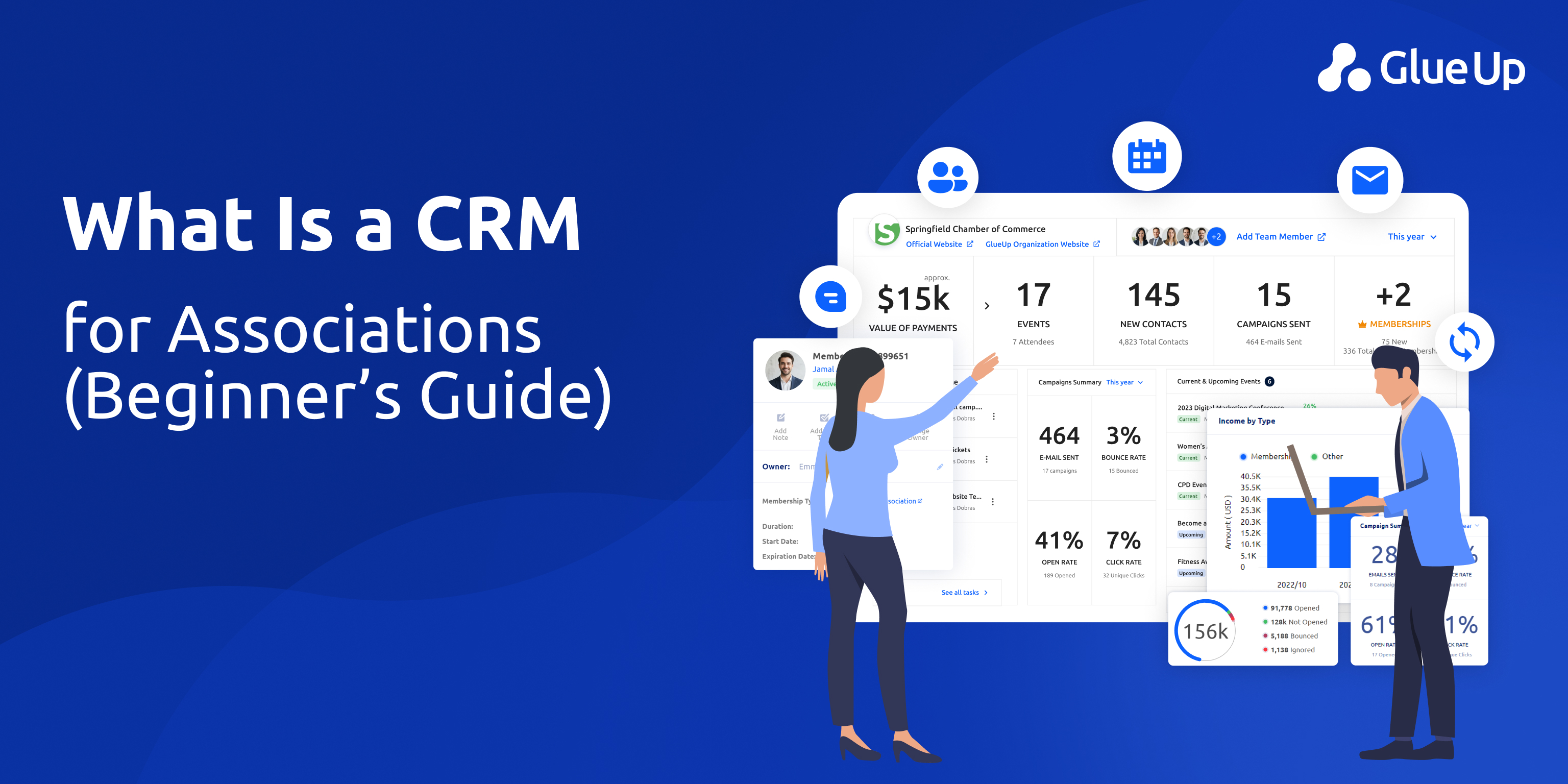
This is the heart of the entire CRM. A full 360 view of every member. You see their entire relationship with your organization in one place.
Engagement Tracking and Activity History
Every interaction tells a story. Who attends events regularly. Who only shows up for webinars. Who always renews at the last minute. Who reads newsletters. Who never replies.
Engagement tracks these details so you see patterns before problems appear.
Smart Segmentation and Lists
A CRM for associations groups people based on behavior, interest, activity patterns, demographics, or anything else you need.
This is where real personalization begins.
Communication and Automation Tools
Every association needs:
Welcome sequences
Renewal reminders
Event follow-ups
Lapsed outreach
New member onboarding
Sponsorship communication
A CRM handles this without forcing your staff to create manual email reminders every week.
Event and CRM Integration
Events are the biggest missed opportunity in most associations. You have dozens, hundreds, or thousands of people showing up to learn from you, yet many never hear from you again.
A CRM for associations connects event activity directly to membership activity. That means every attendee becomes a potential member, every session becomes data, and every follow-up becomes targeted.
Reporting and Decision Support
A CRM gives you the dashboards you need for:
Retention
Revenue
Renewals
Engagement
Growth forecasting
Event conversion
Member lifetime value
This is how you walk into board meetings with clarity instead of anxiety.
Integrations Without the Pain
Associations often use:
Email platforms
Learning systems
Chapter systems
Websites
A CRM for associations connects these systems so your staff does not suffer through broken integrations or manual exports.
Five Problems a CRM for Associations Finally Solves
This is where things get emotional because every membership director will recognize these scenarios.
Problem One: Everything Lives in Spreadsheets
The unofficial AMS for most associations is Microsoft Excel. Except it is not actually an AMS. It is a minefield of outdated columns, mismatched formulas, and hidden tabs that only one person on the team knows how to interpret.
Problem Two: No One Knows the True State of Engagement
Someone might be attending events but ignoring renewals. Another might be reading every newsletter but never volunteering. A CRM for associations exposes these patterns.
Problem Three: Systems Do Not Talk to Each Other
Your event platform knows one version of a person. Your finance system knows another. Your email tool knows a third. Your staff inboxes know a fourth.
A CRM centralizes everything.
Problem Four: The Wrong CRM Was Purchased Years Ago
Many associations bought a sales CRM thinking it could be adapted. What happened instead was a Frankenstein system that requires duct tape, workarounds, custom fields, and connectors that break every month.
Problem Five: The Board Wants Answers You Cannot Provide
“Who is at risk of not renewing?”
“Which event actually drives membership?”
“What is our retention forecast?”
“What is membership growth going to look like next quarter?”
A CRM for associations finally allows you to answer these questions clearly and accurately.
A Beginner’s Guide to Getting Started with a CRM for Associations
If you feel behind, you are not alone. Most associations start with ambition and a few decades’ worth of Excel files.
Here is the simplest, cleanest path for beginners:
Step One: Define Your Real Goals
Is your priority:
Improving retention
Raising engagement
Increasing event conversions
Strengthening forecasting
Reducing staff workload
Unifying data
Most associations realize they need all of the above. Glue Up’s CRM gives you that flexibility.
Step Two: Audit Where Your Data Lives
List every place:
Email lists
Event reports
Payment records
Membership files
Chapter databases
Staff inboxes
PDFs
Legacy systems
This step is often emotional. It shows how scattered the organization really is.
Step Three: Choose Technology Built for Associations
Choose a CRM made for associations, where membership logic, engagement history, payments, events, and communication already live together.
This is where Glue Up stands out.
Step Four: Start With Two Workflows
Do not try to automate everything on day one. Begin with:
Renewals
Event follow-up
New member onboarding
These three workflows generate the fastest wins.
Step Five: Train Your Team and Create Ownership
A CRM works when people use it. Give staff clear workflows, responsibilities, and definitions.
What Success Looks Like When a CRM for Associations Is Finally in Place
You know a CRM is working when the organization feels different. Leaders operate with clarity. Staff stop firefighting. Members feel seen.
Here is what it looks like in real life:
Renewal rates improve because reminders happen automatically
Engagement increases because messages are targeted
Staff spend less time tracking and more time serving
Event attendees become members
Chapters operate with more consistency
Data becomes trustworthy
Board meetings become less chaotic
Forecasts become real instead of hopeful guesses
This is the transformation Glue Up delivers: a single ecosystem that finally merges AMS, CRM, events, community, finance, and engagement into one system built specifically for associations.
FAQ: Beginner Questions About CRM for Associations
What Is the Primary Purpose of a CRM for Associations?
To organize relationships, track engagement, and provide clarity around membership.
Do Associations Need an AMS or a CRM?
Most need both in one system. Glue Up offers a unified platform.
What Data Should Be Stored in a CRM?
Everything that contributes to understanding a member: behavior, event activity, communication history, payments, preferences, and more.
Does a CRM Improve Engagement?
Yes. It reveals patterns, helps personalize communication, and makes follow-up easier.
Is CRM Implementation Hard?
Not with beginners’ workflows. Most associations start with renewals and onboarding.
How Much Does a CRM Cost?
Varies by size and need. Glue Up provides customized pricing because associations operate differently from sales organizations.
The Real Reason Associations Need a CRM
Associations struggle because they lack visibility.
They struggle because their systems do not support the complexity of human relationships.
A CRM for associations is the foundation for stability, growth, and sustainability.
When you finally see every member clearly, you stop reacting and start leading.
Ready to see how modern associations use CRM to grow? Book a demo and explore Glue Up’s unified platform for membership, events, community, and engagement.