You’ve heard about lead scoring for years, but most explanations feel like math homework dressed up as marketing. You already have the fields you need. The event registrations, the email clicks, the dues invoices, the member types; these are sitting inside your CRM or association management system right now. You don’t need predictive AI or a PhD in data science to start. You just need practical lead scoring examples you can run today, and a playbook that ties each score band to an action.
That’s what this article is: real lead scoring examples designed for associations, chambers, and member-based organizations. They use data you already capture, they’re explainable to your board, and they help your team stop guessing about which contacts deserve a call versus which ones belong in nurture.
Key Takeaways
You already have the data you need. Event registrations, email engagement, dues status, and member records provide enough fields to build effective lead scoring models.
Simple frameworks work best. RFM (recency, frequency, monetary value) and other point-based lead scoring examples deliver immediate results when calibrated to actual joins, renewals, or sponsorships.
Action must follow the score. A number is useless without a playbook. Define what happens at 60, 40, and 20 points: who acts, how fast, and through which channel.
Calibration is the secret. Review conversion data every month, adjust weights, and document negative signals (like unsubscribes or inactivity) to keep scores predictive and trustworthy.
Glue Up makes it operational. The platform already tracks the fields used in these lead scoring examples, turning them into Smart Lists and workflows ensures high-score leads are routed to the right staff without guesswork.
Quick Reads
Why Traditional Lead Scoring Still Works
The tech industry loves to hype predictive analytics and machine learning. There’s value there, but the evidence is clear: traditional lead scoring still improves conversion when it’s calibrated to outcomes. A 2023 literature review of sales performance models found that even simple point-based systems increase prioritization accuracy when weights are tied to real results. Predictive systems add lift later, but only when your data is clean and your outcomes are tagged correctly.
For associations, that matters. Most teams don’t have pristine datasets or machine learning staff. What they do have: records of events, invoices, community interactions, and email engagement. Those fields are enough to build a working score.
RFM For Associations: The No-Drama Baseline
RFM: recency, frequency, monetary value, is a retail staple. Swap “purchases” for “renewals, events, or dues,” and you’ve got a baseline scoring model your board will understand instantly.
Here’s a simple lead scoring example using RFM logic:
Recency of meaningful action
≤7 days: +25 points
8–30 days: +15
31–90 days: +5
90 days: 0
Frequency of actions in the last 90 days (event RSVP, attendance, email click, form submit, community reply)
6+ actions: +25
3–5: +15
1–2: +5
0: 0
Monetary potential (prospect’s dues tier estimate or sponsor potential)
High-value tier: +25
Mid-tier: +15
Entry-level: +5
Bands:
55–75 = “Call today”
30–54 = “Email and invite”
<30 = “Nurture”
This model works because it balances timing, activity, and value without drowning in complexity. It’s also easy to present to leadership: red, yellow, green.
Post-Event Momentum: Lead Scoring Examples That Convert In 48 Hours
Nothing is hotter than a lead within 48 hours of an event. After that, inboxes flood, memories fade, and the buzz evaporates. Associations live and die by how quickly they act on this window.
Here’s a lead scoring example tuned to event signals:
Registered: +5
Attended live: +15
Booth scan or session badge: +10
Asked a question or joined chat: +10
Downloaded session slides within 48h: +10
Replied to follow-up email within 48h: +15
No-show: −10
Hard bounce or unsubscribe: −25
Thresholds:
≥35 = Same-day call from staff
20–34 = Two-step email sequence (personalized recap, then invite)
<20 = Nurture with “what you missed” recap
This model doesn’t just assign points; it defines the play. High-score leads get the human touch while interest is still burning. Mid-scores get structured automation. Lows aren’t ignored, but they’re routed to lighter touches.
Fit + Intent: Lead Scoring Examples for Corporate Members and Sponsors
Associations don’t just chase individual members; they also court companies and sponsors. That’s where a two-bucket model shines: Fit + Intent.
Fit (max 40 points):
Decision maker role: +15
Influencer role: +8
Industry match (priority sectors): +10
Company size in target band: +10
Existing chapter presence: +5
Intent (max 40 points):
Viewed sponsor/prospectus pages 2+ times in 14 days: +10
Prospectus download or form submit: +15
Attended sponsor Q&A or booked slot: +15
“Budget not this year” noted: −10
Action: Score ≥55 triggers direct outreach from your partnerships lead with a tailored package.
This lead scoring example works because it separates “can pay” from “wants to pay.” Fit without intent wastes time, intent without fit wastes opportunity.
Renewal Risk and Upsell Propensity
Retention is where associations make or lose money. Scoring renewals and upsells means combining positive and negative signals.
Positive signals:
Renewal due in ≤30 days: +10
Attended ≥2 events last quarter: +10
Used member benefits in last 30 days: +10
Email open rate ≥40% and ≥1 click last 30 days: +10
NPS ≥9: +10
Negative signals:
Overdue invoice: −20
Zero activity in 60 days: −25
Routing:
Risk (score <0 or overdue + inactivity): personal phone call, flexible invoice terms
Upsell (score ≥40, high usage): invite to committee, premium tier, or sponsorship pitch
This lead scoring example turns engagement data into proactive retention plays.
Content-Led Scoring for Education-Heavy Associations
Associations with certifications or learning programs need to track educational intent.
Signals:
Viewed 3+ course pages in 14 days: +10
Registered for a webinar: +10
Attended webinar: +15
Downloaded syllabus or CE guide: +10
Marked “interested in certification” on a form: +15
Used student email without org: −5
Next step: Auto-send a comparison guide, then counselor outreach for cohorts starting within 30 days.
This lead scoring example maps curiosity into action, identifying future high-value learners early.
From Number To Playbook: What Happens At 60, 40, 20 Points
A score is worthless without a playbook. Here’s the skeleton every association should run:
≥60: human contact within 24 hours. Call, personal invite, committee pitch.
40–59: automated + semi-personal touches. Email + invite to event.
20–39: nurture campaigns. Content, guides, recap emails.
<20: light drip. Keep the line open without heavy investment.
Tie each band to ownership (membership, marketing, partnerships) and a time SLA. This way, nobody asks “what do we do now?”
Calibrate Monthly: How To Tune Weights Using Outcomes
The difference between a good score and a gimmick is calibration. Every 30 days:
Pull joins, renewals, and sponsorship wins.
Compare their scores versus non-conversions.
Adjust weights ±5 based on predictive accuracy.
Document negative signals (unsubscribes, job changes).
Reset thresholds based on staff capacity.
Only after this loop is running smoothly should you consider predictive scoring features in platforms like HubSpot or advanced AMS modules. Predictive adds power, but only when the foundation is clean.
Where Glue Up Fits
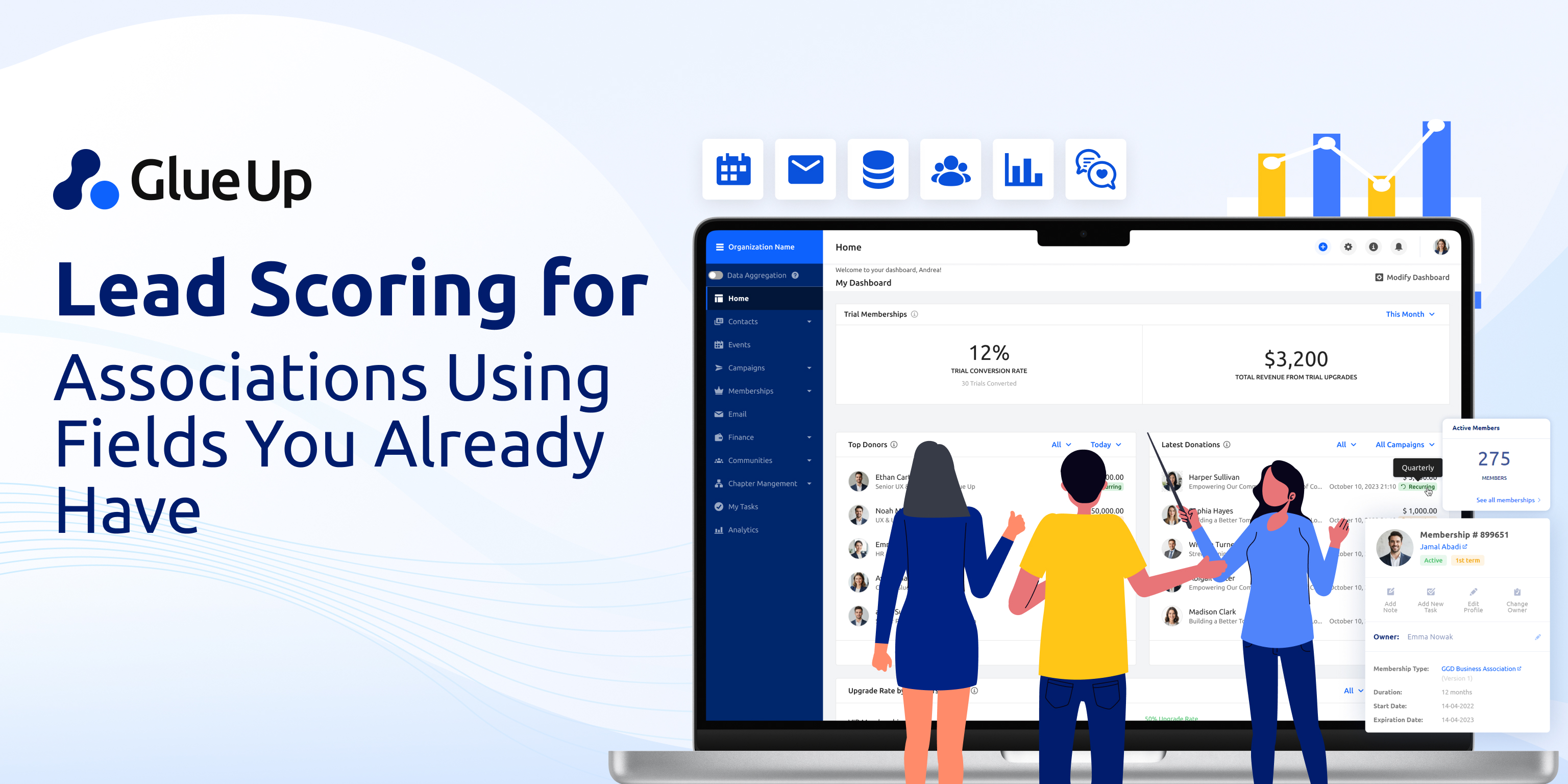
Glue Up already tracks the exact fields these models need:
Contacts and organizations (fit signals)
Event registrations and attendance (recency and frequency)
Email campaigns (opens, clicks, unsubscribes)
Membership types and renewals (monetary and lifecycle)
Invoices and dues status (financial signals)
Communities and engagement (interaction signals)
Inside Glue Up, you can turn these lead scoring examples into Smart Lists, apply automated workflows, and route high-score contacts to the right team. A 60-point sponsor gets a task in the partnerships pipeline. A 20-point member gets a nurture email with upcoming events. The data isn’t abstract; it’s built into your workspace.
FAQ
Do we need machine learning to start?
No. Start with points tied to fields you already store. Predictive models work better once you’ve cleaned data and tested outcomes.
How many signals is too many?
8–12 is plenty. More adds noise.
What if our data is incomplete?
Start with what’s consistent across records (events, emails, dues). Build from there.
Can chapters use different weights?
Yes. Large chapters may weight events differently than smaller ones. Document logic.
How do we prevent gaming the score?
Cap repeat actions. For example, multiple clicks on one email = +5 total, not +5 per click.
Conclusion
Lead scoring doesn’t need to be a black box or a buzzword. With fields you already have: events, emails, dues, forms, you can build models that surface who deserve a call, who needs nurture, and who’s at risk of leaving. The five lead scoring examples here are starting points, not theory. They’re explainable, repeatable, and built for associations that want to act with confidence, not guesswork.
Glue Up makes this work real. Map your existing fields into Smart Lists, set score bands, and let workflows route leads to the right hands. When you do, you’ll stop treating lead scoring as an experiment and start treating it as infrastructure.
Ready to see how? Book a demo and we’ll show you these exact models running inside Glue Up.